
Greater prairie chicken
Tympanuchus
Description
How to identify
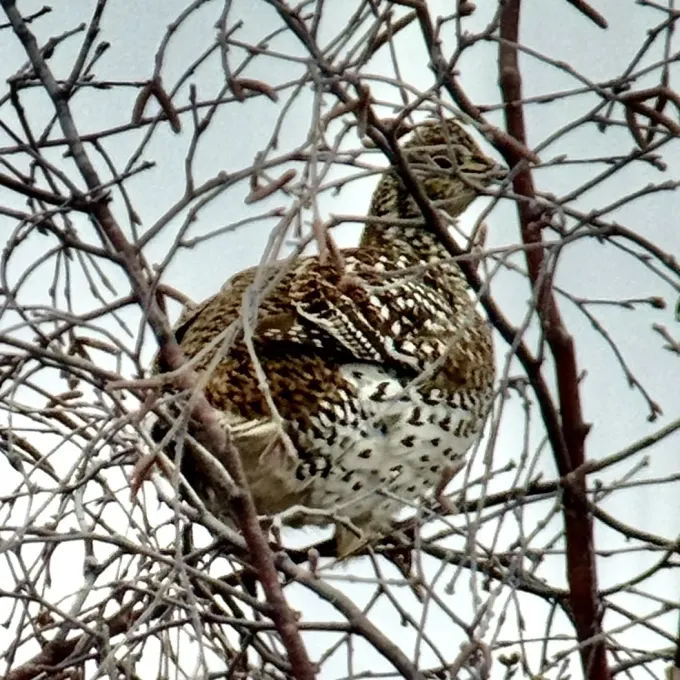
The greater prairie chicken Tympanuchus cupido is a large bird in the grouse family. Adults are characterized by their rounded tails and distinctive pinnae, or ear-like feathers, which are prominent on the males.
They display a brown and white barred plumage, which serves as excellent camouflage within tall grass or cropland. Males possess bright orange neck air sacs that are inflated during spectacular communal mating displays.
These birds primarily inhabit open landscapes, including grasslands, prairies, and agricultural lands. They are highly adaptive to ground-dwelling behaviors and generally avoid dense forests, preferring open areas for their survival.
The life cycle of the greater prairie chicken is closely linked to seasonal changes. During spring, they concentrate on lekking sites for breeding, while in autumn and winter, they form larger social groups that can forage across expansive fields.
Nesting takes place on the ground, usually hidden in dense vegetation. Their reliance on open space makes agricultural fields highly attractive for foraging when native food sources become scarce.
What it damages
The greater prairie chicken can cause significant damage to grain crops such as corn, wheat, and sorghum. The most severe impact occurs when birds consume seeds during the planting season, leading to uneven crop emergence.
Young seedlings are also vulnerable to consumption by these birds. By nipping off the tops of young plants, they impede growth and sometimes result in the complete destruction of individual plants in the field.
During autumn months, large flocks may move into recently sown winter wheat fields. Their feeding habits and physical trampling can significantly reduce the plant density and vigour of the future crop.
Trampling damage, caused by the collective weight and movement of flocks across a field, leads to soil compaction and mechanical injury to plant tissues, which can increase the susceptibility of the crop to diseases.
Economic damage is generally localized but can be substantial in fields adjacent to protected prairie remnants or undisturbed natural habitats, where population densities of the birds are consistently higher.
Control measures
Acoustic repellents are considered one of the most effective ways to manage prairie chicken activity. Using randomized recordings of predator calls can prevent birds from habituating to the noise.
Visual repellents, such as hawk or owl decoys and reflective materials, can serve as temporary deterrents. It is crucial to relocate these devices frequently to maintain their efficacy against the birds.
Proper agronomic practices, such as deeper seeding depths, can help protect seeds from being easily picked up by foraging flocks. Ensuring minimal seed exposure on the soil surface is a key prevention strategy.
Managing the vegetation around field edges is essential. By reducing the cover that shelters birds near the crop area, farmers can make the fields less attractive for loafing or nesting.
Regular monitoring of field activity is recommended, especially during critical growth stages. Implementing preventative deterrent measures as soon as early signs of foraging are observed is more efficient than reactive control.
Taxonomy
- Latin name
- Tympanuchus
- Family
- Phasianidae
- EPPO code
- TYMPSP
Discussion
No discussions yet — be the first.