
Red-legged partridge
Alectoris rufa
Description
How to identify
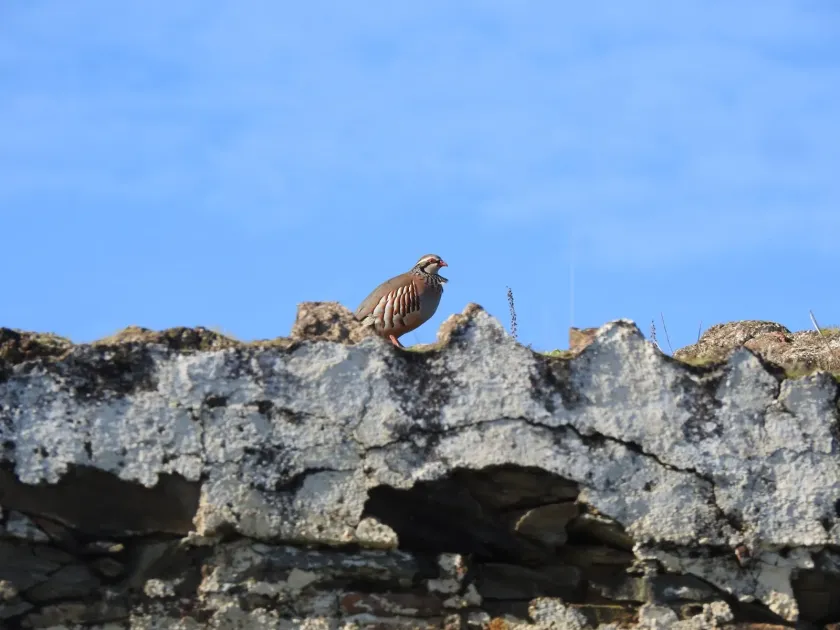
The Red-legged partridge (Alectoris rufa) is a member of the Phasianidae family in the Galliformes order. These birds are characterized by a sturdy build, a brownish-red back, and a distinctive black collar pattern that marks their throat and neck area.
They are primarily ground-dwelling birds that prefer open landscapes, cultivated fields, and field margins. Their natural coloration provides excellent camouflage against stubble and dry vegetation, making it difficult to detect them within the crop canopy during the day.
The biology of this species is closely tied to the presence of food sources on agricultural land. During the breeding season, they establish territories that often include both wild areas and cultivated fields, which can lead to significant interactions between the birds and crops.
Red-legged partridges have a high level of adaptability to human-altered environments. They are known to live in groups, moving between foraging areas and nesting sites throughout the day, which maintains a constant pressure on crops located near their habitat.
Their life cycle includes nesting on the ground in dense vegetation. Once chicks hatch, they begin foraging quickly, which extends the period of potential interaction with agricultural crops throughout the spring and early summer months.
What it damages
The primary damage caused by the Red-legged partridge involves the consumption of young seedlings. The birds forage for germinating seeds and young shoots of cereals, pulses, and vegetables, leading to sparse crop stands and the need for potential replanting.
During the grain maturation stage, the birds target ripening ears, causing significant losses in yield. Furthermore, as they move in flocks, they trample standing crops, flattening plants and creating bare patches that are permanently damaged.
Vegetable crops are particularly vulnerable during their early growth phases. Damage to leaves and stems can stunt the development of plants, making them less productive and potentially more susceptible to secondary fungal infections due to physical trauma.
Damage is usually most severe in fields adjacent to shrublands or forest edges, which provide safe shelters. In these zones, the density of partridges can result in localized crop failure, significantly impacting the overall harvest volume for that particular section of the farm.
Indirect damage includes the contamination of the field with bird droppings, which can foster the growth of pathogens. This lowers the quality of the harvested produce and complicates the sanitation process, especially for crops intended for human consumption.
When it appears
Spring is the period of highest risk, as germinating seedlings are highly nutritious and easily accessible to the birds. The intense foraging activity at this time can lead to a rapid depletion of the crop stand if control measures are not implemented.
During the summer months, the focus of the partridges shifts to ripening crops. As grains reach maturity, the birds forage on seeds and developing ears, causing direct yield losses just before the harvesting period commences.
In autumn, foraging shifts to harvested fields where they consume leftover grain. While this does not damage the standing crop, it encourages the flocks to remain in the area, setting the stage for potential damage to newly sown winter crops as they begin to emerge.
Seasonal dynamics are influenced by agricultural activities. Tillage and sowing operations disturb the soil and expose seeds, creating perfect feeding conditions that attract flocks from the surrounding areas to the newly prepared field beds.
The threat persists until the crops reach a stage where they are less palatable or too dense for the birds to penetrate easily. Understanding this phenology allows farmers to implement protective strategies during the most critical developmental stages of the crop.
Signs of infestation
The main indicators of a Red-legged partridge presence are footprints on the soil surface, especially around sparse patches of seedlings, and the presence of small pits created by their beaks during foraging. Flattened trails through the crop signal regular travel paths.
Damage to seedlings typically features ragged leaf edges, differentiating it from the clean cuts of some insects. In many cases, entire seedlings may be uprooted, leaving small cavities in the soil where the birds have pulled them out to reach the seed or root base.
The presence of feathers in the rows and accumulations of droppings along the field margins are strong visual confirmations of regular bird activity. These areas often serve as resting spots for the flocks between foraging bouts.
Auditory signs, such as the specific calls of the partridges during dawn and dusk, can help in localizing the flocks. Sudden flushing of a group from the field edge is a clear indication that a nesting site or feeding territory is nearby.
The use of motion-activated cameras can effectively monitor the field and confirm the size of the flock. Early detection is essential, as the rate of damage can escalate quickly once the birds have established the field as a primary feeding ground.
Control measures
Effective control measures include the use of visual deterrents like predator decoys (e.g., owl or hawk figures) and reflective ribbons. It is essential to reposition these devices frequently to prevent the birds from becoming accustomed to them.
Acoustic deterrents, including gas cannons or high-frequency emitters, are highly effective on larger farms. These devices simulate danger, prompting the birds to avoid the area during the most vulnerable crop development phases.
Agronomic strategies involve deep sowing to prevent seed exposure and the maintenance of clear field margins. Removing scrub and dense vegetation near field borders reduces the availability of nesting sites, making the area less attractive to the partridges.
- Automatic bioacoustic devices that broadcast predator calls.
- Protective netting for high-value vegetable plots or experimental fields.
- Clearing weeds and brush from field perimeters to reduce habitat suitability.
Chemical methods for bird control are rarely used due to their potential impact on non-target species and environmental regulations. Integrated pest management, focusing on a combination of deterrents and habitat modification, remains the gold standard for protecting crops.
Taxonomy
- Latin name
- Alectoris rufa
- Family
- Phasianidae
- EPPO code
- ALCTRU
Discussion
No discussions yet — be the first.