
Bamboo partridge
Bambusicola
Description
How to identify
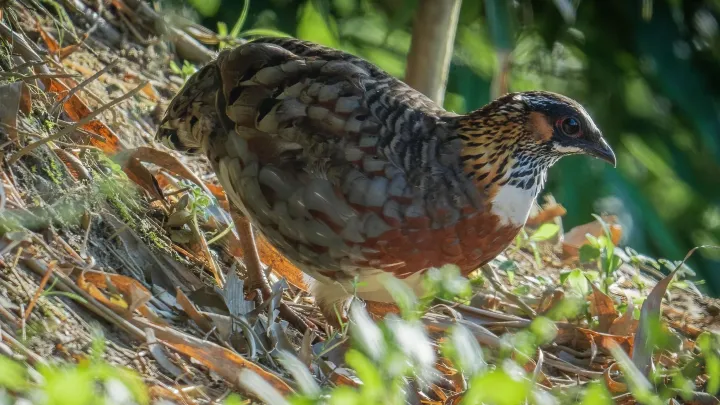
The bamboo partridge (lat. Bambusicola thoracicus) belongs to the order Galliformes and the family Phasianidae. It is a ground-dwelling bird of medium size.
They have a robust, compact body shape. Their plumage provides excellent camouflage, featuring a mix of grey, brown, and reddish tones with dark spots, blending perfectly into dry vegetation.
To identify the species, look for the distinctive reddish patterns on the throat and breast. These birds are frequently seen moving in small family groups across open terrain.
Their primary range covers East Asia, particularly China, where they favor habitats such as forest edges, bamboo thickets, and shrubbery bordering agricultural fields.
Within agricultural landscapes, they remain cautious but can gather in large groups in open areas to forage when they feel undisturbed.
What it damages
This species causes significant damage to various agricultural crops, especially during the seed germination phase and the initial emergence of seedlings.
The most severe damage is observed in grain fields, including rice, wheat, and millet, where birds actively dig up and consume seeds from the soil.
Beyond seeds, the bamboo partridge can damage young, tender sprouts and buds of vegetable crops, leading to a noticeable thinning of the plant stand.
During periods of natural food scarcity, flocks may specifically target vegetable plots, trampling plants while foraging intensely for food.
The economic impact of these birds also includes the contamination of crops with droppings and indirect damage to root systems caused by their scratching behavior.
When it appears
Bird activity is directly linked to the phenological stages of crop development, with peaks occurring during the spring and early summer seasons.
In spring, immediately after sowing, partridges show high interest in fields as they easily locate seeds through scent and visual observation.
During summer, as grain crops reach the milk and wax stages, the birds shift their attention to the ripening crops, making fields constant targets for foraging flocks.
In autumn, damage potential remains high near harvest sites where birds feed on spilled grain, which often leads to soil disruption.
During winter, when natural food is scarce, they may concentrate near grain warehouses and livestock farms to exploit anthropogenic food sources.
Signs of infestation
The presence of bamboo partridges is easily identified by their three-toed footprints found in moist or loose soil within the field.
Small holes or craters on the soil surface, created by their beaks while extracting seeds or seedlings, are clear indicators of their feeding activity.
Locating large amounts of bird droppings in areas where seedlings are sparse serves as strong evidence of a flock's presence in that sector.
During peak foraging times, one might observe trampled patches of crops where the plants appear crushed or pulled out entirely.
Their distinct, sharp calls often reveal their presence in nearby windbreaks or dense grass thickets long before they emerge to feed on the crops.
Control measures
Protecting fields requires a multi-layered approach aimed at deterring birds from agricultural land without causing them direct physical harm.
- Utilizing visual repellents such as reflective ribbons, predator decoys, and dynamic scarecrows to create an unwelcoming environment.
- Installing acoustic deterrents that mimic predator cries or produce sudden loud noises to startle and disperse the flocks.
- Using netting or fencing on smaller plots that are particularly vulnerable to bird damage.
- Treating seeds with specialized bird-repellent coatings that have a bitter taste to discourage ingestion.
- Maintaining field hygiene and promptly removing harvest residues to prevent creating attractive feeding grounds.
Taxonomy
- Latin name
- Bambusicola
- Family
- Phasianidae
- EPPO code
- BAMCSP
Discussion
No discussions yet — be the first.