
Chukar
Alectoris chukar
Description
How to identify
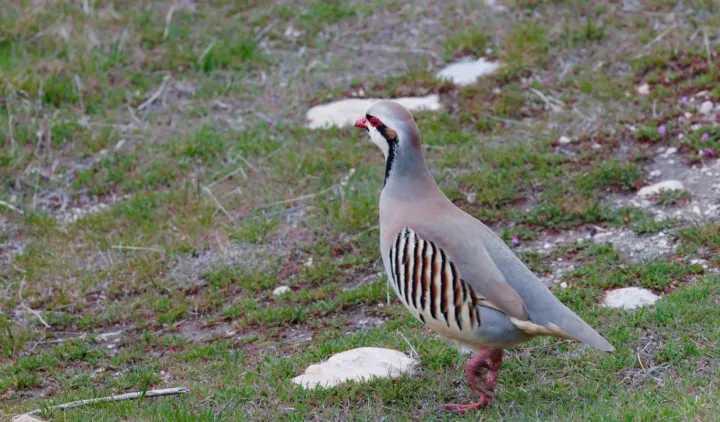
The Chukar (Alectoris chukar) is a sturdy game bird belonging to the pheasant family. Adults are easily recognized by their buff-grey coloration, white throat bordered by a thick black necklace, and reddish-brown flanks with prominent black and white bars.
Key identification features include their bright red bill, red legs, and red eye-rings. They are medium-sized birds, typically measuring between 32 and 35 centimeters in length, with a rounded body shape.
Chukars are primarily ground-dwelling birds that prefer arid, rocky terrain, steep hillsides, and canyons. They are well-adapted to walking and running rather than flying, although they will take flight if threatened.
Socially, they are gregarious, often forming groups known as coveys. During the non-breeding season, these coveys can consist of significant numbers of birds, increasing their impact on nearby agricultural fields.
Their biological adaptability allows them to thrive in regions where seasonal food scarcity forces them to explore cultivated fields as reliable food sources, often leading to conflict with farmers.
What it damages
Chukars primarily damage grain crops including wheat, barley, and millet. They are known to peck at seeds during the sowing phase and consume tender seedlings, causing reduced stand density and potential yield loss.
Legumes such as chickpeas and peas are also frequently targeted. The birds are skilled at digging, allowing them to expose and consume seeds that have been sown at shallow depths, requiring costly reseeding.
As the crops mature, Chukars may damage the heads of wheat and other small grains, leading to grain shattering and overall harvest loss, especially in fields adjacent to their nesting or resting grounds.
Vegetable crops planted near arid borders may also suffer from feeding damage. Both adults and juveniles may consume foliage or young stems, causing deformed growth and structural damage to young plants.
The extent of the damage is often tied to the size of the local covey. In years of drought when natural seed availability is low, the pressure on agricultural crops intensifies significantly.
When it appears
Feeding activity is most intense in early spring when birds emerge from wintering areas to exploit fresh, protein-rich green shoots of emerging cereal crops.
During the summer months, while raising their brood, Chukars require substantial amounts of food, leading to increased visits to fields with ripening grains or maturing pulse crops.
In the autumn, Chukars often feed on newly planted winter grain crops. This can be critical, as the loss of young plants during this stage directly impacts the survival and growth of the crop through winter.
Their seasonal presence is dictated by environmental factors: during high temperatures, they stay closer to water sources, but as temperatures cool, they move freely across larger territories, including farmlands.
Monitoring these seasonal movements allows agronomists to implement deterrent measures at the exact moment birds begin transitioning into cultivated lands before significant damage occurs.
Signs of infestation
One of the most reliable signs of Chukar activity is the presence of three-toed footprints in loose soil, along with shallow holes where birds have scratched to expose seeds.
Uneven crop stands or patches of missing plants at the field edges, especially near rocks or scrubby vegetation, indicate that the area is being used as a primary feeding ground.
Droppings left in fields are distinct and serve as an indicator of the bird's presence. Finding clusters of these in specific areas suggests regular use of that field for feeding or loafing.
The distinctive noise made by a flushed covey is often the first indicator for farm workers. Sudden, noisy take-offs near field borders are a classic signal of the birds' presence.
Secondary signs include discarded feathers found near field boundaries and visible trampling marks, which indicate where the birds have spent time congregating or moving through the crop canopy.
Control measures
Effective management involves a combination of non-lethal deterrents designed to disrupt the birds' comfort and make the field appear unsafe or unappealing.
- Deploying acoustic deterrents such as propane cannons that mimic distress calls or predator sounds.
- Using visual scare tactics like hawk silhouettes or reflective, moving materials.
- Applying non-toxic seed treatments that deter birds through bitter taste.
- Maintaining field edges by clearing weeds that provide cover for foraging and hiding.
- Using guard dogs or automated patrol systems to discourage long-term residency of coveys.
Cultural control practices, such as ensuring proper planting depth and timing, are essential to minimize the period during which seeds are vulnerable to being dug up.
It is important to manage buffer zones around fields by planting less attractive vegetation to draw the Chukars away from the main production areas.
Regular monitoring of local populations allows farmers to adjust their defense strategies, ensuring that the most cost-effective methods are utilized during the crop's most susceptible growth stages.
Taxonomy
- Latin name
- Alectoris chukar
- Family
- Phasianidae
- EPPO code
- ALCTCH
Discussion
No discussions yet — be the first.