
Pale damsel bug
Tropiconabis capsiformis
Description
How to identify
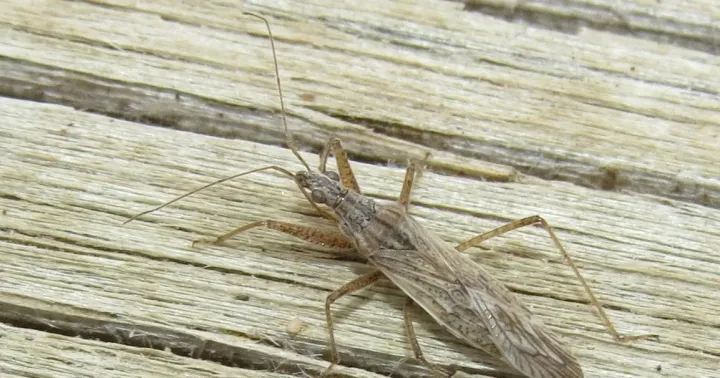
Tropiconabis capsiformis, commonly known as the pale damsel bug, belongs to the family Nabidae. These insects are slender predators, typically measuring between 7 to 9 millimeters in length, with a straw-colored or light brown appearance that provides excellent camouflage in grassy habitats.
The insect is characterized by a strong, curved rostrum (proboscis) used for piercing prey. They have prominent, well-developed eyes that allow them to spot movement from a distance, making them highly effective hunters in agricultural fields.
This species exhibits wing dimorphism, with both macropterous (long-winged) and brachypterous (short-winged) forms. The long-winged form is highly mobile, capable of colonizing new fields quickly when prey density changes or environmental conditions shift.
The life cycle consists of an egg stage, five nymphal instars, and the adult stage. Females insert their eggs into plant tissues, such as stems, which provides a level of protection against predators and some pesticide applications.
Depending on regional temperatures, the development from egg to adult takes approximately 30 to 40 days, allowing for several generations throughout a single growing season under optimal conditions.
What it damages
While Tropiconabis capsiformis is primarily a predator that feeds on aphids, spider mites, and small caterpillars, it is known to exhibit facultative phytophagy. When prey sources are scarce, these bugs pierce plant cells to extract sap.
The primary hosts affected by this bug include various cereal crops such as wheat, barley, and oats. Young seedlings are particularly susceptible to the damage caused by the bug's saliva, which can lead to localized necrosis.
Damage symptoms include the appearance of small, yellowing, or necrotic spots on leaves and stems where the bug has fed. In severe infestations, growth may be stunted, reducing the vigor of the crop during critical development phases.
Beyond cereals, they can be found on legumes and various weed species, which often serve as primary breeding grounds before the insects migrate into cultivated areas.
The economic impact is generally low due to their predatory nature, but under high population densities, their phytophagous habits can lead to visible injury in young stands of sensitive crops.
Control measures
Managing Tropiconabis capsiformis should focus on integrated pest management practices. Maintaining clean fields by controlling weed populations is essential, as many weeds act as refugia for the bugs when crops are not present.
Crop rotation is a highly recommended strategy to disrupt the life cycle of the pest, as it prevents the continuous buildup of local populations within a specific field.
Chemical control should be used sparingly and only when monitoring indicates that the economic injury level has been exceeded. Whenever possible, selective insecticides should be chosen to preserve beneficial predatory insects in the ecosystem.
Field scouting should be conducted during the early morning or late afternoon when the insects are most active. Standard sweep-netting techniques are the most effective method for quantifying population density.
- Maintaining field margins to support natural enemy populations.
- Early season monitoring of seedling stages.
- Selective insecticide application to protect non-target predatory species.
- Deep plowing or destruction of crop residues after harvest to reduce overwintering success.
Taxonomy
- Latin name
- Tropiconabis capsiformis
- Order
- Hemiptera (bugs, aphids, leafhoppers)
- Family
- Nabidae
- EPPO code
- TROICA
Discussion
No discussions yet — be the first.