
Nabicula limbata
Nabicula limbata
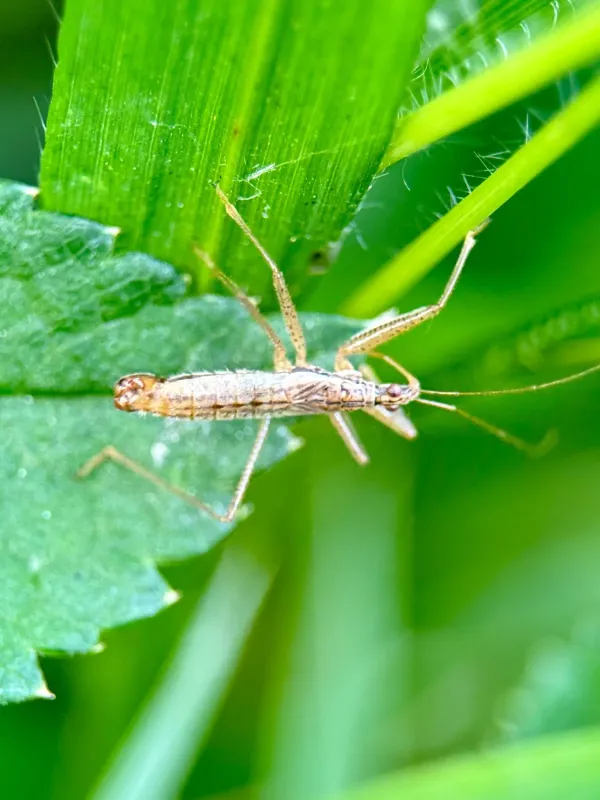
Description
How to identify
Nabicula limbata belongs to the order Hemiptera and the family Nabidae, commonly known as damsel bugs. These insects have an elongated body, typically ranging from 7 to 9 millimeters in length, characterized by a yellowish-brown coloration and a distinctive dark border along the edges of the pronotum.
Adult specimens possess developed piercing-sucking mouthparts, adapted for both feeding on plant sap and predating on smaller insects. Many individuals within this species exhibit reduced wing development or brachyptery, which significantly restricts their migratory capabilities compared to other bug species.
Nymphs resemble the adults morphologically but are smaller and lack fully formed wings. Their coloration varies from light yellow to greenish, providing effective camouflage within dense vegetation.
A defining characteristic of the Nabidae family is the presence of long, raptorial forelegs designed to grasp prey. These morphological features are essential for accurate identification during field scouting.
The life cycle encompasses the egg stage, five nymphal instars, and the adult stage. Overwintering typically occurs as eggs laid within the stems of cereal crops or wild grasses.
What it damages
Although Nabicula limbata is primarily regarded as an entomophage that feeds on aphids and small larvae, it can switch to phytophagy when animal prey is scarce. This shift causes damage to cereal crops, including wheat, barley, and oats.
The bugs pierce tender plant tissues and developing ears, injecting saliva containing digestive enzymes. This disrupts plant development, leading to ear deformation and reduced grain quality.
Significant damage is most commonly observed during years of population outbreaks, when a shortage of natural food forces the insects to attack agricultural crops on a massive scale.
Damage symptoms manifest as localized necroses on stems, which slow down overall plant growth. In severe cases, affected shoots may yellow and wither prematurely, directly impacting crop yields.
In intensive farming, the economic loss caused by this species can be compounded by damage from other bug species, complicating the overall phytosanitary management of the field.
When it appears
The emergence of these insects in the field occurs during the spring when soil temperatures reach optimal levels for the hatching of overwintered eggs. The active life cycle period extends through mid-summer.
Population density peaks typically coincide with the jointing and heading phases of cereal crops. During this time, high humidity and the availability of succulent plant tissues create favorable conditions for population growth.
The species completes one generation per season. Mated females lay eggs within plant tissues, selecting the most vulnerable sections of the stem to ensure survival of the offspring.
The second half of summer is marked by a gradual decrease in adult activity as they prepare for overwintering. Temperature fluctuations late in the season significantly influence the survival rate of late-instar nymphs.
Adult migration to overwintering sites often involves moving to field borders or margins, where plant debris provides the necessary shelter to survive harsh winter conditions.
Signs of infestation
Initial signs of infestation include characteristic light spots and "needle-prick" marks on leaves and stems. Upon close inspection, adults can be found hiding in leaf axils or deep within the plant canopy when disturbed.
During the early heading stage, "white heads" or partial underdevelopment of the ear may indicate feeding activity in the growth zone. These symptoms can be easily confused with other pests, necessitating professional inspection.
The presence of small, dark excrement spots on leaves serves as a clear indicator of sustained feeding activity. Frequently, secondary fungal infections develop at the sites of the piercing wounds.
Stems may show signs of distortion, bending, or premature lodging, which often indicates systematic damage to structural tissues by members of the Nabidae family.
Population spikes are typically identified through regular entomological monitoring using sweep nets or by inspecting sampling quadrats along field margins.
Control measures
The primary control strategy is agrotechnical. It is recommended to maintain clean field margins by eliminating weeds, as these areas serve as major reservoirs and overwintering sites for the pest population.
Crop rotation and optimized sowing dates help reduce crop vulnerability during the periods of peak bug activity. Proper soil tillage after harvest effectively destroys eggs deposited in the stubble.
If the economic threshold of damage is reached, broad-spectrum insecticides may be utilized. However, it is crucial to consider the presence of beneficial entomophages to avoid disrupting the natural biocenosis balance.
Biological control methods include encouraging the presence of natural enemies, such as predatory beetles and parasitic wasps, which help suppress the population naturally without chemical intervention.
- Monitoring population levels with pheromone traps.
- Timely chemical treatment of field perimeters.
- Usage of high-vigor seed varieties.
- Minimizing insecticide usage during the early growth stages.
Taxonomy
- Latin name
- Nabicula limbata
- Order
- Hemiptera (bugs, aphids, leafhoppers)
- Family
- Nabidae
- EPPO code
- NABCLI
Discussion
No discussions yet — be the first.