
Himacerus
Himacerus
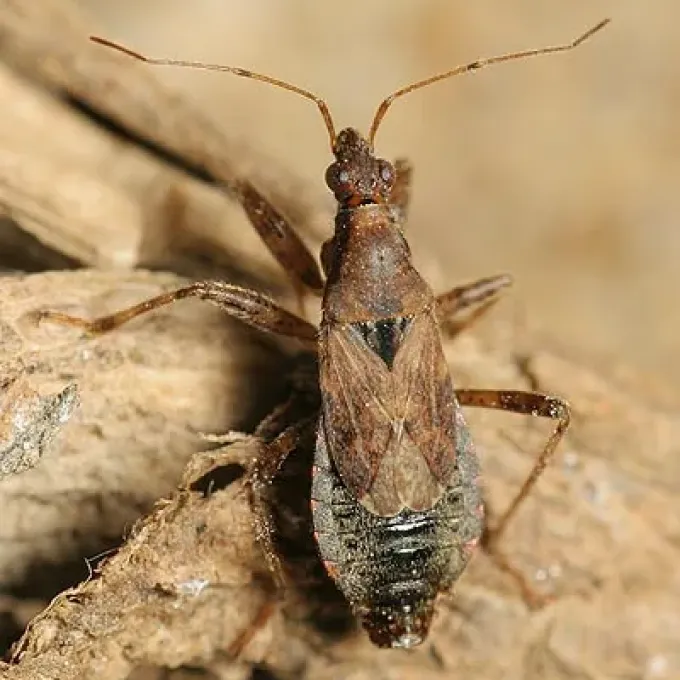
Description
How to identify
Himacerus is a genus of predatory bugs belonging to the family Nabidae within the order Hemiptera. These insects are common inhabitants of field and garden ecosystems.
Adults typically have an elongated body, ranging from 7 to 11 mm in length, usually colored in yellow-brown or dark brown shades. They possess powerful raptorial forelegs adapted for seizing prey.
Nymphs resemble the adults in appearance but are smaller in size and lack fully developed wings. They are highly mobile and actively roam plant surfaces in search of food.
The vision of these bugs is well-developed, allowing them to effectively track the movement of small insects on plant foliage.
Unlike true phytophagous insects, Himacerus has a short, sturdy proboscis designed for piercing the prey's exoskeleton and injecting digestive enzymes.
What it damages
It is important to note that Himacerus is an entomophagous insect rather than a specialized crop pest. They primarily feed on aphids, small caterpillars, beetle larvae, and thrips.
Direct damage to plants is rarely significant; however, in cases of extreme prey scarcity, they may occasionally feed on plant sap from young shoots.
They are most frequently observed on cereals, legumes, vegetables, and various weeds where aphid colonies are concentrated.
Due to their generalist predatory nature, they act as an important regulator of insect population density, protecting crops from multiple pest species.
In regions with intensive chemical pesticide use, the population of Himacerus drops significantly, often leading to outbreaks of major agricultural pests.
When it appears
The activity of these bugs begins in the spring when stable positive temperatures allow adults to emerge from their overwintering sites.
They overwinter primarily as adults in leaf litter, crop residues, or under tree bark, which ensures their survival through cold periods.
Population peaks are typically observed during the summer months, coinciding with the maximum density of their prey, such as aphids and other small invertebrates.
The life cycle includes an egg stage, five nymphal instars, and the adult stage, with one generation usually requiring 30–45 days depending on climate conditions.
In autumn, the bugs enter diapause, actively searching for suitable shelter to safely survive the coming winter months.
Signs of infestation
The presence of Himacerus in a field is often indicated by the remains of small insects, typically appearing as empty husks after the predator has extracted their fluids.
The bugs themselves are usually discovered during visual inspections of the undersides of leaves or flowers where they wait to ambush prey.
The absence of fruit or leaf damage despite the presence of pest colonies often indicates the effective activity of natural enemies like Himacerus.
Unlike sucking pests, the activity of Himacerus does not cause chlorotic spots or tissue deformation on the affected plant parts.
Their population can be monitored using sweep netting or by placing yellow sticky traps in the crop canopy.
Control measures
Specific control measures against Himacerus are generally unnecessary, as they are considered beneficial components of a healthy agroecosystem.
The use of broad-spectrum insecticides should be avoided, as these cause direct harm to predator populations and may trigger secondary pest outbreaks.
To preserve beneficial insects, it is recommended to use selective pesticides that target only the specific pest species without harming predators.
Implementing wildflower strips along field edges helps sustain Himacerus populations by providing essential shelter and alternative food sources.
Conservation tillage practices allow these insects to overwinter successfully within crop residues, enhancing their population density in the following season.
Taxonomy
- Latin name
- Himacerus
- Order
- Hemiptera (bugs, aphids, leafhoppers)
- Family
- Nabidae
- EPPO code
- HIMASP
Discussion
No discussions yet — be the first.