
Nettle sucker
Trioza urticae
Description
How to identify
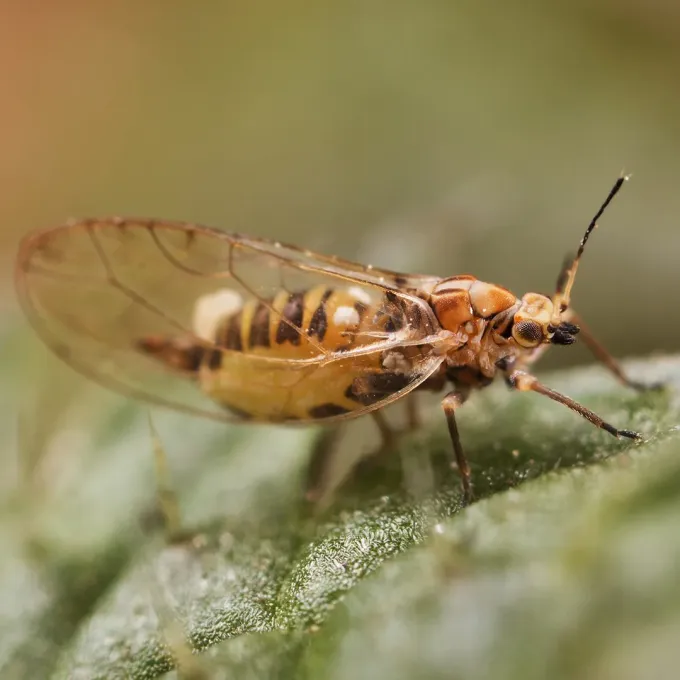
The Nettle sucker (Trioza urticae) belongs to the order Hemiptera and the family Triozidae. These are small, jumping insects typically measuring 3 to 4 mm in length.
The adults are characterized by their greenish or yellowish-green color, often featuring dark markings on the body and well-developed wings for active flight.
The life cycle encompasses several stages, including eggs, five larval instars, and the adult stage. The species typically overwinters as an adult in sheltered locations.
During the spring, these insects migrate to their primary host plants, the common stinging nettle (Urtica dioica), to feed and begin the reproduction cycle.
They are widely distributed throughout Europe, and their biology is intimately tied to the phenology of the nettle plant, making them specialized dwellers of these habitats.
What it damages
The Nettle sucker feeds exclusively on stinging nettles, causing localized damage to the leaves. It is not considered a threat to standard vegetable or ornamental crops.
As the larvae feed within the leaf tissues, they induce the formation of galls—abnormal growths or swellings on the surface of the leaves—where they reside and develop.
The damage caused is primarily cosmetic and physiological to the host plant, disrupting the transport of nutrients and limiting the plant's photosynthetic efficiency.
In professional herb production, high levels of infestation can reduce the overall quality and harvest yield of the nettle leaves due to severe leaf deformation.
Since the pest does not transition to garden crops, it poses no significant risk to orchard health or agricultural food security in typical backyard or commercial settings.
Signs of infestation
The most prominent sign of infestation is the appearance of curled, deformed leaves covered in distinct swellings or galls, which may range in color from light green to red.
If you examine the underside of an affected leaf, you may find the sedentary larvae, often surrounded by white, waxy secretions that act as a protective barrier.
In cases of heavy infestation, the tips of the nettle stems become highly branched or stunted, losing their normal growth pattern and vibrancy.
The leaves may show signs of yellowing or chlorosis due to the localized feeding activity, which prevents them from maintaining healthy metabolic processes.
The presence of adult jumping insects around the nettle beds during late spring and early summer is a clear indication that the population is actively breeding.
Control measures
As the Nettle sucker is not a major agricultural pest, active control measures are rarely required unless the nettles themselves are being farmed for specific purposes.
If management is necessary, mechanical removal of affected leaves and shoots before the adults emerge from the galls is the most effective and eco-friendly method.
Promoting a healthy environment for natural predators such as lacewings, lady beetles, and parasitic wasps is the best long-term strategy for population suppression.
Chemical intervention is strongly discouraged, as it often causes more damage to the beneficial insect ecosystem than the pest causes to the nettle plants.
Sanitation practices, such as clearing away dense leaf litter and debris in the autumn, can reduce the number of suitable overwintering sites for the adults.
Taxonomy
- Latin name
- Trioza urticae
- Order
- Hemiptera (bugs, aphids, leafhoppers)
- Family
- Triozidae
- EPPO code
- TRIZUR
Discussion
No discussions yet — be the first.