
Potato psyllid
Bactericera tremblayi
Description
How to identify
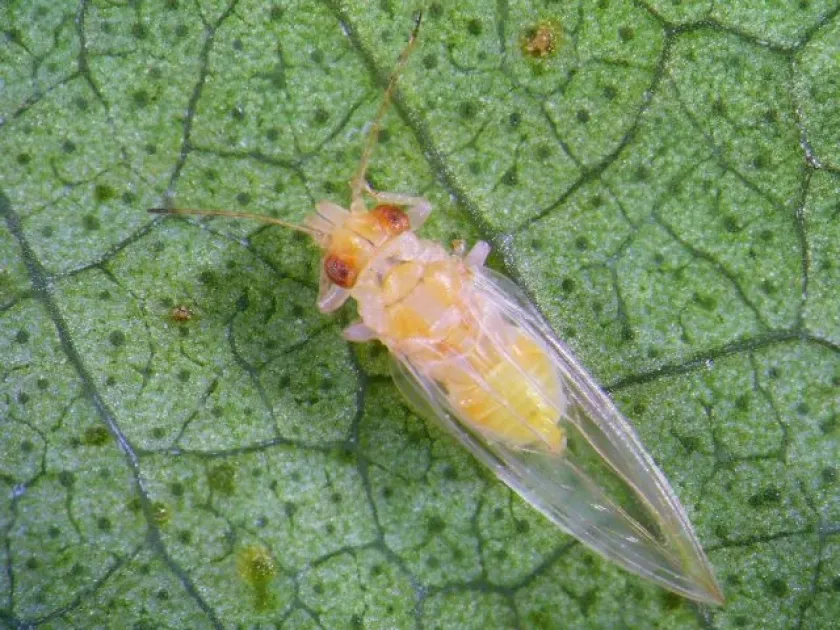
The potato psyllid (Bactericera tremblayi) is a member of the Triozidae family within the Hemiptera order. These small insects, typically measuring 2–3 mm in length, are highly mobile and characterized by their ability to jump when disturbed.
Adult psyllids exhibit a greenish-yellow to brownish coloration, often featuring dark markings on the body. Their transparent wings are folded roof-like over their backs, which is a key morphological trait for field identification.
Nymphs of the potato psyllid are generally flattened, sedentary, and often coated in a waxy substance, which helps protect them from environmental stressors and pesticides.
The eggs are oval and attached to the underside of leaves by a fine, hair-like stalk, preventing them from being dislodged by wind or rain during the incubation period.
The life cycle involves incomplete metamorphosis, progressing through egg, several nymphal stages, and the adult phase, allowing for multiple generations per growing season.
What it damages
The primary host for this pest is the potato plant, though it frequently attacks other solanaceous crops including tomatoes, eggplants, and wild nightshade species, causing significant agricultural losses.
Both adults and nymphs cause damage by feeding on plant phloem sap. This nutrient extraction weakens the plant, disrupts metabolic processes, and hinders general physiological development.
Beyond physical sap-sucking damage, the potato psyllid can act as a vector for various phytoplasmas and viruses, which are responsible for severe deformities in foliage and tuber development.
Economic impact is highest when infestation occurs during the critical phases of tuber bulking, as the stress induced by the pests directly leads to reduced yields and inferior quality.
Severe infestations often result in premature senescence of the canopy, leaving the plant unable to complete its growth cycle, which drastically reduces the market value of the potatoes.
Signs of infestation
One of the earliest indicators of an infestation is the curling of upper leaves, which often show chlorotic or reddish tints, frequently misidentified as symptoms of nutritional deficiencies or viral diseases.
A closer inspection of the abaxial (underside) surface of the leaves reveals the presence of nymphs, which look like tiny scales, often accompanied by sticky secretions known as honeydew.
The accumulation of honeydew promotes the growth of sooty mold, a fungus that covers leaf surfaces in a black layer, further inhibiting photosynthesis and aggravating plant health issues.
Heavily infested plants appear stunted, with thickened, brittle stems and distorted leaves that give the plant a "rosette" or "broom-like" appearance, signaling significant internal damage.
Farmers may notice a general lack of vigor across the field, with affected patches failing to grow at the same rate as surrounding healthy plants during the vegetative stage.
Control measures
Effective management begins with rigorous field sanitation, specifically the removal of solanaceous weeds that serve as alternative hosts for psyllids during the off-season.
The use of certified, disease-free seed potatoes and strategic spatial isolation of plots are essential components to minimize the risk of early-season colonization.
Chemical control involving systemic insecticides is recommended once economic thresholds are reached to protect the crop during its most vulnerable developmental stages.
It is vital to rotate different classes of insecticides to prevent the development of resistant pest populations and to follow all regional guidelines regarding application timing and pre-harvest intervals.
- Deployment of yellow sticky traps to monitor adult psyllid activity.
- Prompt destruction of crop residues immediately after harvest.
- Encouraging natural predators such as ladybirds and lacewings.
- Integration of biological control agents where suitable for local conditions.
Taxonomy
- Latin name
- Bactericera tremblayi
- Order
- Hemiptera (bugs, aphids, leafhoppers)
- Family
- Triozidae
- EPPO code
- TRIZTE
Discussion
No discussions yet — be the first.