
Tomato psyllid
Bactericera cockerelli
Description
How to identify
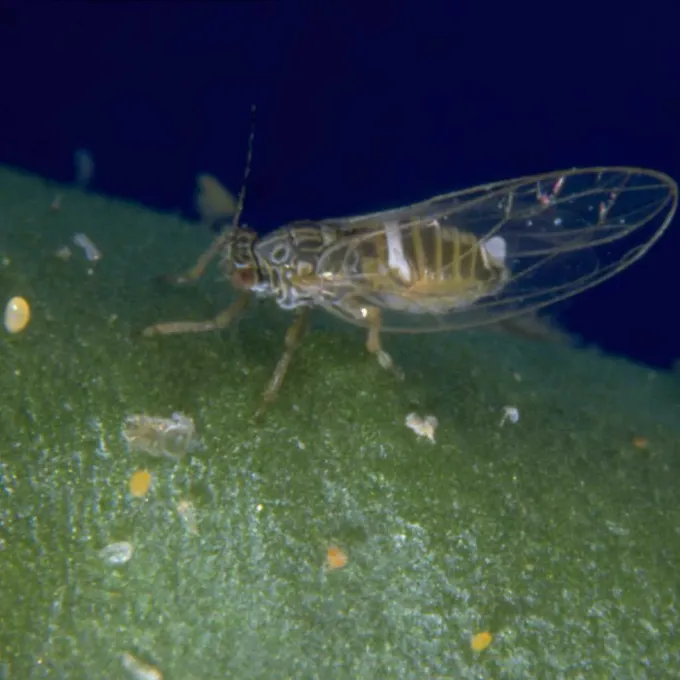
The tomato psyllid (Bactericera cockerelli) belongs to the Triozidae family within the order Hemiptera. The adult is a tiny, jumping insect, approximately 2-3 mm long, with transparent wings that are held roof-like over its body.
Adult psyllids are typically dark-colored, often featuring white or yellowish markings on their abdomen. The nymphs undergo five developmental stages; they are flat, oval-shaped, and resemble tiny scales, usually presenting a pale yellowish-green color.
The life cycle is highly dependent on temperature. Under optimal conditions of +20°C to +25°C, the cycle from egg to adult takes about three to four weeks, allowing for multiple generations per year depending on the climate.
Females lay eggs on thin stalks, primarily on the underside of leaves along the margins. This placement provides the eggs with protection against environmental stressors and potential contact with pesticide residues.
This pest is a major vector for the bacterium Candidatus Liberibacter solanacearum, which causes a devastating disease known as "zebra chip" in potatoes and "psyllid yellows" in tomatoes.
What it damages
Primary hosts include various members of the Solanaceae family, including tomatoes, potatoes, peppers, and eggplants. Certain weeds, such as silverleaf nightshade, also serve as significant hosts for this pest.
Both nymphs and adults feed by piercing plant tissues and extracting phloem sap. During feeding, they inject salivary toxins that disrupt the plant's metabolic processes and overall physiological functions.
The direct physical damage is exacerbated by the transmission of plant pathogens. These diseases lead to stunted growth, leaf chlorosis, deformed fruits, and substantial yield losses that can reach 100% in untreated fields.
In greenhouse settings, psyllid infestations can spread with alarming speed. Due to the lack of natural predators in controlled environments, the population can reach economic injury levels in a very short amount of time.
Excretion of honeydew by the psyllids promotes the growth of sooty mold on the foliage, which blocks sunlight and further inhibits the photosynthetic capacity of the affected plants.
Signs of infestation
One of the earliest warning signs is the curling and yellowing of the youngest leaves at the tops of the plants. This condition, often termed "psyllid yellows," is frequently misidentified as a nutrient deficiency.
Affected plants exhibit rigid leaves, chlorotic discoloration, and shortened internodes, giving the plant a stunted, rosette-like appearance. This is a clear indicator of systemic toxicity caused by the pest.
Close inspection of the leaf undersides reveals colonies of flat, scale-like nymphs. Additionally, sticky honeydew deposits can often be found on the foliage, which may be accompanied by black sooty mold growth.
As the infestation progresses, fruits fail to develop properly, becoming small and distorted. In severe cases, the plants suffer from root decay, leading to premature wilting and the total collapse of the crop.
Yellow sticky traps are essential diagnostic tools. Placing these traps in the field or greenhouse allows growers to detect adult psyllid activity early and initiate control measures before significant damage occurs.
Control measures
Effective management requires an Integrated Pest Management (IPM) approach. Eliminating solanaceous weed hosts in and around the growing area is a critical sanitation practice to reduce reservoir populations.
Chemical control focuses on targeting the nymphs during their active growth phases. Insecticides from groups such as neonicotinoids, pyrethroids, and spirotetramat are commonly used, with strict rotation required to prevent the development of insecticide resistance.
- Deploy yellow sticky traps for monitoring adult movement.
- Implement strict quarantine protocols for incoming transplants.
- Remove and destroy highly infested plants immediately.
- Introduce biological controls like predatory bugs and lacewings.
In greenhouses, maintaining strict climate control and installing insect-proof netting over vents are effective preventive measures. Regular scouting for nymphs and eggs is necessary for timely intervention.
Post-harvest sanitation is vital. Removing all crop debris and weeds after the season prevents the overwintering of the pest and breaks the life cycle, significantly reducing the risk of re-infestation in the next cropping cycle.
Taxonomy
- Latin name
- Bactericera cockerelli
- Order
- Hemiptera (bugs, aphids, leafhoppers)
- Family
- Triozidae
- EPPO code
- PARZCO
Discussion
No discussions yet — be the first.