
Ambiguous psyllid
Bactericera dubia
Description
How to identify
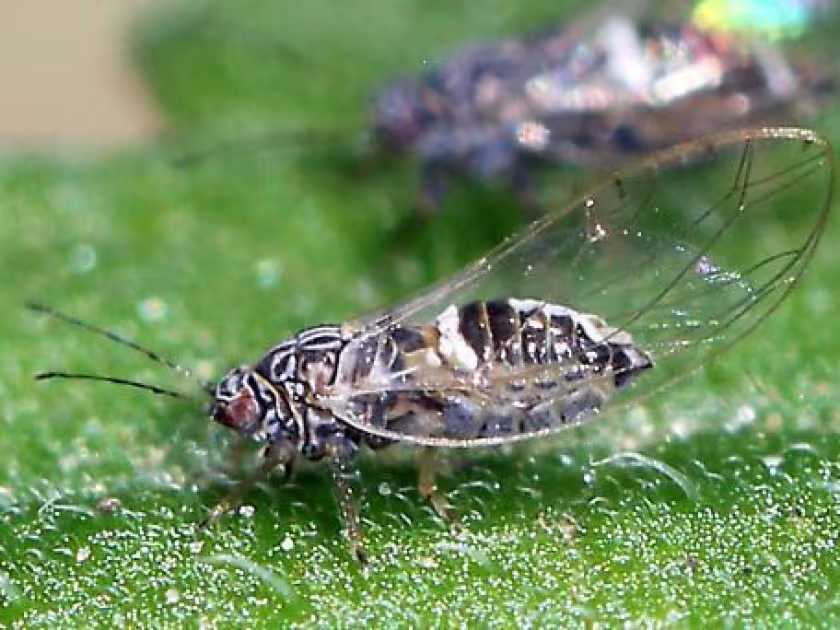
The ambiguous psyllid (Bactericera dubia) is a small jumping insect belonging to the Triozidae family within the order Hemiptera. These insects are often referred to as plant lice due to their size and feeding habits.
Adults possess strong, enlarged hind legs that enable them to leap quickly when disturbed, making them difficult to capture. Their bodies are usually yellowish, brownish, or greenish, providing effective camouflage against foliage.
Their wings are transparent with distinct veining, held in a roof-like position over the abdomen. The head is broad, equipped with large compound eyes and specialized mouthparts adapted for piercing and sucking.
Nymphs are typically sedentary, flattened, and often covered with waxy secretions or exudates. This waxy coating serves as a protective layer, making them cryptic against the surface of leaves or stems.
The life cycle involves incomplete metamorphosis, including the egg stage, several nymphal instars, and the adult stage. The duration of these stages is highly dependent on environmental temperature and host availability.
What it damages
Ambiguous psyllids primarily feed on host plants within the Solanaceae family and various other herbaceous species. They utilize their piercing-sucking mouthparts to extract sap from plant tissues.
Direct damage occurs as the insects deplete the plant of essential fluids, leading to reduced turgor pressure and disrupted nutrient transport. This causes overall plant weakness and stunted development.
During feeding, the psyllids inject saliva into the plant, which often contains phytotoxins that trigger physiological changes, such as leaf curling, chlorosis, and malformation of buds.
High populations can lead to significant yield loss, as the plants fail to reach maturity or produce low-quality fruits. The stress caused by the feeding makes plants more susceptible to secondary stressors.
Indirect damage involves the excretion of honeydew, which coats the foliage and provides a growth medium for sooty molds. This fungus blocks sunlight, severely hindering the plant's ability to photosynthesize.
When it appears
Adult psyllids typically overwinter in sheltered locations such as leaf litter, bark crevices, or under dense weeds. They remain in diapause until environmental conditions become favorable in the spring.
As temperatures rise, the adults emerge to migrate toward suitable host plants. This timing usually coincides with the early vegetative growth phase of crops, providing an abundant food source.
Throughout the growing season, multiple generations can occur. The population dynamics are heavily influenced by cumulative degree days and moisture levels, leading to potential flare-ups during hot summer periods.
Peak activity is often observed during the rapid growth stage of the host crop, where the young, succulent tissue is most attractive for feeding and oviposition.
As autumn approaches and day length decreases, adults begin to seek overwintering sites, gradually reducing their presence on field crops and shifting towards natural habitats.
Signs of infestation
The earliest signs of infestation include tiny, pale-yellow spots appearing on leaves, which represent the feeding sites of the psyllids. These spots may eventually merge, leading to necrotic tissue.
A classic symptom is leaf curling or crinkling, often referred to as "psyllid yellows" or leaf distortion. Affected leaves may become brittle and lose their normal shape or color.
Upon inspection of the leaf undersides, one may observe the nymphs, which look like small, waxy scales. The presence of sticky honeydew or black sooty mold is a clear indicator of a persistent infestation.
The overall appearance of the plant becomes stunted, with shortened internodes and a bushy habit. Development of flowers or fruits is frequently delayed or halted entirely due to the loss of energy.
In severe cases, plants may show signs of yellowing across the canopy, resembling nutrient deficiency, which often leads to poor crop uniformity and reduced commercial value at harvest.
Control measures
Effective pest management begins with cultural practices. Removing weeds and cleaning up crop residues after harvest are critical to eliminating overwintering habitats and reducing initial population levels.
Implementing crop rotation disrupts the psyllid life cycle, making it harder for the pest to maintain a stable population in a specific area year after year.
Biological control methods, including the encouragement of natural predators like lacewings, ladybugs, and parasitic wasps, can help keep psyllid numbers below the economic threshold.
When monitoring indicates a high population, targeted insecticide applications may be necessary. Systemic insecticides are often preferred to ensure coverage, especially targeting the undersides of the leaves.
To avoid the development of insecticide resistance, it is crucial to rotate chemical classes. Regular monitoring using sticky traps is essential to determine the optimal timing for intervention.
Taxonomy
- Latin name
- Bactericera dubia
- Order
- Hemiptera (bugs, aphids, leafhoppers)
- Family
- Triozidae
- EPPO code
- PARZDU
Discussion
No discussions yet — be the first.