
Psyllid
Bactericera
Description
How to identify
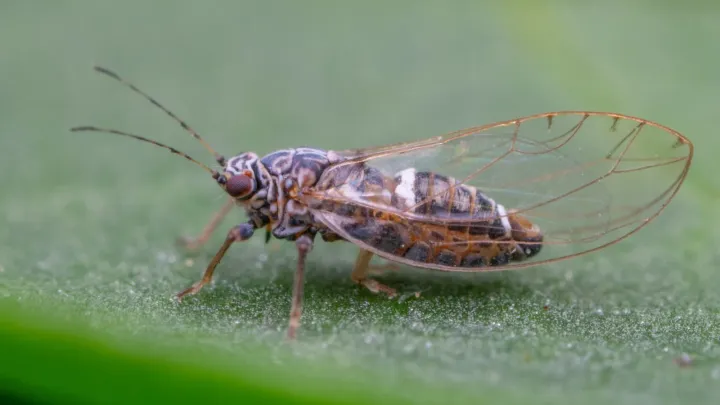
Psyllids of the genus Bactericera are small jumping insects that resemble miniature cicadas. Adult specimens measure between 2 and 4 mm in length, with coloration varying from greenish to dark, almost black, often featuring distinctive wing patterns.
Systematically, these pests belong to the order Hemiptera and the family Triozidae. They possess piercing-sucking mouthparts, which are perfectly adapted for extracting sap from the host plant's tissues.
The eggs are oval-shaped and are attached to the leaf surface via a delicate stalk. Larvae undergo several developmental stages, during which they exhibit significant changes in body structure and behavior.
The species Bactericera cockerelli, commonly known as the tomato psyllid, is of particular concern. It does not only damage tissues mechanically but also serves as a vector for dangerous phytoplasma diseases, such as "zebra chip" in potatoes.
The activity of these insects is directly influenced by climatic conditions; they prefer moderately warm weather and can reproduce rapidly under favorable temperature regimes, producing multiple generations throughout the season.
What it damages
The primary crops targeted by psyllids are members of the Solanaceae family: potatoes, tomatoes, peppers, and eggplants. In some instances, the pest can migrate to weeds, sustaining its population throughout the year.
Damage is caused by both adults and larvae. They pierce the epidermis of leaves and young shoots, consuming nutrients, which leads to significant weakening of the plant and stunted overall development.
Massive infestation results in the deformation of leaf blades, curling, and gradual yellowing. Plants become depressed, leading to a sharp decline in crop yield and deterioration of the quality of the fruits.
Beyond sap extraction, psyllids secrete specific substances during feeding. In many crops, this causes "psyllid yellows" — a physiological disorder that inhibits the plant's normal growth processes.
The critical danger lies in the transmission of pathogens. Viral and bacterial infections spread by the pest can lead to the total loss of crops in a very short time, making control measures a mandatory part of agricultural practice.
Signs of infestation
The first visual sign of a psyllid presence is the appearance of characteristic white or yellowish larvae on the underside of leaves, often covered with a waxy substance. Traces of "honeydew," a sugary excretion that attracts ants, may also be visible on the leaves.
Affected plants often display chlorosis, starting from the upper tiers. Leaves curl into a boat shape or become puckered, turning a purple or reddish hue, which is a consequence of nutrient deficiency.
During morning inspections, one may notice jumping insects that scatter quickly upon mechanical contact with the plant. Adult individuals tend to congregate at growth points, which halts apical development.
In infested potatoes, tubers often appear smaller, and dark vascular rings may appear on cross-sections, rendering the produce unsuitable for storage or processing. These signs are typical of specific diseases carried by Bactericera.
If tomato tips are mass-curling and the overall condition of the plants deteriorates rapidly for no apparent reason, a thorough inspection of stems and leaf axils for small colonies of the pest is necessary.
Control measures
The protection system against psyllids is based on an integrated approach combining agrotechnical, biological, and chemical methods. An important stage is strict adherence to crop rotation and spatial isolation of solanaceous crops.
Preventive measures include the timely elimination of host weeds where the pest may overwinter or breed. Using protective insect netting in greenhouses significantly reduces the risk of insect migration into the facility.
Upon detection of the first individuals, the application of systemic and contact insecticides is recommended. Products based on imidacloprid, acetamiprid, or pyrethroids are effective, provided that pre-harvest intervals are strictly observed.
Biological control methods include the use of entomophages — natural enemies of the psyllid, such as lacewings or predatory bugs. These methods are most effective in enclosed environments when the pest density is moderate.
- Regular monitoring of plantations using yellow sticky traps.
- Spatial isolation of potato fields from tomato plantations.
- Use of healthy, certified planting material.
- Application of balanced fertilizers to enhance plant immunity.
- Removal and burning of heavily infested plant residues after harvest.
Taxonomy
- Latin name
- Bactericera
- Order
- Hemiptera (bugs, aphids, leafhoppers)
- Family
- Triozidae
- EPPO code
- BCTCSP
Discussion
No discussions yet — be the first.