
Potato psyllid
Bactericera maculipennis
Description
How to identify
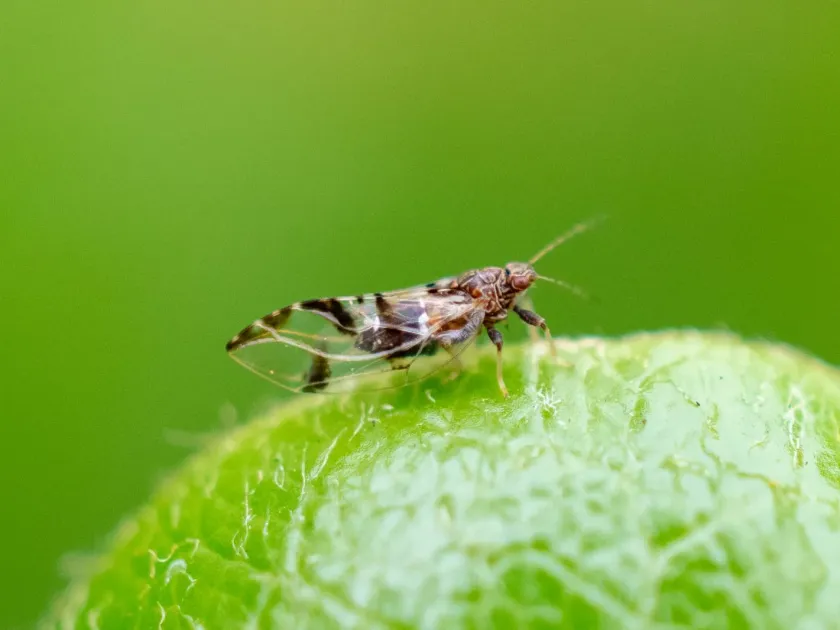
The potato psyllid (Bactericera maculipennis) is a small insect belonging to the Triozidae family, often referred to as jumping plant lice due to its hopping behavior.
Adults are very small, resembling miniature cicadas, and are known for their distinct wing markings which are diagnostic for this specific species.
The life cycle progresses through egg, nymph, and adult stages. Nymphs are flat, scale-like, and typically found on the undersides of leaves where they feed.
Because of their small size, they are difficult to spot with the naked eye. Agronomists often use yellow sticky cards to detect the presence of adults in fields early in the season.
Proper identification is crucial, as they can easily be confused with other psyllid species that do not pose the same economic threat to solanaceous crops.
What it damages
The primary hosts of the potato psyllid include essential crops such as potatoes, tomatoes, peppers, and eggplants, all members of the Solanaceae family.
Direct damage occurs when both nymphs and adults suck sap from the phloem, causing significant stress to the plant and reducing overall vigor.
A major concern is the transmission of plant pathogens. Psyllids can inject toxins into the plant during feeding, leading to severe physiological disorders and plant deformities.
Yield loss can be catastrophic, as the feeding damage combined with pathogen transmission can lead to stunted plant growth and poor tuber quality.
In high-pressure situations, untreated infestations can cause nearly total crop failure in susceptible potato varieties.
When it appears
Potato psyllids are most active during warm and dry periods, which allow for rapid population growth and multiple generations within a single growing season.
Adults migrate into fields as temperatures rise in the spring, typically colonizing younger, more succulent plant tissues first.
Population density often peaks mid-season, as the insects reproduce quickly, requiring vigilant monitoring by farmers and agronomists.
Cooler autumn weather slows their development, but they can persist on alternative hosts or crop debris until the onset of winter.
Environmental conditions, particularly humidity and temperature, play a critical role in predicting the intensity of an outbreak each year.
Signs of infestation
A classic symptom of infestation is "psyllid yellows," where leaves become chlorotic, curl upwards, and develop a distinct reddish or purple tint at the edges.
As nymphs feed, they secrete a waxy, sugary substance often referred to as "psyllid sugar," which appears as white flakes or powder on the underside of leaves.
Affected plants show significantly reduced growth, with shortened internodes and a bushy, stunted appearance that is easily recognizable in the field.
Infected plants may also show abnormal fruit or tuber development, failing to reach commercial size or standard quality requirements.
- Upward curling and yellowing of leaves.
- Presence of white waxy exudate on foliage.
- Stunted plant development.
- Reddish-purple tinting of leaf margins.
Control measures
Integrated Pest Management (IPM) is the most effective approach, combining regular field scouting with timely chemical intervention when economic thresholds are met.
Systemic insecticides are frequently utilized early in the season to protect young plants from initial colonization and pathogen transmission.
Cultural practices, such as removing solanaceous weeds and destroying crop debris post-harvest, are essential to break the insect's life cycle.
Rotation of insecticide modes of action is mandatory to prevent the development of resistance in psyllid populations, which can occur rapidly.
Beneficial insects, including lady beetles and lacewings, can provide natural control, and maintaining their populations through selective pesticide use is highly recommended.
Taxonomy
- Latin name
- Bactericera maculipennis
- Order
- Hemiptera (bugs, aphids, leafhoppers)
- Family
- Triozidae
- EPPO code
- BCTCMA
Discussion
No discussions yet — be the first.