
Avocado psyllid
Trioza perseae
Description
How to identify
The Avocado psyllid (Trioza perseae) is a small insect belonging to the Triozidae family within the order Hemiptera. These insects are known for their ability to jump when disturbed, earning them the name jumping plant lice.
Adults have clear, veined wings and piercing-sucking mouthparts. They typically exhibit shades of yellow, green, or brown, allowing them to blend into the canopy of the avocado tree.
The nymphs are sedentary and typically found on the undersides of leaves. As they develop through several instars, they undergo physiological changes while remaining attached to the leaf surface.
Distinguishing Trioza perseae from other pests often involves examining the specific type of leaf reaction they induce, which is a hallmark of this particular psyllid species.
Field identification usually requires a magnifying lens to observe the small nymphal stages that produce the characteristic galls on the host plant's foliage.
What it damages
The primary host for this pest is the avocado tree (Persea americana). Damage is primarily localized on the leaves, where nymphs feed by sucking sap from the plant tissues.
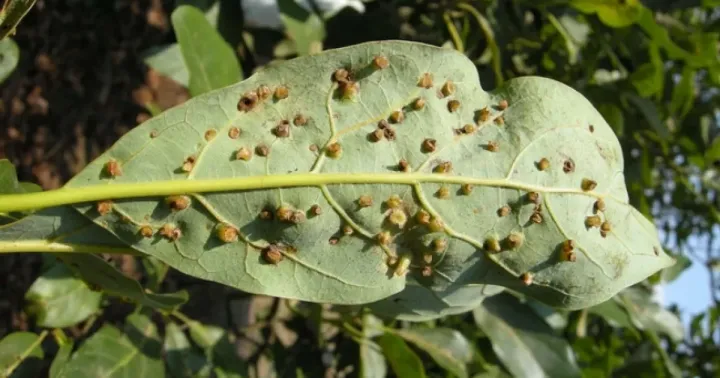
The feeding process triggers a plant defense response that manifests as the formation of leaf galls. These galls are physical deformations that reduce the overall photosynthetic capacity of the tree.
By diverting nutrients and disrupting the plant's vascular system in the affected area, the infestation causes stunted growth and weakens the tree's vigor.
Heavy infestations can lead to premature leaf drop, which puts significant stress on the tree, potentially leading to yield losses and lower fruit quality.
In addition to direct feeding damage, the openings created by the psyllid can serve as entry points for secondary infections by fungi and bacteria, further damaging the tree's health.
Signs of infestation
The most distinctive symptom of an avocado psyllid infestation is the presence of small, wart-like or crater-like galls appearing on the leaf surface.
Early stages of the infestation show up as small pale spots on the upper leaf surface, which correspond to the exact location of the nymphs feeding underneath.
Upon closer inspection, the undersides of the leaves will reveal the nymphs, which appear as tiny, flat, often transparent or yellowish discs adhering to the leaf.
Leaves may become twisted, curled, or distorted due to the formation of multiple galls, making the foliage look unhealthy and reducing its overall green area.
- Characteristic raised leaf galls (small swellings).
- Deformed or crinkled leaf edges.
- Presence of nymphs on the lower leaf surface.
- Premature yellowing and shedding of leaves.
- Reduced vigor in young shoots and new growth.
Control measures
Integrated pest management (IPM) is the most effective approach for controlling Trioza perseae, combining biological, cultural, and chemical tactics.
Cultural control measures include pruning and removing heavily infested leaves or branches, which helps to mechanically lower the population of the pest.
Chemical control involving systemic insecticides is often necessary when populations exceed economic thresholds. These are usually applied to protect new flushes of growth.
Biological control agents, such as parasitoid wasps that specifically target psyllid nymphs, can provide significant natural suppression of the pest population.
Strict quarantine and inspection of new nursery stock are critical to preventing the movement of this pest into unaffected avocado orchards and commercial operations.
Taxonomy
- Latin name
- Trioza perseae
- Order
- Hemiptera (bugs, aphids, leafhoppers)
- Family
- Triozidae
- EPPO code
- TRIZPE
Discussion
No discussions yet — be the first.