
Galium psyllid
Trioza galii
Description
How to identify
The Galium psyllid (Trioza galii) is a small insect belonging to the Triozidae family within the order Hemiptera. These insects are specialized feeders that thrive on specific plant species, primarily those in the genus Galium.
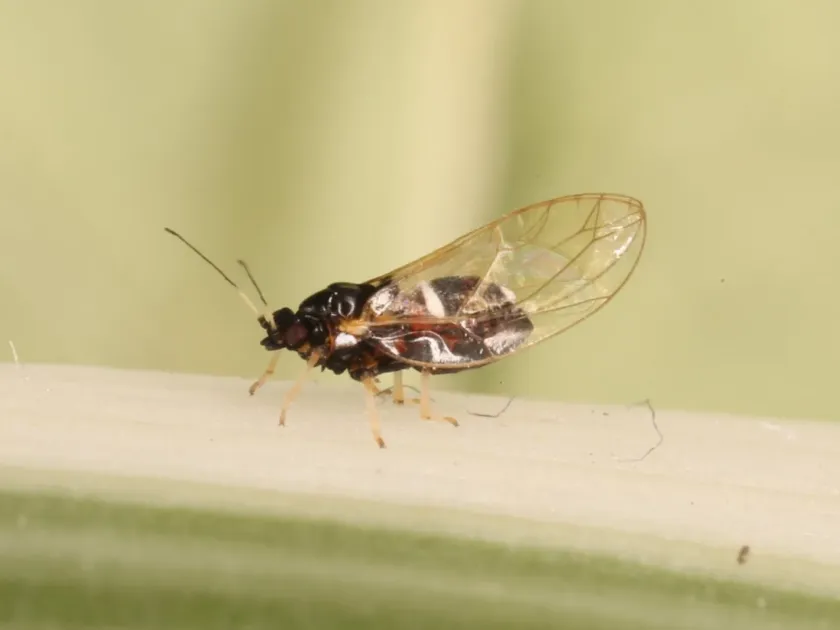
Adult psyllids are characterized by their small size, winged bodies, and specialized jumping legs. Their coloration often blends with the host plant, ranging from light green to yellowish or brown, providing effective camouflage.
The nymphs are the life stage most often associated with host plant damage. They are largely sedentary and secrete substances that induce the formation of galls, where they reside and feed in safety.
Identification is primarily achieved by inspecting the host plants for specific morphological changes. The characteristic gall formations are a definitive sign of their presence, often more diagnostic than spotting the insects themselves.
The life cycle of the Galium psyllid is highly synchronized with the vegetative stage of its host. Environmental conditions, such as temperature and humidity, play a critical role in the rate of population growth during the spring and summer months.
What it damages
This pest targets members of the Rubiaceae family, with wild and cultivated Galium species being the primary victims. In commercial settings, these infestations can lead to significant yield losses in herbal and medicinal crops.
The psyllids feed on plant sap, draining vital resources and causing metabolic stress to the host. Chronic feeding results in the weakening of the plant's overall architecture and reduced health.
Beyond direct feeding damage, the insects cause physical deformation of the leaves and stems. These deformations disrupt normal photosynthesis, as the leaf surface area is reduced or severely compromised.
Furthermore, the physical openings created by the psyllids during feeding can serve as entry points for bacterial and fungal pathogens. This secondary infection often complicates the health status of the crop.
The economic impact is particularly pronounced in areas where Galium is grown for its pharmaceutical properties. Deformed foliage is generally considered low-quality waste, making the entire harvest less marketable.
Signs of infestation
The most prominent sign of infestation is the formation of leaf galls. The edges of the leaves curl downwards and thicken, creating a protective enclosure for the developing nymphs to feed in peace.
Infested plants exhibit stunted growth and distorted, curled shoots. This architectural change in the plant's growth pattern is a clear indication that a colony of psyllids has established itself on the host.
Observing the undersides of leaves or the inside of galls often reveals small, scale-like nymphs. These are sometimes covered in a waxy or white secretion, which makes them easier to distinguish from the leaf tissue.
Yellowing or chlorosis of the affected leaves is common as the feeding process progresses. In extreme cases, the plant may show signs of premature senescence and tissue necrosis due to the persistent drainage of sap.
The arrival of adult psyllids on crops can be monitored using yellow sticky traps. These are highly effective for early detection, allowing growers to gauge the population pressure before significant galling occurs.
Control measures
Managing the Galium psyllid requires an integrated approach that focuses on prevention and early intervention. Since the nymphs are protected within galls, timing the control measures is essential for success.
Good agricultural practices, such as removing surrounding wild Galium hosts, can drastically reduce the pest pressure. Eliminating these reservoirs limits the migration of psyllids into commercial fields.
Chemical control usually necessitates systemic insecticides that are capable of translocating through the plant tissue. This is crucial because contact sprays often fail to reach the nymphs hidden inside the galls.
- Implement regular field scouting to detect initial gall formation.
- Use yellow sticky traps to track adult population spikes.
- Encourage natural predators such as ladybugs and lacewings.
- Apply systemic insecticides during the peak of adult activity.
Always consider the safety of the harvested material when using chemical interventions. It is highly recommended to follow established pesticide application schedules to ensure that residue levels remain well within the acceptable limits for herbal products.
Taxonomy
- Latin name
- Trioza galii
- Order
- Hemiptera (bugs, aphids, leafhoppers)
- Family
- Triozidae
- EPPO code
- TRIZGA
Discussion
No discussions yet — be the first.