
African citrus psyllid
Trioza eafra
Description
How to identify
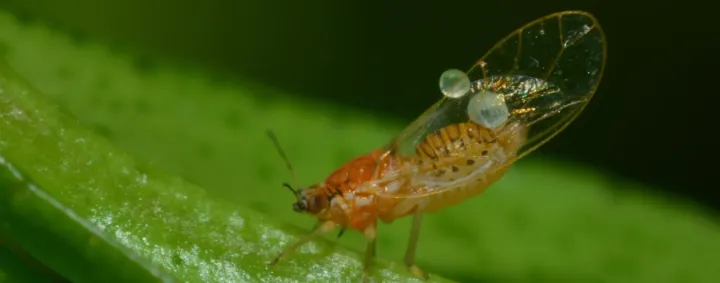
The African citrus psyllid, scientifically known as Trioza erytreae, belongs to the order Hemiptera and the family Triozidae. It is a tiny insect, measuring about 3 to 4 mm in length, with transparent wings featuring distinct venation.
Adult psyllids are characterized by their jumping ability when disturbed, which is why they are often referred to as jumping plant lice. Their color varies from light green to dark brown, providing excellent camouflage against citrus foliage.
The nymphal stage is sedentary. Nymphs are flat, oval, and covered with waxy secretions, often making them look like white, flaky spots on the undersides of leaves.
The life cycle progresses from eggs, which are deposited in the tissue of young leaves, through five nymphal instars, to the adult stage. The species thrives in cool, humid environments.
High temperatures and low humidity are detrimental to the psyllid population, significantly reducing the survival rate of the nymphs and the overall reproductive success of the adults.
What it damages
Trioza erytreae is a specialized pest primarily affecting citrus species, including oranges, lemons, mandarins, and limes. It represents a significant threat to both commercial orchards and home gardens.
The primary damage occurs during the feeding process, where both nymphs and adults extract sap from tender, actively growing shoots. This causes physiological stress to the host plant.
The pest is also a notorious vector for dangerous plant pathogens, including bacteria that cause serious systemic diseases in citrus trees, leading to total orchard decline.
Feeding damage prevents the normal development of new leaves. When the infestation is severe, it can result in stunted growth, leaf distortion, and premature abscission of young foliage.
In addition to direct tissue damage, the secretion of honeydew promotes the growth of sooty mold, which blocks sunlight and impairs the photosynthetic capacity of the entire tree.
Signs of infestation
The most distinctive symptom of an infestation is the formation of galls on the leaves. As nymphs feed, they create depressions, which appear as characteristic bumps or "warts" on the upper leaf surface.
Leaves become curled, twisted, and chlorotic as the infestation progresses. One can also observe white, waxy, snowflake-like excretions on the foliage and petioles.
The presence of sooty mold, appearing as a black, dusty coating on leaves and fruit, is a secondary sign resulting from the honeydew produced by the psyllid nymphs.
Shoot tips may appear deformed or stunted, with shortened internodes. In severe cases, the branches may lose their structural integrity and cease producing new growth cycles.
Regular monitoring of young flushes is essential for early detection, as the psyllids have a strong preference for the newest, most succulent leaf growth available on the tree.
Control measures
Integrated Pest Management (IPM) is the most effective approach for controlling the African citrus psyllid, combining cultural, biological, and chemical strategies.
Systemic insecticides are frequently utilized in commercial settings to eliminate populations that are hidden within the leaf tissues or protected by waxy secretions.
- Regular pruning of infested shoots to remove the bulk of the nymphal population.
- Deployment of biological control agents, such as parasitoid wasps, which naturally suppress psyllid numbers.
- Application of horticultural oils to suffocate nymphs and prevent adult movement on the canopy.
- Implementation of strict quarantine protocols to prevent the transport of infected nursery stock between regions.
Strategic timing of treatments, synchronized with the tree's growth flushes, is vital to maintaining the pest density below the economic injury level and protecting the harvest.
Taxonomy
- Latin name
- Trioza eafra
- Order
- Hemiptera (bugs, aphids, leafhoppers)
- Family
- Triozidae
- EPPO code
- TRIZEA
Discussion
No discussions yet — be the first.