
Persimmon psylla
Trioza diospyri
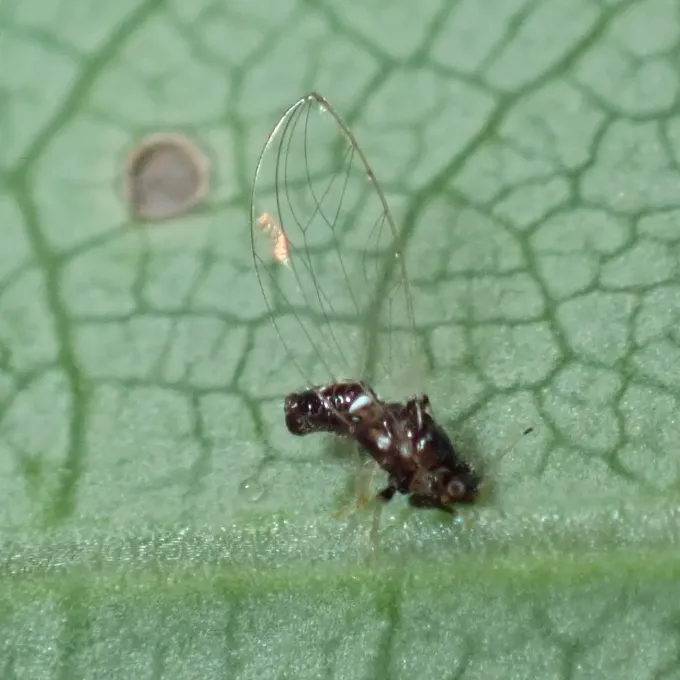
Description
How to identify
The persimmon psylla (Trioza diospyri) is a small jumping plant louse belonging to the order Hemiptera and the family Triozidae. It is a specialized pest primarily associated with persimmon trees.
Adult insects are tiny, characterized by their jumping ability and translucent wings with specific vein patterns. They are usually brownish or tan, allowing them to blend in with the bark of the host plant.
The life cycle consists of incomplete metamorphosis, transitioning through egg, nymph, and adult stages. Nymphs are particularly recognizable due to the protective waxy secretions they produce during development.
Overwintering occurs primarily in the adult stage, hiding in crevices of tree bark or leaf litter. They emerge in early spring as temperatures rise, ready to colonize the fresh growth of persimmon trees.
This species is highly adapted to the host plant, meaning it can quickly establish a presence in both wild and cultivated persimmon orchards if environmental conditions are favorable.
What it damages
Trioza diospyri primarily targets different species of persimmon, including Diospyros virginiana and Diospyros kaki. Infestations are most damaging to young trees and nursery stock.
The insects feed by piercing plant tissues and extracting sap from young leaves and growing tips. This removal of nutrients severely weakens the plant and disrupts its regular physiological development.
Feeding damage results in typical symptoms like severe leaf curling and distortion. As the leaves curl, they create a protected micro-environment for the nymphs to feed and develop safely.
Heavy infestations reduce the tree's photosynthetic capability, leading to stunted shoot growth, premature defoliation, and decreased fruit production in mature specimens.
Repeated stress from psylla feeding makes the trees more vulnerable to environmental factors and secondary pathogens that might otherwise be managed by a healthy tree.
Signs of infestation
The most distinctive sign of a persimmon psylla infestation is the curling and distortion of new leaves. Affected leaves often turn pale green or yellow, indicating chlorosis caused by sap depletion.
If you inspect the undersides of the curled leaves, you will likely find clusters of flat, wax-covered nymphs. These waxy, white particles are a clear indication of a psylla population.
A sticky substance known as honeydew is frequently found on the leaves and stems of infested plants. This sweet, sugary secretion often promotes the growth of sooty mold, which appears as a black, velvety coating.
Stunted and twisted shoot growth is a common observation in trees that have endured a persistent attack by this pest throughout the growing season.
- Distorted, curled leaves on new growth.
- White, waxy, or flocculent material on leaf undersides.
- Sticky honeydew buildup on branches and foliage.
- Black sooty mold fungus on leaves and shoots.
- Premature leaf drop in heavily infested trees.
Control measures
Cultural control practices are foundational for managing the persimmon psylla. Maintaining tree vigor through proper watering and balanced fertilization helps trees recover from minor infestations.
Biological control involves fostering the presence of natural predators, such as lady beetles, lacewings, and minute pirate bugs, which feed on the nymphs and help naturally suppress the population.
Chemical control should be reserved for cases where infestations threaten the plant's health. Applying horticultural oils or systemic insecticides during the early stages of nymph activity can be highly effective.
Pruning out and disposing of heavily infested shoots is a simple yet effective way to physically remove large numbers of nymphs and reduce the local breeding population.
Monitoring the orchard using yellow sticky cards helps track the arrival of adults in the spring, allowing for targeted and timely intervention before significant leaf damage occurs.
Taxonomy
- Latin name
- Trioza diospyri
- Order
- Hemiptera (bugs, aphids, leafhoppers)
- Family
- Triozidae
- EPPO code
- TRIZDI
Discussion
No discussions yet — be the first.