
Camphor jumping plant louse
Trioza camphorae
Description
How to identify
The camphor jumping plant louse (lat. Trioza camphorae) belongs to the order Hemiptera, family Triozidae. It is a small insect that is capable of active movement over significant distances during its adult stage.
Adult specimens have a typical structure for the family: jumping hind legs and transparent wings folded roof-like. Body coloration varies depending on the insect's age and the season.
Nymphs of the plant louse are characterized by a flattened body and low mobility, often covered with a waxy coating. They develop on young plant organs, living a hidden life under the protection of specific galls.
Identification of the pest is complicated by its miniature size, so detection often occurs through indirect signs such as leaf deformation and the presence of characteristic galls.
The biology of the species is closely linked to the camphor laurel, making the plant the only primary host for the completion of the insect's full life cycle.
What it damages
The main object of feeding and reproduction is the camphor laurel (Cinnamomum camphora). The pest prefers young shoots and leaves that have not yet fully unfurled.
As a result of the nymphs feeding on the plant's sap, the normal development of tissues is disrupted. Leaf blades in the areas where the pests are located begin to lose their natural shape.
Severe infestation leads to a general weakening of the tree, slowing down biomass growth, and reducing the ornamental qualities of the landscape plantings.
In large plantations or gardens, mass reproduction of the jumping plant louse can cause premature leaf drop, which depletes the plant's energy reserves.
Indirect damage is caused by the fact that damaged tissues become entry points for secondary infections, including fungal diseases that develop where honeydew is secreted.
When it appears
The activity of the pest directly correlates with the growth phases of the camphor laurel. The main period of spring development begins when stable warm temperatures are established.
The highest number of individuals is observed during the period of active sap flow and the emergence of new shoots, which are essential for the nymphs to feed.
Throughout the growing season, the plant louse is capable of producing several generations, creating a constant threat to new shoots of the tree throughout the summer.
With the onset of autumn, as temperatures drop and active shoot growth concludes, the population size gradually decreases as insects prepare for overwintering.
Overwintering of adults most often occurs in bark crevices of trees or in leaf litter, where conditions provide protection from sudden temperature fluctuations.
Signs of infestation
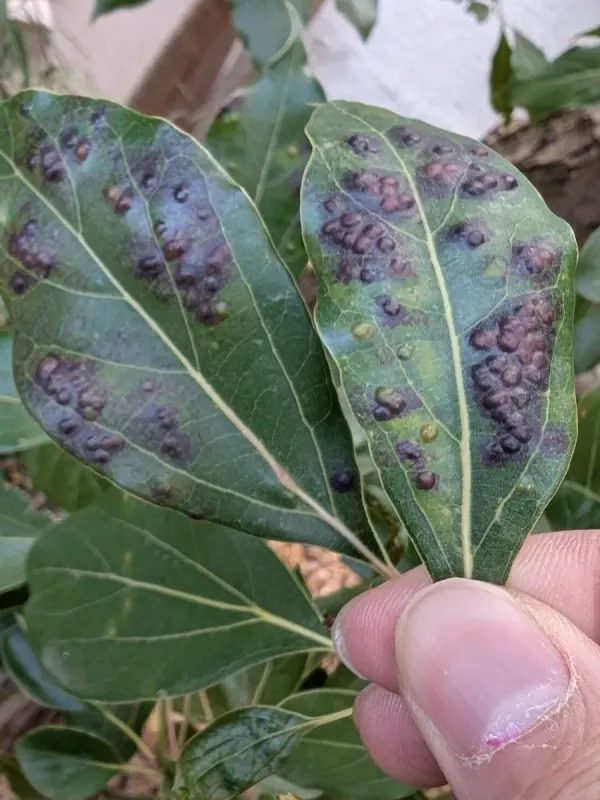
The first and most noticeable sign of infestation is the appearance of specific galls on the leaves. The leaf blade deforms, forming characteristic swellings or pustules.
Inside such galls or under the curled edges of the leaf, one can find the nymphs themselves. With careful inspection, the waxy fluff they secrete can be seen.
A sticky secretion, honeydew, often accumulates on the leaf surface as a byproduct of the plant louse's life activity. This substance attracts ants and promotes the growth of sooty mold.
Leaves affected by the pest often change color, acquiring a yellowish hue or chlorotic spots due to the disruption of the photosynthesis process.
During mass infestations, the crown looks curled and depressed, which sharply reduces the aesthetic appeal of the tree in urban plantings.
Control measures
The basis of control is regular monitoring of the condition of plantings and timely sanitary pruning of damaged branches where nymphs are located.
In cases of high pest populations, systemic insecticides are applied. They penetrate the plant's tissues, which effectively eliminates the hidden individuals.
It is recommended to use preparations based on neonicotinoids or organophosphorus compounds, while adhering to safety regulations for the environment.
It is important to carry out treatments in the early morning or evening hours when the pests are most active and less susceptible to direct sunlight.
- Preventive treatment before bud break.
- Attracting natural entomophages (predatory insects).
- Use of biological preparations during the flowering period.
Taxonomy
- Latin name
- Trioza camphorae
- Order
- Hemiptera (bugs, aphids, leafhoppers)
- Family
- Triozidae
- EPPO code
- TRIZCA
Discussion
No discussions yet — be the first.