
African citrus triozid
Trioza bussei
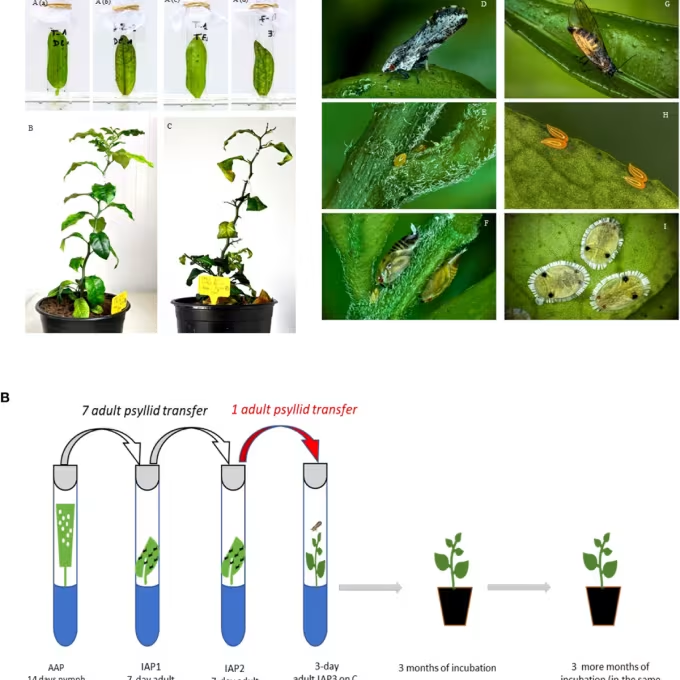
Description
How to identify
The African citrus triozid (Trioza bussei) is a small insect belonging to the Triozidae family within the order Hemiptera. These insects are closely related to other psyllids that affect woody plants.
Adults are small, winged insects capable of flying short distances to colonize new citrus hosts, particularly those in a flush of active growth.
The life cycle progresses through several nymphal stages before reaching adulthood. Nymphs are sedentary and primarily feed on the undersides of young leaves.
Environmental factors, especially temperature and the availability of tender foliage, significantly influence the reproductive rate of this species throughout the year.
Due to their small size and cryptic behavior, identifying them in the field requires close inspection of tender shoots and leaves under magnification.
What it damages
This pest specifically targets citrus species, causing significant stress to both commercial groves and nursery stock.
The primary damage occurs when nymphs feed on tender plant tissues, extracting sap and injecting saliva that alters plant cell development.
Feeding activity leads to distorted, curled, and galled leaves, which reduces the total leaf surface area available for photosynthesis.
In addition to direct physiological damage, the weakening of the tree makes it more susceptible to secondary environmental stresses and potential pathogens.
Heavy infestations result in stunted growth of young trees, delayed maturity, and a potential reduction in overall fruit quality and yield.
Signs of infestation
Visible curling and distortion of new leaves are the most characteristic symptoms indicating an infestation by this psyllid species.
Chlorotic spots or localized yellowing on leaves often appear at the sites where nymphs are actively feeding on the phloem.
The presence of honeydew secreted by the nymphs often leads to the development of sooty mold, which coats the leaves and further inhibits gas exchange.
Stunted growth of apical shoots is commonly observed, as the plant redirects energy to cope with the stress caused by the feeding insects.
Inspecting the underside of newly emerged leaves reveals the presence of settled nymphs and their cast skins, providing definitive evidence of colonization.
Control measures
Effective management of the African citrus triozid relies on an integrated pest management (IPM) strategy to maintain populations below economic thresholds.
Chemical control involving systemic insecticides is often used to reach nymphs that are protected by distorted leaf tissues during their development.
Biological control, utilizing beneficial predatory insects and parasitoids, plays a crucial role in suppressing populations in integrated systems.
Cultural practices, such as pruning infected shoots and optimizing fertilization to avoid prolonged succulent growth, help mitigate the severity of attacks.
- Deploying yellow sticky traps for population monitoring.
- Removing and destroying heavily infested branches.
- Applying targeted systemic insecticides.
- Encouraging populations of natural predators such as ladybirds and lacewings.
Taxonomy
- Latin name
- Trioza bussei
- Order
- Hemiptera (bugs, aphids, leafhoppers)
- Family
- Triozidae
- EPPO code
- TRIZBS
Discussion
No discussions yet — be the first.