
Laurel sucker
Trioza ata
Description
How to identify
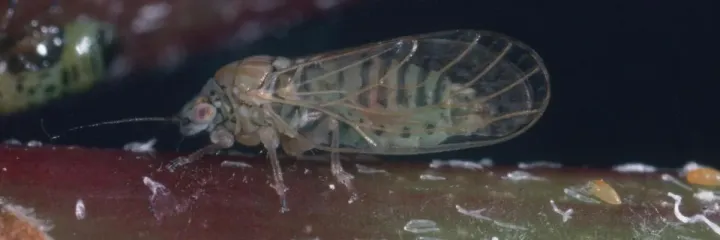
The laurel sucker (Trioza alacris), also known as the bay sucker, is a tiny sap-sucking insect belonging to the family Triozidae. These insects are closely related to psyllids and are highly specialized pests that feed on Laurus nobilis.
Adult laurel suckers are approximately 3-4 mm long and possess transparent wings, often appearing pale green or yellowish. They are highly mobile and tend to fly off when disturbed, making detection difficult during early stages.
The lifecycle begins with eggs deposited on the underside of young, succulent leaves. Once hatched, the nymphs begin to feed, causing the plant to respond by forming protective galls around them.
These insects thrive in environments where bay trees grow vigorously, particularly during spring and summer months when tender new foliage is abundant and available for colonization.
The population can expand rapidly if left unchecked, especially in greenhouse conditions where natural predators are absent and environmental factors are controlled to favor insect reproduction.
What it damages
The damage caused by the laurel sucker is primarily cosmetic and physiological. By feeding on the phloem of young shoots, they remove vital nutrients and inject substances that trigger abnormal tissue growth.
The most visible form of injury is the curling of leaf margins, which creates a protective pocket for the developing nymphs. These deformed leaves lose their natural flat shape and structural integrity.
Severely infested bay trees may show stunted growth, as the plant directs resources towards repairing damaged tissues rather than structural development and foliage production.
In addition to physical distortion, the insects secrete honeydew, a sugary substance that coats the leaves. This serves as a substrate for sooty mold, which inhibits photosynthesis and gives the plant an unkempt, black appearance.
While the pest rarely kills an established tree, persistent infestations drastically reduce the quality of the laurel foliage, rendering it unsuitable for culinary use or decorative display.
Signs of infestation
The hallmark sign of a laurel sucker infestation is the distinctive curling and thickening of leaf edges, often referred to as "leaf-rolling." The leaves often curl downward, creating a chamber.
Inside these rolled edges, one can observe small, flat, often yellowish or translucent nymphs. These nymphs are usually covered in a waxy, white secretion that helps protect them from external elements.
Yellow or brownish discolored spots often appear along the margins of the leaves where the nymphs are actively feeding. Over time, these spots can turn necrotic if the infestation is severe.
The presence of sticky honeydew on the foliage and branches is a clear indicator of a pest issue. This sticky residue often attracts ants and facilitates the growth of black sooty mold fungus.
As the season progresses, one may notice premature leaf drop or the failure of terminal buds to develop properly, leading to an irregular and sparse canopy appearance.
Control measures
Effective management of the laurel sucker involves early identification and a combination of physical, chemical, and biological control strategies to prevent population explosions.
Pruning is the most effective manual method. By cutting off and destroying the infested, curled leaves early in the season, gardeners can remove a large portion of the next generation of nymphs.
For chemical control, systemic insecticides are the most effective choice. Because the nymphs are protected inside the curled leaves, contact sprays often fail, while systemic products are absorbed by the plant and ingested by the pests.
Biological control can be implemented in protected environments by introducing natural predators like lacewings or ladybirds, which are known to feed on psyllid nymphs.
- Regular inspection of new shoots during the spring growth flush.
- Manual removal and disposal of distorted leaves before nymphs mature.
- Application of systemic insecticides (e.g., acetamiprid) during active infestation.
- Promotion of natural biodiversity to attract beneficial predatory insects.
- Ensuring healthy growing conditions to improve the plant's natural resistance.
Taxonomy
- Latin name
- Trioza ata
- Order
- Hemiptera (bugs, aphids, leafhoppers)
- Family
- Triozidae
- EPPO code
- TRIZAT
Discussion
No discussions yet — be the first.