
Carrot psyllid
Trioza apicalis
Description
How to identify
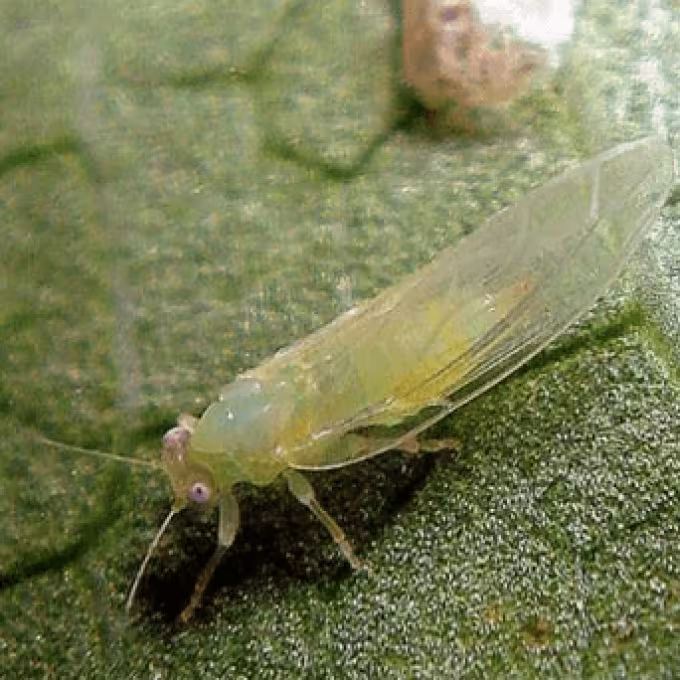
The carrot psyllid (Trioza apicalis) is a small jumping insect belonging to the Triozidae family. The adult psyllid measures about 3–4 mm in length and possesses transparent wings, with a body color that shifts from greenish to brownish as the season progresses.
Adult psyllids overwinter primarily on coniferous trees, such as spruce or pine. As soon as temperatures reach 10–12 degrees Celsius in early spring, they migrate to their primary host crops, specifically those in the Apiaceae family.
The insects are highly mobile and use their strong hind legs to jump. They disperse across fields in search of young carrot plants, where they begin feeding and laying eggs, initiating the reproductive cycle.
The nymphs are flat, yellowish-green, and typically settle on the undersides of the leaves. They undergo five developmental stages, continuously feeding on plant sap throughout their nymphal growth.
Typically, only one generation of the carrot psyllid develops per year. The peak migration period coincides with the emergence of carrot seedlings, making young plants the most susceptible to infestation.
What it damages
The carrot psyllid is a specialist pest, primarily targeting cultivated carrots. However, if host plants are limited, it can also infest related species such as celery, parsley, dill, and parsnip, particularly when they are planted nearby.
The most significant damage occurs when the plants are in the 2- to 4-leaf stage. During this vulnerable period, heavy infestation can stunt growth permanently or cause the collapse of entire rows of seedlings.
As the psyllids feed, they inject toxic salivary secretions into the plant tissues. This causes profound physiological stress, leading to a breakdown in the plant's metabolic functions and overall development.
Affected carrots often develop stunted, woody, and deformed root structures. These roots are not only poor in flavor but also lack the commercial quality required for fresh market sales or long-term storage.
Severe infestations often result in reduced plant stands, causing significant yield losses. In many cases, farmers are forced to replant fields if the infestation occurs early in the growing season.
Signs of infestation
The most distinctive symptom of a carrot psyllid infestation is "curling" or "gophering" of the leaves. The foliage loses its natural shape, becomes brittle, and often turns yellow, red, or purple, mimicking symptoms of nutritional deficiency or virus infection.
A closer inspection of the underside of the leaves usually reveals colonies of nymphs. They remain relatively sedentary and are often covered by a waxy substance, making them appear like small, scale-like spots on the foliage.
Infected plants show stunted height compared to healthy ones. The leaves often form a dense, bushy rosette that inhibits normal growth, which is a classic indicator of psyllid-induced physiological change.
In extreme cases, the growing tip may die entirely. This can cause the plant to produce numerous lateral roots on the main carrot, giving the root a "hairy" appearance that renders it unsaleable.
Widespread yellowing of the carrot tops across a field is a sign of high pest pressure. If not managed immediately, this leads to significant loss of biomass and potential failure of the carrot crop.
Control measures
Integrated Pest Management for the carrot psyllid begins with cultural practices. Avoiding planting carrots near coniferous windbreaks and maintaining strict weed control around the fields can help reduce initial infestation levels.
For organic growers or small-scale plots, covering carrot beds with lightweight row covers or insect netting immediately after sowing is highly effective at physically preventing adult psyllids from reaching the young plants.
Chemical control involves the use of systemic or contact insecticides when adult migration is at its peak. It is crucial to monitor field populations carefully to time the applications for maximum efficacy against the adults.
- Using yellow sticky traps to monitor the timing and density of adult migration.
- Prioritizing early sowing to ensure plants reach a more mature stage before peak infestation.
- Removing crop debris and weeds from the Apiaceae family to eliminate potential alternate hosts.
Biological control methods, such as utilizing entomopathogenic fungi or predators like lacewings, can support a balanced ecosystem, although they are generally less reliable than integrated chemical and physical barriers under high-pressure scenarios.
Taxonomy
- Latin name
- Trioza apicalis
- Order
- Hemiptera (bugs, aphids, leafhoppers)
- Family
- Triozidae
- EPPO code
- TRIZAP
Discussion
No discussions yet — be the first.