
Joro spider
Trichonephila clavata
Description
How to identify
The Joro spider (Trichonephila clavata) belongs to the orb-weaver family and is known for its distinct golden silk and impressive physical characteristics.
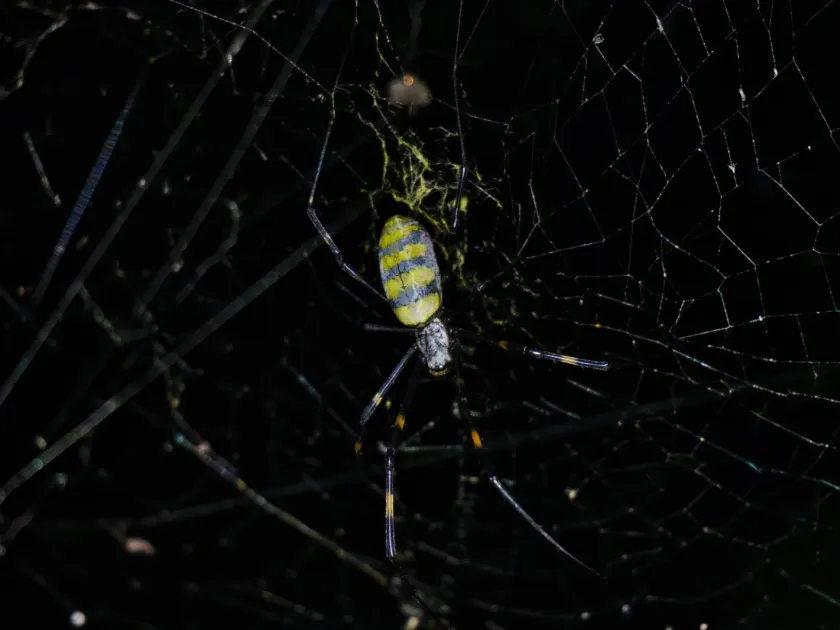
Female Joro spiders are significantly larger than males and feature a striking yellow and blue-black color pattern with red markings on the abdomen, making them easily identifiable.
Males are much smaller and usually brown, often residing near the edges of the female's massive web rather than constructing their own large traps.
The webs are multi-layered and exhibit a unique golden sheen, especially visible when sunlight hits the high-tensile silk strands.
As an invasive species, they utilize "ballooning," where young spiders use silk threads to travel on wind currents, allowing for rapid geographic expansion.
What it damages
The primary concern for agriculture is the disruption of local ecosystems, particularly by capturing beneficial pollinators such as honeybees and native bees.
Large, sticky webs draped over fruit trees or vines can block essential sunlight, which may slightly reduce the photosynthetic efficiency of the plant leaves.
In nursery environments, the weight of the webs and debris trapped within them can cause physical distortion to young, fragile stems and shoots.
The presence of dense webs can interfere with routine maintenance tasks, such as pruning, thinning, and harvesting, thereby increasing labor costs.
Additionally, the aesthetic appeal of ornamental or produce crops is diminished by the heavy accumulation of webs, leaves, and insect debris.
When it appears
The Joro spider's lifecycle begins with egg hatching in the spring, typically as temperatures begin to consistently rise throughout the region.
Throughout the summer, the spiders grow rapidly, expanding their webs to capture an increasing number of flying insects for their diet.
By late summer and early autumn, the spiders reach full maturity, and the webs reach their maximum size and structural complexity on trees and fences.
With the onset of late autumn frosts, adult spiders die, but they leave behind resilient egg sacs that protect the next generation throughout the winter.
Field scouting for Joro spiders is most productive during the autumn months when the large, golden webs are most conspicuous against the changing foliage.
Signs of infestation
The most immediate indicator is the presence of large, orb-shaped webs that often span between adjacent trees, bushes, or utility structures.
Evidence of a Joro spider infestation includes a high density of insect remains, particularly beneficial flying insects, caught within the golden threads.
The presence of large, vibrant females hanging in the center of their webs is a clear sign that the population is established in the immediate area.
Accumulation of dead leaves and organic debris trapped in the webs provides a cluttered appearance, indicating long-term spider presence.
Observation of egg sacs—small, silken, beige or brownish bumps—attached to sheltered branches or undersides of structures confirms reproduction.
Control measures
Mechanical removal is the safest and most recommended method: use a long pole or brush to tear down webs and dispose of the spiders manually.
During the dormant season, inspect trees and structures for egg sacs and remove them to significantly reduce the population for the following year.
Regular pruning and maintenance of tree canopies can make the environment less suitable for large-scale web construction by these spiders.
Avoid broad-spectrum insecticides, as these will kill beneficial predators and pollinators, often exacerbating other pest issues in the garden.
For high-value agricultural crops, keep the area around the plants clear of tall weeds and debris, which serves as a foundation for web attachment.
Taxonomy
- Latin name
- Trichonephila clavata
- Family
- Araneidae
- EPPO code
- NEPLCV
Discussion
No discussions yet — be the first.