
Aculepeira armida
Aculepeira armida
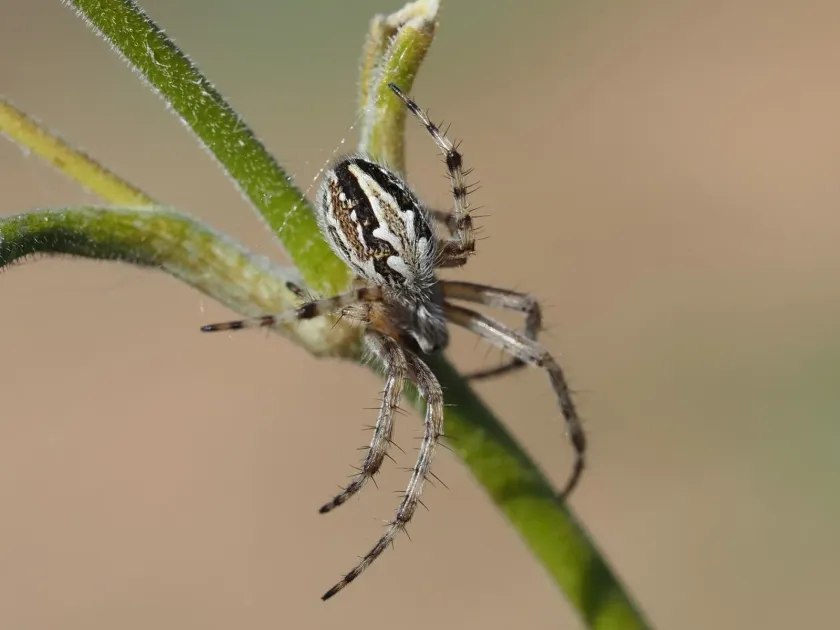
Description
How to identify
Aculepeira armida belongs to the orb-weaver spider family (Araneidae). This species is a typical representative of spiders that spin classic radial webs.
Outwardly, this spider is distinguished by a specific pattern on the abdomen, which resembles an intricate ornament with characteristic light spots. Females are significantly larger than males, which is a typical trait for most orb-weaver species.
The biology of the species is closely related to living on tall grasses and shrubs. The spider prefers sunny, well-warmed areas, making it a frequent visitor at forest edges and neglected agricultural lands.
The life cycle includes passing through several larval stages, ending with the transformation into an adult. Spiders of this species hibernate primarily as young individuals or in cocoons in sheltered places.
It is important to understand that spiders in agroecosystems act as entomophages, but under specific conditions, their excessive activity can affect the plant's microclimate or complicate crop management.
What it damages
This species is not a direct pest of plant tissues, as it does not feed on plant sap or organs. However, its presence is classified as undesirable due to the creation of dense webs.
The main damage consists of wrapping leaves, inflorescences, and young shoots in spider silk. This leads to mechanical deformation of the plants and creates favorable conditions for the reproduction of secondary pests.
Thick webs impede normal gas exchange and photosynthesis, especially on young leaf blades. This can lead to local yellowing and stunted growth of apical shoots.
The aesthetic appearance of ornamental crops is compromised, and agrotechnical measures, such as spraying or manual harvesting, are hindered by the presence of sticky webs.
In commercial orchards and greenhouses, web accumulation can trap dust and spores of pathogenic fungi, which indirectly increases the risk of plant diseases in high humidity conditions.
When it appears
The active life cycle of Aculepeira armida begins in late spring when the air temperature stays consistently above 15 degrees Celsius.
The peak of web spinning occurs in mid-summer, when there is a maximum number of insect prey that makes up this predator's diet.
Mating occurs in late summer and early autumn, after which the females lay cocoons. During this period, spider activity increases significantly, leading to the appearance of new webs.
With the arrival of the first frosts, activity drops sharply, and most adults die. Hibernation takes place in hidden spots, such as under bark or in plant debris.
Regular monitoring of the site in June and July allows for timely detection of the start of mass infestation and prevents the webbing of the entire planting area.
Signs of infestation
The first sign of Aculepeira armida appearing on the site is the discovery of characteristic radial webs between shrub branches or high stems of herbaceous plants.
The presence of whitish, sticky threads visible in the sunlight indicates the spider's location. A female can often be seen in the center of the web, waiting for prey.
Curling or deformation of young leaves that have been "pulled together" by spider silk is a clear visual signal of the pest's presence in that area.
When inspecting plants, one can notice the remnants of chitinous shells of insects caught in the web, which confirms the predator's activity in that specific spot.
In the early morning hours, the presence of dew on the webs makes them clearly visible even at great distances, which simplifies the identification of their locations.
Control measures
The most effective control method is an agrotechnical approach: regular site cleaning of weeds and dry plant debris, where spiders find shelter.
Mechanical removal of webs using garden tools or a high-pressure water spray allows for quick cleaning of plants without the use of chemical agents.
In case of a critical population surge, it is recommended to use environmentally safe products aimed at suppressing the number of insects that the spider feeds on.
Organizing proper ventilation in greenhouses and sparse planting of crops reduce the attractiveness of conditions for this species to spin webs.
- Regular sanitary pruning of dense branches;
- Weed control around garden beds;
- Manual collection of cocoons in winter;
- Maintaining proper irrigation to prevent high humidity.
Taxonomy
- Latin name
- Aculepeira armida
- Family
- Araneidae
- EPPO code
- ACUEAR
Discussion
No discussions yet — be the first.