
Hawthorn sawfly
Trichiosoma tibiale
Description
How to identify
The hawthorn sawfly, scientifically known as Trichiosoma tibiale, is a member of the Cimbicidae family of sawflies. Adult insects are relatively large and display Batesian mimicry by resembling bumblebees.
The body is robust and covered in dense, dark hair. Their wings are clear with specific venation patterns typical for this family of Hymenoptera, which are easily observable under close inspection.
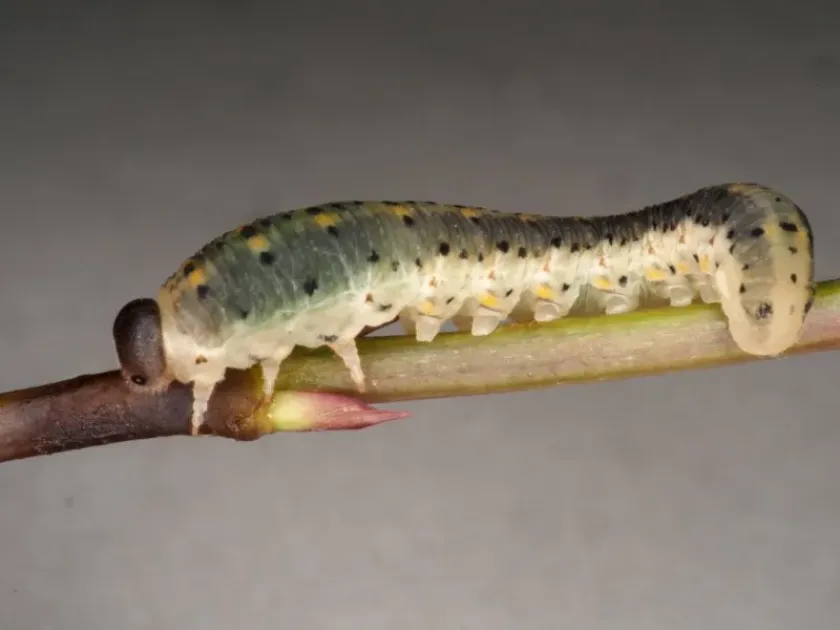
The larvae, often referred to as false caterpillars, are cylindrical in shape. They possess a remarkable ability to curl into a spiral position when they feel threatened by predators.
Larval coloration is typically light green with a whitish bloom, providing excellent camouflage against the foliage of host trees. The head capsule is well-developed with strong mandibles.
Pupation occurs within a tough, parchment-like cocoon. These cocoons are attached firmly to tree branches or twigs, providing protection from harsh environmental conditions and predators.
What it damages
As the name suggests, the hawthorn sawfly primarily feeds on hawthorn trees. However, it also frequently targets various rosaceous fruit trees in orchards and domestic gardens.
Commonly affected fruit trees include apple, pear, plum, and bird cherry. The damage is caused exclusively by the feeding larvae, which are known to be quite destructive.
Young larvae typically start by skeletonizing leaves, consuming the soft tissue between the leaf veins. As they grow, they proceed to consume the entire leaf lamina.
In cases of heavy infestation, the pest can defoliate entire trees. This results in significant stress for the plant, hindering its ability to perform photosynthesis effectively.
Secondary effects of damage include reduced winter hardiness and weakened overall health. Affected trees may show a decline in fruit yield and be more susceptible to secondary diseases.
When it appears
Adult emergence typically occurs in late spring, usually around May or June. This timing aligns with the period of active vegetative growth for most deciduous trees.
Females deposit eggs by sawing into the leaf tissue, generally on the underside or edges. The embryonic development phase lasts for about two weeks.
The larval stage, characterized by high feeding activity, peaks during the summer months. This is when the larvae accumulate the nutrients required for their metamorphosis.
The species completes only one generation per year, making the seasonal window for observation and control relatively predictable for gardeners and arborists.
The overwintering phase takes place as a prepupa within the protective cocoon. This strategy allows the insect to endure winter temperatures until the following spring.
Signs of infestation
The most obvious sign of infestation is the presence of eaten leaves. The damage pattern ranges from small holes to completely stripped leaves with only major veins remaining.
Searching for the characteristic brownish, oval-shaped cocoons on the branches is an effective way to detect the presence of this pest during the dormant season.
Visible excrement pellets on the leaves beneath the feeding areas provide a clear indication of larval activity. This can often lead to the soiling of the tree foliage.
Significant leaf loss or premature yellowing of the canopy can occur during heavy infestations. The tree often appears sparse and visibly stressed by mid-summer.
Upon tapping branches, one might notice larvae hanging from threads or dropping to the ground, which is a common defensive response for this species.
Control measures
Cultural control involves systematic inspection of trees during pruning. Removing and destroying the cocoons found on branches significantly lowers the population.
Tilling the soil under the tree canopy in the autumn can disturb potential pupation sites. This practice helps to reduce the number of insects emerging in the next season.
Biological control methods include fostering environments for insectivorous birds and predatory insects, which can help keep the sawfly population in check naturally.
Chemical intervention should be considered only when the infestation level is high and poses a direct threat to the tree's health using targeted insecticides.
- Pruning infested branches during the dormant period.
- Encouraging natural predators within the orchard.
- Monitoring the onset of egg-laying to time any control measures effectively.
Taxonomy
- Latin name
- Trichiosoma tibiale
- Order
- Hymenoptera
- Family
- Cimbicidae
- EPPO code
- TCSMTI
Discussion
No discussions yet — be the first.