
Birch sawfly
Trichiosoma lucorum
Description
How to identify
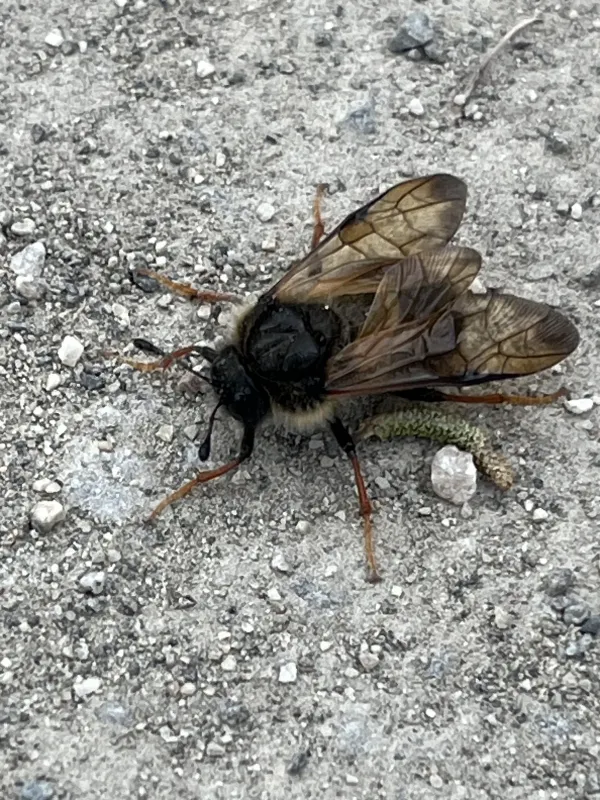
The birch sawfly (scientific name Trichiosoma lucorum) belongs to the family Cimbicidae. It is a large, hymenopterous insect that resembles a hornet or bumblebee in appearance, reaching a body length of up to 25 millimeters.
The adult insect is easily recognized by its club-shaped antennae, which is a characteristic feature of its family. The body is typically robust, colored black with yellow or reddish markings on the abdomen, and it has clear, membranous wings.
The larvae, often referred to as false caterpillars, are yellowish-green with distinct transverse folds along their bodies. They possess a well-defined head with strong mouthparts, which they use for feeding on plant foliage.
Distinguishing them from true moth caterpillars, these larvae have several pairs of prolegs, allowing them to cling tightly to birch leaves. When threatened or resting, they typically curl into a S-shape or a coil.
Pupation occurs within dense, brown, barrel-shaped cocoons. These cocoons are typically attached securely to twigs or branches, serving as a protective casing during the overwintering stage of the insect's development.
What it damages
The primary host for Trichiosoma lucorum is the birch tree, particularly the silver and downy birch. It is a significant pest in woodland areas, public parks, and forest plantations where birch is a dominant species.
While birch is their preferred host, larvae can also feed on the foliage of alder and willow trees. When populations are high, they may strip entire branches of their foliage, leading to severe tree stress.
Young larvae feed by creating small holes in the leaf blades, but as they grow, they consume the entire leaf, leaving only the primary veins. This process, known as skeletonization, significantly reduces the tree's photosynthetic capacity.
Severe infestations result in extensive defoliation by mid-summer. This loss of canopy cover weakens the tree, making it susceptible to drought, subsequent pest attacks, and wood-decaying fungal pathogens.
Repeated yearly defoliation can cause dieback of the crown and, in extreme cases, the total death of the tree, representing a major concern for silviculture and urban forestry management.
When it appears
Adult sawflies emerge in the spring, typically around May or June, once temperatures are sufficiently high. During this time, they feed on nectar and mate before the females seek suitable host trees.
Females use their serrated ovipositor to cut slits into the leaf epidermis and deposit their eggs. The incubation period lasts for approximately one to two weeks, depending on ambient temperature conditions.
Larvae are active throughout the early summer months. They undergo several molts during their development, with the most significant damage occurring during the final larval stages when their appetite is at its peak.
By late summer, the larvae finish feeding, seek a site on the branches, and construct their cocoons. The insect remains inside the cocoon through the autumn and winter as a pupa or pre-pupal stage.
The life cycle is univoltine, meaning there is only one generation per year. This synchronized development with the leafing of the birch tree ensures the larvae emerge when food is most abundant.
Signs of infestation
Initial signs of an infestation include the appearance of irregular holes within the leaf tissues, indicating the presence of young, feeding larvae on the underside of the canopy.
The presence of larvae themselves, often seen curled on the edges of leaves, is the most diagnostic feature. They are generally gregarious when young, meaning they stay in groups on specific branches.
A heavy accumulation of frass (larval excrement) on the leaves or falling to the ground beneath the tree serves as a clear indication of a large, active population of feeding sawfly larvae.
Observing the brown, barrel-shaped cocoons on the branches during the winter months is a reliable way to assess the potential population level for the upcoming spring season.
Noticeable yellowing, browning, and premature dropping of foliage during the summer months, in the absence of obvious disease symptoms, strongly point to an infestation by this sawfly.
Control measures
Mechanical control is effective in small areas or on individual trees; it involves manual removal and destruction of the cocoons from the branches during the winter when they are dormant.
Early intervention is crucial, so hand-picking larvae during the initial stages of the infestation can significantly reduce the potential for widespread damage to the tree's canopy.
Biological control using Bacillus thuringiensis, a specialized bacterial pathogen, can be applied to target the larvae. This method is highly effective while remaining safe for non-target beneficial insects.
Chemical control with insecticides is generally reserved for severe outbreaks where tree survival is at risk. Applications should be timed carefully to match the larval feeding stage for maximum efficacy.
Maintaining a healthy ecosystem by encouraging natural predators, such as birds, parasitic wasps, and predatory beetles, is the best long-term strategy for preventing population explosions of the birch sawfly.
Taxonomy
- Latin name
- Trichiosoma lucorum
- Order
- Hymenoptera
- Family
- Cimbicidae
- EPPO code
- TCSMLU
Discussion
No discussions yet — be the first.