
Trichia
Trichia
Description
How to identify
Trichia is a genus of slime molds (myxomycetes) belonging to the class Myxogastria. These organisms are not fungi, but they share similar characteristics, moving through the environment as a mobile mass called a plasmodium.
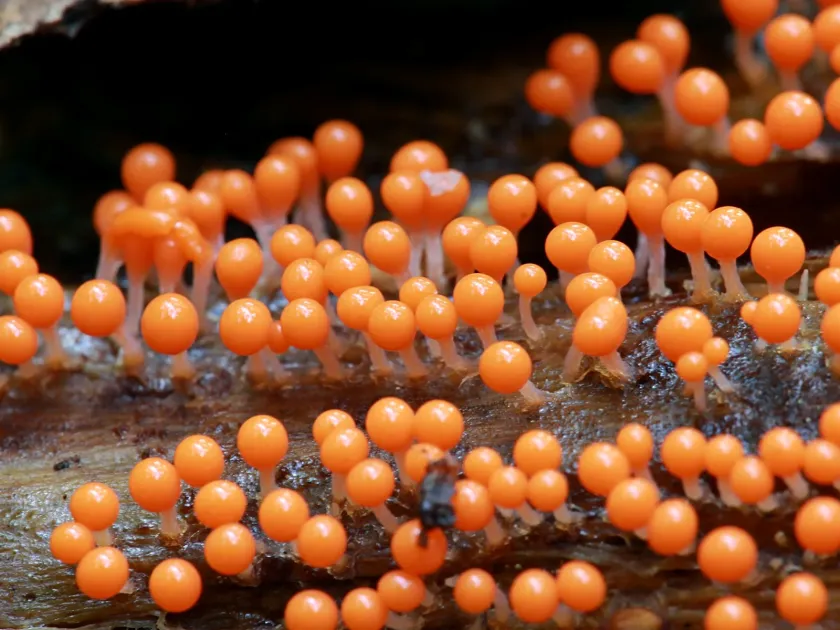
In their reproductive stage, they form small, colorful fruiting bodies (sporangia) often appearing as yellow, orange, or reddish-brown clusters on decaying organic matter.
They belong to the family Trichiidae. These organisms feed primarily on bacteria, fungal spores, and small organic particles found in damp environments.
Scientific identification requires microscopic examination of the capillitium, which contains spiral thickenings characteristic of the genus Trichia.
They spread through microscopic spores that can be carried by wind or water, allowing them to colonize damp garden beds or greenhouses rapidly.
What it damages
Trichia is generally saprophytic, meaning it feeds on dead material; however, its presence on living plants can cause significant indirect damage.
The primary issue is the physical obstruction of plant tissues; when slime or fruiting bodies cover stems or leaves, they restrict essential processes like respiration and photosynthesis.
The moist film created by the plasmodium stage can facilitate the colonization of pathogenic bacteria and fungi, leading to secondary rots in stems.
Young seedlings are particularly vulnerable, as the slime can envelop delicate stems, leading to dampening-off and death of the young plant.
Plants affected by significant colonies often show signs of stunted growth, chlorosis, and general weakness due to the disruption of their immediate environment.
When it appears
Trichia activity is closely tied to environmental moisture levels, peaking in periods of high humidity and rainfall.
In outdoor garden settings, they are most active during the spring and summer months when weather patterns remain consistently wet.
In greenhouse environments, they can thrive throughout the year if ventilation is poor and substrate surfaces remain perpetually damp.
Autumn conditions, characterized by high dew and decaying leaf litter, often provide the ideal substrate for spore germination and colony expansion.
Temperature plays a role, with most species favoring moderate temperatures between 15°C and 25°C for optimal development.
Signs of infestation
Initial signs include the appearance of transparent, yellowish, or viscous slime patches on the soil surface or the base of plant stems.
As the organism matures, these patches harden into tiny, dusty fruiting bodies that release a fine, colored powder when disturbed.
Leaves or stems may appear covered in an unnatural film, which significantly interferes with the plant’s ability to thrive in its environment.
Stunted growth, wilting of lower leaves, and a faint musty smell in the greenhouse area are common indicators of a thriving slime mold colony.
The soil surface around affected plants often shows signs of organic accumulation that has become excessively wet and dense, supporting slime mold growth.
Control measures
The most effective strategy for managing Trichia is to adjust environmental conditions to make the habitat less suitable for slime mold survival.
- Improve ventilation in greenhouses to reduce surface moisture on plants and soil.
- Remove decomposing organic debris where slime molds typically originate and feed.
- Adjust watering schedules to ensure soil surfaces can dry out slightly between waterings.
- Maintain adequate spacing between plants to improve airflow and reduce micro-humidity levels.
Physically removing visible colonies can help manage spore counts, though it will not prevent recurrence if the humidity remains excessively high.
Chemical fungicides are generally ineffective against myxomycetes, making cultural practices and sanitation the cornerstones of successful management.
If colonization occurs on pots or trays, sanitizing these containers with a diluted bleach or copper-based solution can prevent the spread of spores to healthy crops.
Taxonomy
- Latin name
- Trichia
- Order
- Molluscs
- Family
- Hygromiidae
- EPPO code
- TRHISP
Discussion
No discussions yet — be the first.