
Tremex fuscicornis
Tremex fuscicornis
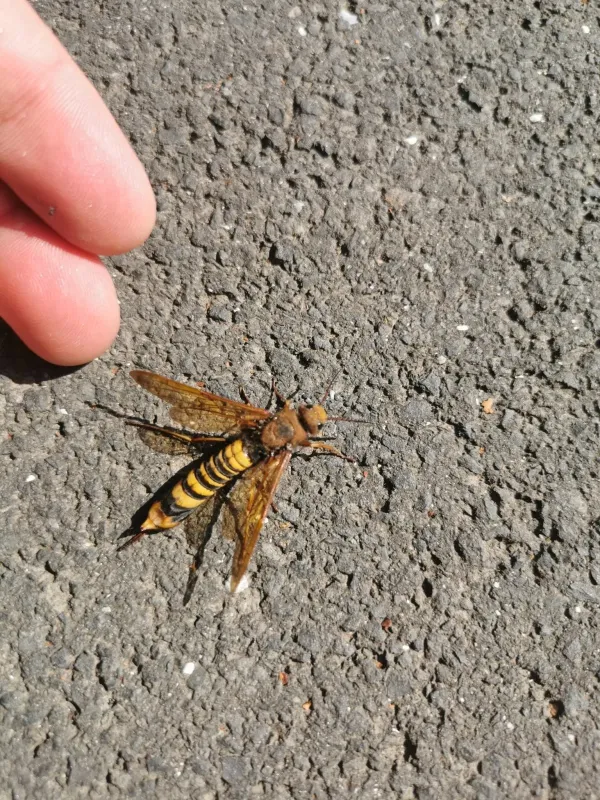
Description
How to identify
Tremex fuscicornis, commonly known as a type of wood wasp, belongs to the family Siricidae within the order Hymenoptera. This large insect is easily recognized by its distinctive body shape and size.
Adult females reach a length of 25 to 40 millimeters, exhibiting a dark brownish to black coloration with yellow markings on the abdomen. They possess a long, needle-like ovipositor used for egg-laying.
The males are generally smaller than females and show a lighter, rusty-brown appearance. They lack the long ovipositor but feature a horn-like process at the tip of the abdomen, which is a characteristic trait of the family.
The larvae are cylindrical, creamy-white in color, and possess a well-developed head capsule. A small, dark spine is located at the posterior end of the larvae, aiding their movement through wood tunnels.
These insects are highly specialized in their ability to bore through dense wood. Their physical structure is evolutionarily adapted to penetrate bark and sapwood to ensure the survival of their offspring.
What it damages
Tremex fuscicornis is a significant wood-boring pest, primarily targeting hardwood species such as poplar, willow, birch, elm, and various fruit trees. It favors weakened or dying timber.
The larvae tunnel deep into the xylem of the tree, creating complex galleries. This activity disrupts the vascular system, significantly impeding the transport of water and nutrients throughout the tree.
Trees affected by this pest suffer from internal structural degradation. The wood becomes brittle, and the tunnels act as entry points for wood-rotting fungi, which further accelerate the decay of the tree.
Economic losses in the timber industry are significant because wood riddled with larval galleries is downgraded or deemed unsuitable for commercial use, furniture, or construction purposes.
In ornamental and urban forestry, severe infestations lead to the decline and eventual death of valuable trees, posing a safety risk if the structural integrity of the trunk is compromised.
When it appears
The flight period of adult wood wasps typically occurs during the summer months, specifically June and July. During this time, they actively mate and search for suitable host trees.
Females use their ovipositors to drill through the bark and deposit eggs directly into the wood. The process is lengthy, ensuring the eggs are placed deep enough for larvae to thrive in a protected environment.
Larval development is a multi-year process, often taking one or two years depending on the ambient temperature and the health status of the host tree. They remain hidden within the tree throughout this stage.
Pupation occurs inside the wood in specially constructed chambers. Once the adult stage is reached, the insect gnaws a circular exit hole through the bark to emerge and start the cycle anew.
Seasonal weather patterns play a crucial role in the timing of their emergence and the overall success of the larval development, making population dynamics variable by region.
Signs of infestation
The most prominent sign of an infestation is the presence of perfectly circular exit holes on the tree bark, measuring approximately 5 to 8 millimeters in diameter.
Close inspection of the trunk may reveal small, clustered puncture marks left by the female's ovipositor, which indicate that the tree has been used as a site for egg deposition.
Frass, or wood dust, is often found at the base of the tree or in bark crevices. This is the waste material expelled by the larvae as they create their galleries deep within the wood.
Visible decline in the tree's canopy, such as premature yellowing of leaves or twig dieback, serves as a secondary indicator that the internal tissues have been severely damaged by larval activity.
In cases of heavy infestation, tapping the trunk can reveal hollow spaces inside, accompanied by a sound distinct from the solid, resonant thud of a healthy, non-infested tree.
Control measures
Effective management starts with rigorous forest sanitation. Removing and destroying infested or dead timber prevents the emergence of adults and the spread of the population to healthy trees.
Storing freshly cut logs near healthy forest stands should be avoided during the peak flight season, as the odor of fresh wood acts as a powerful attractant for female wood wasps.
The use of trap trees, which are left specifically to attract females during the egg-laying period and then removed and burned, is a proven method for reducing local pest numbers.
Chemical control via systemic insecticides may be applied to tree trunks during the adult flight period, although it has limited success once the larvae are established deep inside the timber.
Biological control methods, such as encouraging the presence of natural parasitoids (e.g., ichneumonid wasps), play a vital role in maintaining ecological balance and suppressing wood wasp populations.
Taxonomy
- Latin name
- Tremex fuscicornis
- Order
- Hymenoptera
- Family
- Siricidae
- EPPO code
- TREXFU
Discussion
No discussions yet — be the first.