
Pigeon tremex
Tremex columba
Description
How to identify
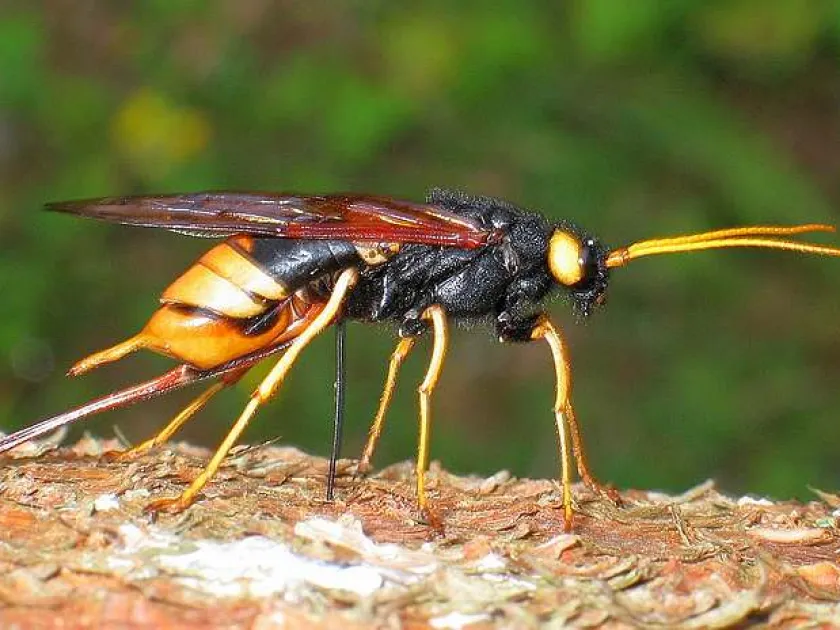
The Pigeon Tremex (Tremex columba) is a large species of horntail or wood wasp belonging to the family Siricidae. Adult females are quite distinctive, reaching 40–50 mm in length, with a black and yellow cylindrical body.
The male of the species is generally smaller, usually around 30 mm, and is characterized by a darker, brownish-black coloration. Both sexes are recognizable by their robust appearance and the horntail-like projection at the end of the abdomen.
The larvae are creamy-white, legless grubs with a small, spine-like appendage at the rear. They possess powerful mandibles adapted for boring deep into woody tissues.
Taxonomically, this insect belongs to the order Hymenoptera, sharing characteristics with sawflies, but it is unique due to its specialized wood-boring larval stage.
Adult females use a long, needle-like ovipositor to drill into the wood, where they deposit eggs along with symbiotic fungi that assist in breaking down the wood fiber.
What it damages
The Pigeon Tremex primarily attacks stressed, diseased, or dying broad-leaved trees, including maple, elm, apple, pear, beech, and oak species.
The damage is caused by the larvae, which tunnel through the heartwood and sapwood. These galleries weaken the structural integrity of the tree's trunk and branches.
As the larvae bore, they introduce fungi that cause white rot, further compromising the tree's health and accelerating the decay process within the wood.
While the wood wasp is often considered a secondary pest that favors already weakened trees, in instances of severe drought or environmental stress, they can infest healthier specimens.
- Reduction in timber quality and value.
- Structural damage leading to branch breakage.
- Increased susceptibility to wood-decaying fungi.
When it appears
Adults emerge during the summer months, typically from June through August, to mate and seek suitable hosts for egg-laying.
The life cycle of the Pigeon Tremex usually spans one to two years, depending heavily on the condition of the host tree and local climatic variables.
Females are attracted to trees that show signs of physiological stress, as these hosts provide an ideal environment for the development of the next generation.
Once the female selects a host, she bores into the wood to lay eggs, a process that requires considerable time and energy to complete successfully.
After the larval stage is complete, the insect pupates inside the wood, and the adult emerges by chewing a clean, circular exit hole to the surface.
Signs of infestation
The most visible sign of an infestation is the presence of perfectly circular exit holes, approximately 5–8 mm in diameter, on the bark of the host tree.
Coarse sawdust, often called frass, may be found around the base of the tree or caught in bark crevices as the larvae clear their tunnels.
General signs of tree decline, such as yellowing leaves, thinning canopy, and the dieback of upper branches, often accompany a heavy infestation.
Adults may be seen resting on the bark of trees during the day, particularly on warm, sunny afternoons when the females are actively searching for nesting sites.
Closer inspection of the bark may reveal tiny puncture marks left by the female's ovipositor during her search for the perfect spot to deposit her eggs.
Control measures
The primary control strategy involves sound forest and orchard management, specifically the timely removal and disposal of dead, dying, or stressed trees.
Avoid stacking or storing recently cut logs near healthy trees, as the fresh wood serves as an attractive breeding ground for adult wood wasps.
Maintaining tree vigor through proper watering, fertilization, and general care is the best defense against colonization by wood-boring pests.
Biological control plays a significant role in nature, as various parasitic wasps (such as Megarhyssa species) prey upon Pigeon Tremex larvae inside the wood.
Chemical treatments are generally ineffective against larvae once they have penetrated deep into the trunk, making sanitation the most reliable management tool.
Taxonomy
- Latin name
- Tremex columba
- Order
- Hymenoptera
- Family
- Siricidae
- EPPO code
- TREXCO
Discussion
No discussions yet — be the first.