
Wood wasp
Tremex
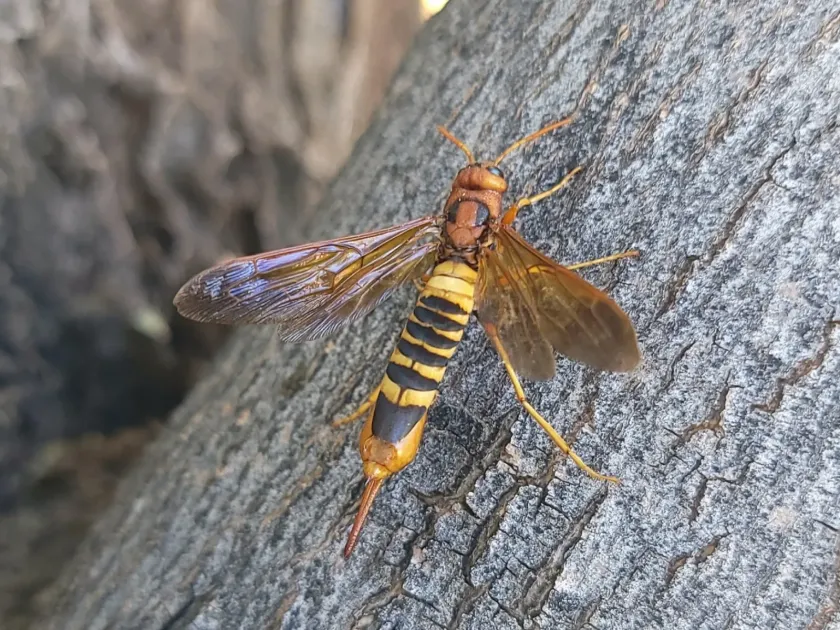
Description
How to identify
Wood wasps belong to the order Hymenoptera and the family Siricidae. The genus Tremex includes large insects with cylindrical bodies, reaching up to 40 mm in length.
Females possess a long, needle-like ovipositor covered by a sheath, which is used to insert eggs deep into the wood. Males are generally more slender, often exhibiting contrasting yellow and black markings.
The larvae are legless, whitish grubs with a distinct horn-like projection on the end of the abdomen, which distinguishes them from other wood-boring larvae like longhorn beetles.
Adult insects have powerful mandibles; however, since their primary role is reproduction, they do not feed significantly during their adult stage.
Adults are most active on warm, sunny days, frequently landing on tree trunks or stacked timber to locate suitable sites for egg-laying.
What it damages
The primary hosts for Tremex species are deciduous trees, including beech, elm, maple, birch, poplar, and oak. They infest both weakened living trees and freshly cut timber.
The damage is caused by larvae that bore long, deep galleries through the wood, which disrupts the structure and degrades the quality of timber products.
Furthermore, when depositing eggs, females introduce wood-decaying fungi spores into the tree, accelerating the rot process and structural deterioration of the wood.
Severe infestations render the wood unsuitable for construction or furniture making, as the numerous internal tunnels compromise the mechanical integrity of the material.
Heavily infested trees become highly susceptible to secondary pests, which can accelerate the decline and eventual death of the affected trees.
When it appears
The flight period for adult wood wasps typically begins in early summer and lasts until late August, depending on the local climate and temperature.
During this period, females actively search for suitable host trees, using their ovipositors to drill into the sapwood and deposit their eggs.
The larval stage develops entirely within the wood and may last anywhere from one to three years, making early detection of the pest quite difficult.
Pupation occurs just beneath the surface of the wood, allowing the emerging adults to easily chew their way out of the host tree or log.
The emergence of adults leaves behind distinct circular exit holes, which are clear indicators that the timber has been infested in previous seasons.
Signs of infestation
The most visible sign of a wood wasp infestation is the presence of perfectly circular exit holes, usually measuring 4–8 mm in diameter, on the surface of the wood.
In areas where eggs were laid, one might notice small, pin-like punctures, though these can be hard to spot amidst the natural crevices of the bark.
On living trees, signs of infestation include premature yellowing of leaves and gradual crown thinning as the larvae interfere with the tree's vascular system.
Fine wood dust (frass) accumulating around logs or on the forest floor is a reliable indicator of active larval feeding galleries within the timber.
- Circular exit holes in wood.
- Accumulation of fine wood dust.
- Crown decline and branch dieback.
- Visible oviposition punctures on the bark.
Control measures
The most effective preventive measure is the prompt removal and processing of weakened, dying, or windthrown trees, which serve as primary breeding grounds for the pest.
Quickly processing or debarking freshly cut timber prevents female wood wasps from successfully depositing eggs, as they require bark to initiate the boring process.
On timber storage sites, maintaining low humidity and using protective chemical treatments or kiln-drying processes can effectively prevent infestations.
Biological control plays a significant role, as various species of parasitic wasps naturally prey upon wood wasp larvae, helping to keep their populations in check.
Proper forest management, including maintaining diverse and healthy stands, reduces the attractiveness of trees to wood-boring insects and boosts natural resistance.
Taxonomy
- Latin name
- Tremex
- Order
- Hymenoptera
- Family
- Siricidae
- EPPO code
- TREXSP
Discussion
No discussions yet — be the first.