
Lace bugs
Tingis
Description
How to identify
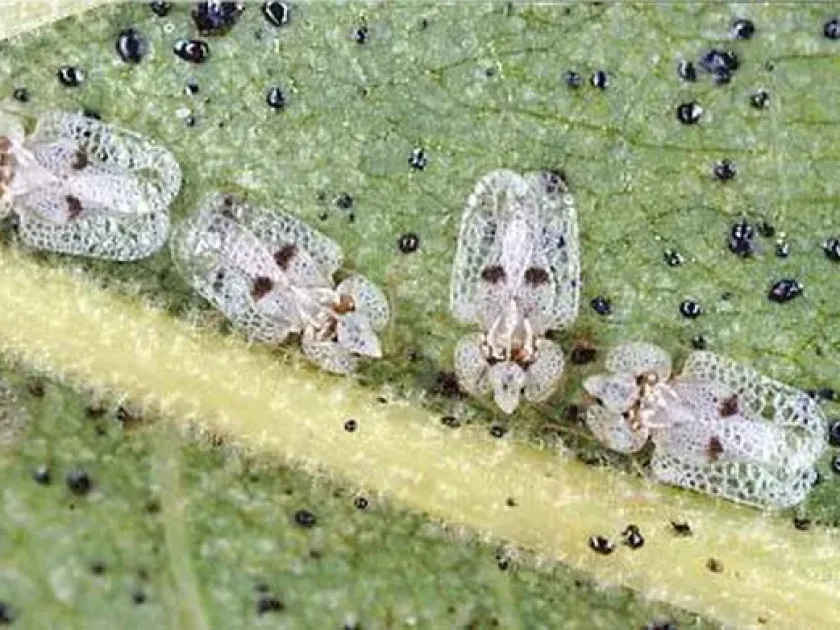
Lace bugs (genus Tingis) belong to the family Tingidae within the order Hemiptera. They are famously named for the intricate, reticulated, lace-like appearance of their wings and thoracic covers.
These are diminutive insects, typically measuring between 2 to 5 millimeters in length. Their coloration often mimics their surroundings, ranging from brown to translucent, providing excellent natural camouflage.
Lace bugs often possess elaborate spines or hood-like projections on their heads and pronotums. They lead a sedentary lifestyle and are rarely seen flying, preferring to remain stationary on the undersides of leaves.
Nymphs of the lace bug are similar to adults in general appearance but lack fully developed wings and are frequently covered in bristles or spines, which serve as a defense against potential predators.
Due to their tiny size and habit of staying hidden under foliage, infestations are often overlooked by growers until visual symptoms on the leaf surface become prominent.
What it damages
Lace bugs are polyphagous pests that affect a wide range of woody plants, shrubs, and some herbaceous crops. They use their piercing-sucking mouthparts to feed on plant sap.
Common hosts include various trees such as oak, apple, and pear, as well as popular garden shrubs like rhododendrons and hawthorn. The feeding process causes direct cellular damage.
By extracting sap, these insects destroy the photosynthetic tissues of the leaf. This disruption leads to a significant decrease in the plant's ability to produce energy, weakening its overall health.
Heavy infestations lead to widespread chlorosis, causing the leaves to turn yellow or white, eventually drying out and falling off long before the natural seasonal cycle ends.
These feeding sites are also prone to secondary infections, as the weakened plant tissue becomes susceptible to fungi and bacteria, further complicating the plant's recovery.
When it appears
The lifecycle of the lace bug is highly dependent on environmental temperature. Adults typically overwinter in protected areas, such as leaf litter, bark crevices, or loose soil.
In spring, as temperatures rise, the overwintered adults emerge, move to the host foliage, and begin the reproductive cycle. Depending on the climate, multiple generations can occur per year.
Peak population levels are usually reached during mid-to-late summer when warm conditions favor rapid egg development and nymph maturation.
By early autumn, shorter days and dropping temperatures trigger the transition of the final generation into a diapause state, signaling the move towards hibernation sites.
The duration of a single generation can be as short as a few weeks, which explains why populations can explode rapidly if not monitored during the warmer months.
Signs of infestation
The most diagnostic sign of a lace bug infestation is the development of mottled, yellowish, or whitish stippling on the upper leaf surface, resulting from the destruction of chlorophyll cells below.
On the underside of the leaves, one can usually find colonies of bugs, dark droplets of sticky excrement, and translucent cast skins left behind as the nymphs molt.
Severe infestations result in a scorched appearance of the foliage, leaf curling, and premature leaf drop. The aesthetic damage is particularly noticeable on ornamental varieties.
- Mottled or stippled leaf surfaces (chlorosis).
- Presence of tiny black spots (excrement) on leaf undersides.
- Cast nymphal skins clinging to the foliage.
- Leaf curling and early senescence.
- General loss of plant vigor and stunted growth.
Regular scouting, particularly looking at the underside of leaves throughout the summer, is the primary method for early detection and mitigation of lace bug outbreaks.
Control measures
Chemical control is often necessary for significant infestations, involving the use of systemic or contact insecticides applied during the peak emergence of nymphs.
Cultural practices play a key role in management: removing and destroying infested plant debris in the autumn significantly reduces the number of overwintering sites for the adults.
Encouraging natural predators such as lady beetles, lacewings, and pirate bugs can help keep lace bug populations below damaging thresholds in balanced ecosystems.
Maintaining plant health through adequate irrigation and nutrient management helps plants recover faster from the stress of insect feeding, improving their natural defense mechanisms.
For high-value ornamental plants, monitoring and early intervention are crucial, as significant damage to the canopy can be difficult to reverse once the growing season is well underway.
Taxonomy
- Latin name
- Tingis
- Order
- Hemiptera (bugs, aphids, leafhoppers)
- Family
- Tingidae
- EPPO code
- TINGSP
Discussion
No discussions yet — be the first.