
Davis cicada
Tibicen davisi
Description
How to identify
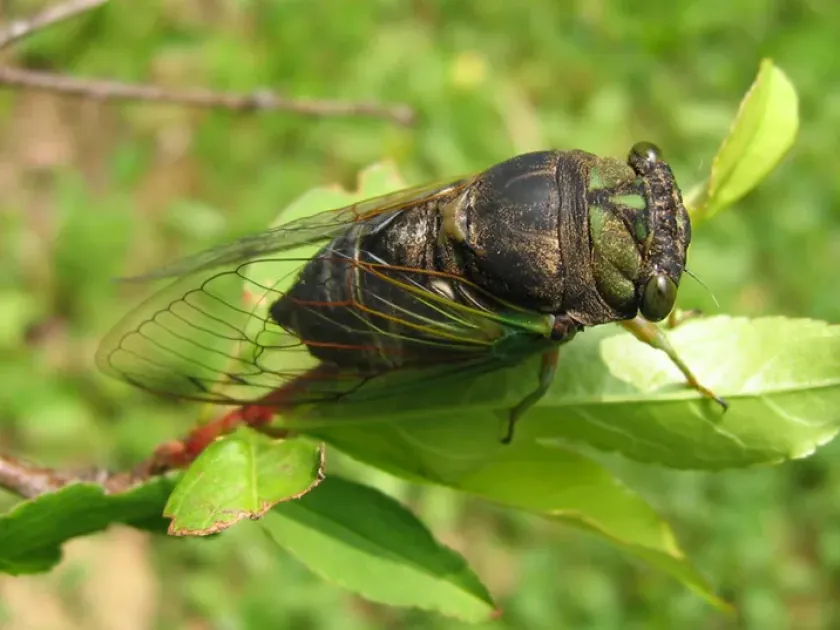
The Davis cicada (Tibicen davisi) belongs to the Cicadidae family, order Hemiptera. These insects are easily recognizable by their stout bodies and clear wings with distinct, vein-heavy patterns.
Adult males are well-known for their loud, rhythmic buzzing calls produced by specialized abdominal structures known as tymbals, used for species identification and mating.
The immature stages, known as nymphs, spend several years developing underground, feeding on the xylem sap from the roots of various woody plants.
Nymphs possess strong, fossorial (digging) front legs that allow them to navigate through compacted soil, where they spend most of their multi-year lifecycle.
When they emerge to become adults, they climb onto tree trunks to molt, leaving behind empty, brown, crusty exoskeletons that are common diagnostic features.
What it damages
Damage is caused by both nymphs feeding on roots and adult females damaging branches during oviposition (egg-laying), which can cause significant stress to trees.
Root feeding by large populations of nymphs can suppress tree growth, leading to overall decline in health and reduced nutrient uptake in young saplings.
The most visible damage occurs when females insert their sharp ovipositors into young, succulent twigs to lay eggs, causing deep longitudinal slits in the bark.
These slits weaken the branches, frequently causing them to wilt, dry out, or break off under pressure, which severely impacts the development of young orchards.
In addition to structural damage, these wounds provide entry points for secondary fungal and bacterial infections, further compromising the vitality of the host tree.
When it appears
The emergence of adult Davis cicadas typically occurs during mid-to-late summer, when soil and air temperatures reach optimal levels for their transition.
Most of the insect's lifecycle is hidden beneath the soil surface, where nymphs grow slowly over several years, making them inaccessible to surface-applied pesticides.
The adult stage is short-lived, with the primary objective of reproducing before the season ends and temperatures begin to drop in the autumn.
Weather patterns, particularly variations in moisture and temperature, can influence the timing and magnitude of cicada emergence cycles each year.
Once the adult emergence season concludes, the cycle resets as newly hatched larvae drop to the ground to begin their long underground development.
Signs of infestation
The primary auditory sign of a Davis cicada infestation is the intense, continuous buzzing noise emanating from the forest or orchard canopy during sunny hours.
Visual inspection of small branches often reveals characteristic scars or rows of ragged slits, indicating sites where female cicadas have laid their eggs.
The presence of small, circular exit holes, approximately one centimeter in diameter, in the soil near the base of trees indicates recent nymphal emergence.
Empty exuviae, or cast skins, found on the lower portions of tree trunks are definitive proof of successful molting and the presence of adult cicadas.
Branch tip flagging, where the terminal ends of twigs turn brown and die, is a common indicator of structural damage caused by oviposition sites.
Control measures
Managing Davis cicada populations focuses on cultural practices that prioritize tree health and early intervention to minimize physical damage to branches.
- Pruning and destroying infested twigs during the late summer to remove eggs before they hatch and drop to the ground.
- Maintaining healthy soil and moisture conditions to ensure trees can withstand the impact of nymphal root feeding.
- Applying insecticide treatments during the narrow window of adult emergence, if population levels threaten to cause severe orchard damage.
- Promoting local bird and predator populations, which can significantly reduce the number of adult cicadas present during the breeding season.
Since the nymphal stage is protected by the soil, chemical control is largely ineffective until the insects appear on the surface as adults.
Taxonomy
- Latin name
- Tibicen davisi
- Order
- Hemiptera (bugs, aphids, leafhoppers)
- Family
- Cicadidae
- EPPO code
- TIBCDA
Discussion
No discussions yet — be the first.