
Manna cicada
Cicada orni
Description
How to identify
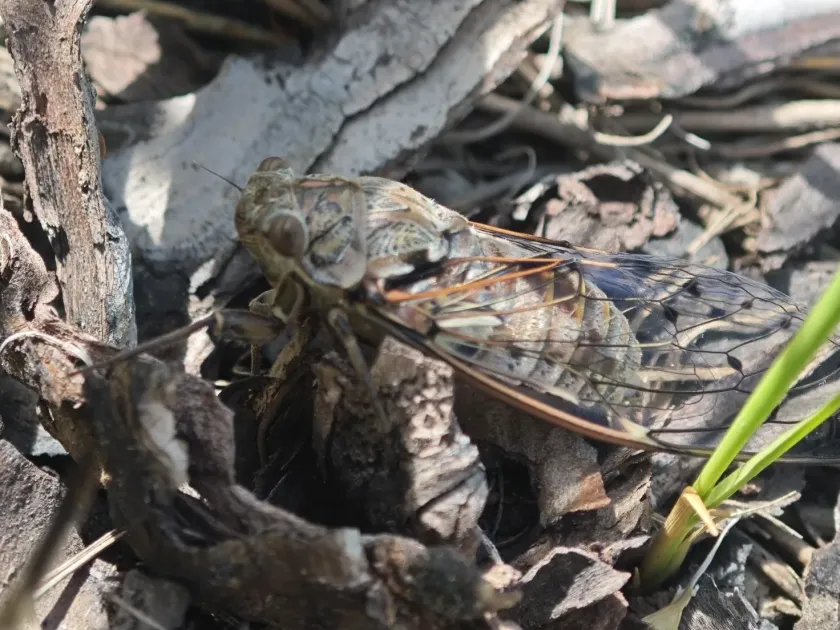
The manna cicada (Latin: Cicada orni) belongs to the order Hemiptera and the family Cicadidae. It is a large insect with a wingspan of up to 70 mm, recognized by its spotted wings and prominent, wide-set eyes.
Adults possess a robust piercing-sucking mouthpart designed for feeding on plant sap. Their bodies are protected by a thick chitinous shell, typically colored in grayish-brown shades, providing excellent camouflage against tree bark.
A key characteristic of this species is the loud, vibrating sound produced by males during the breeding season. The nymphs spend most of their life cycle underground, resembling small crustaceans with strong, digging forelimbs.
The biological development of the manna cicada is complex and prolonged, often taking several years to reach adulthood. While nymphs feed on roots below the surface, adults live for a shorter period, focused on reproduction.
Although historically native to the Mediterranean region, climate change has allowed this species to expand its range, making it a growing concern for orchards and forest management in broader areas.
What it damages
This pest primarily affects woody plants, including fruit trees like apples, pears, and peaches, as well as forest species such as ash, olive, and maple. Adults damage trees during feeding by puncturing young twigs.
Nymphs, living in the soil, feed on the tree's root system, draining vital nutrients. This causes the tree to weaken, reducing its resistance to diseases and stunting growth throughout the growing season.
Female cicadas cause significant damage during oviposition. Using their sharp ovipositors, they create deep incisions in young branches to deposit eggs, which disrupts the flow of sap within the plant tissue.
Necrotic areas often develop at the puncture sites, leading to localized dieback of the bark. Damaged twigs become fragile and are prone to breaking under wind pressure, resulting in crown deformation and reduced yield.
Heavy infestations can lead to premature leaf drop, dieback of major branches, and, in severe cases, the death of the entire tree if effective management strategies are not implemented.
When it appears
The life cycle of Cicada orni is multi-annual, typically lasting between two and four years depending on environmental conditions, with the vast majority of this time spent as nymphs underground.
Adults emerge in summer, primarily from late June through August. This is the period of peak activity, clearly marked by the intense, rhythmic buzzing of the males, which is most audible during warm, sunny days.
Egg-laying occurs in the latter half of the summer. Once hatched, the nymphs drop to the ground and burrow into the soil to begin their long-term feeding process on roots.
Temperature plays a crucial role in development; warm summers accelerate the metamorphosis process, while colder periods can delay the emergence of adults, affecting the population dynamics for subsequent years.
Orchard monitoring should focus on the summer months when adults are active and visible, as this is the best time to assess population density and implement control measures.
Signs of infestation
The most prominent sign of a manna cicada infestation is the loud, vibrating buzz that becomes nearly constant during the day in mid-summer. This acoustic activity is a direct indicator of adult presence.
Visual confirmation can be achieved by inspecting branches for specific damage. Affected twigs typically show rows of small holes or slits created by females when depositing eggs.
- Wilting or yellowing of the tips of young branches.
- Sap exudation (gummosis) at the sites of oviposition or feeding.
- Empty larval exuviae (cast skins) left on tree trunks after adult emergence.
- Mechanical breakage of twigs due to structural weakening from incisions.
If a tree shows unexplained stress or reduced vigor, inspecting the base of the tree and the surrounding soil for nymphal activity or emergence holes is highly recommended.
Control measures
Effective management of the manna cicada requires an integrated strategy, combining cultural practices, mechanical measures, and, when necessary, chemical control to reduce population numbers.
A highly effective mechanical method is the pruning and immediate disposal of twigs showing signs of oviposition. Removing this material prevents the next generation of nymphs from entering the soil.
During the peak adult flight period, the application of contact-action insecticides, approved for use in orchards, can help reduce the adult population before they lay eggs.
Proper soil maintenance, including shallow cultivation of the orchard floor, can help disturb or destroy nymphs during their emergence phase, reducing the number of adults in the subsequent season.
Maintaining strong tree health through adequate irrigation and balanced fertilization allows trees to withstand the stress caused by root feeding and recover more quickly from mechanical injuries.
Taxonomy
- Latin name
- Cicada orni
- Order
- Hemiptera (bugs, aphids, leafhoppers)
- Family
- Cicadidae
- EPPO code
- TTTGOR
Discussion
No discussions yet — be the first.