
Mountain Cicada
Cicadetta
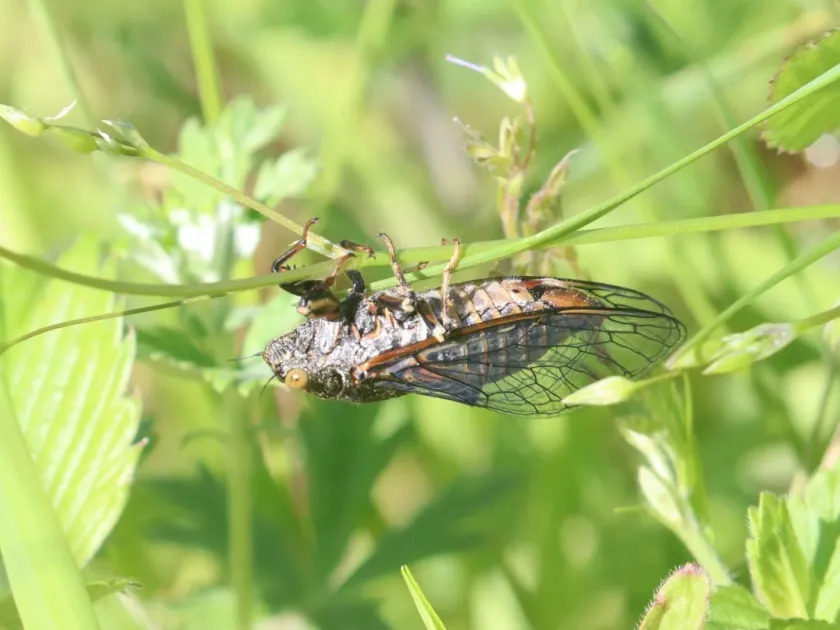
Description
How to identify
The Mountain Cicada (Latin: Cicadetta montana) is a member of the family Cicadidae. Unlike its larger relatives in tropical regions, this species is well-adapted to the cooler climates of Europe and parts of Asia.
Adults typically reach 20–25 mm in length. Their bodies are dark, often black, with subtle yellow or reddish markings. The wings are transparent and display a distinct pattern of dark, robust veins.
The head is broad, featuring large compound eyes and three simple ocelli on the top. Their mouthparts consist of a needle-like proboscis, specialized for piercing plant tissue to extract xylem sap.
Nymphs live entirely underground. They are wingless and possess strong, shovel-like front legs designed specifically for tunneling through soil to reach plant roots.
The most recognizable identification feature is the high-pitched, buzzing song produced by males during warm, sunny days when they are actively seeking mates in the tree canopy.
What it damages
The Mountain Cicada is a polyphagous pest, meaning it feeds on a variety of hosts. In agricultural settings, it commonly targets fruit-bearing trees such as apples, pears, and plums.
Damage is twofold: adult feeding on shoots and physical trauma inflicted during egg-laying. When adults feed, they pierce the bark, which can drain the tree of vital nutrients and water.
The most significant damage occurs when females use their ovipositor to create deep, longitudinal slits in young branches to deposit eggs. This physically destroys the cambium layer.
These incisions often cause the branches to wilt or break. Furthermore, these wounds leave the tree vulnerable to secondary infections, fungal diseases, and bacterial gummosis.
Underground, nymphs feed on the root systems of trees. While an individual nymph does minimal damage, a large population can cause significant growth stunting and decline in tree health.
When it appears
The life cycle of the Mountain Cicada is notably long, ranging from 3 to 5 years. The vast majority of this time is spent as a nymph developing in the soil.
Adults emerge from the ground in late spring to early summer. The primary flight season occurs between June and July, depending on local weather conditions.
This period is characterized by intense mating activity. Males sing in the canopy to attract females, and once mating occurs, the females search for suitable branches for egg deposition.
Eggs are embedded in the wood and usually hatch within about a month. The first-instar nymphs then emerge and drop to the ground, immediately burrowing into the soil to find roots.
Throughout their development, nymphs go through several stages underground. Only when they reach the final stage do they crawl to the surface to undergo their final molt into adults.
Signs of infestation
The primary sign of a Mountain Cicada infestation is the unmistakable, continuous, high-frequency buzzing sound coming from the trees during sunny summer afternoons.
Close inspection of young branches often reveals characteristic slit-like scars or punctures in the bark, indicating where eggs were inserted by a female cicada.
Sap or gum oozing from small holes in the bark, known as gummosis, is a common reaction of the tree to the piercing-sucking activity of the adults feeding on the stem.
Trees that appear suddenly stunted, or show wilting leaves on individual branches despite adequate watering, may be suffering from root damage caused by underground nymphs.
- Persistent buzzing song in the canopy.
- Longitudinal slit scars on young shoots.
- Gummosis (sap flow) on the bark surface.
- Premature yellowing or wilting of branch foliage.
- General decline in the tree's annual growth rate.
Control measures
Control of the Mountain Cicada is challenging due to the hidden life cycle of the nymphs. Management efforts should focus on both cultural practices and chemical interventions.
Sanitation is key: prune and destroy branches showing signs of egg-laying slits before the eggs hatch. This effectively reduces the number of nymphs entering the soil.
During the peak flight season, systemic or contact insecticides can be applied to the foliage to reduce the adult population and prevent further egg-laying occurrences.
Maintaining strong tree vigor through proper fertilization and irrigation helps trees heal from wounds faster and tolerate moderate feeding pressure from the insects.
Monitoring using sticky traps or simple visual inspections in June can help determine the severity of the infestation and guide the timing of protective treatments.
Taxonomy
- Latin name
- Cicadetta
- Order
- Hemiptera (bugs, aphids, leafhoppers)
- Family
- Cicadidae
- EPPO code
- CCDTSP
Discussion
No discussions yet — be the first.