
Crab spider
Thomisus onustus
Description
How to identify
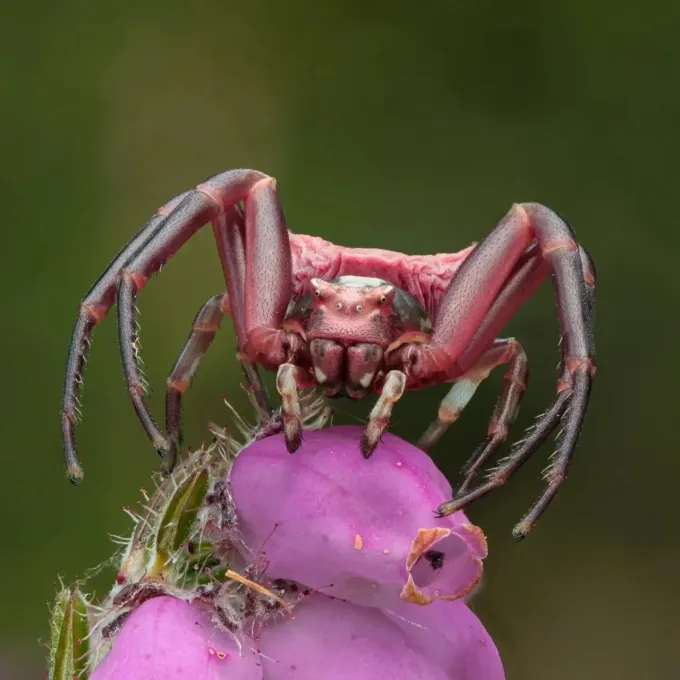
The crab spider (Latin Thomisus onustus) belongs to the Thomisidae family. It is easily identified by its unique crab-like body structure, where the two front pairs of legs are significantly longer and sturdier than the rear ones, allowing lateral movement.
A distinctive feature of this species is its remarkable ability to change color. Depending on the flower they inhabit, they can shift between white, yellow, or pink, effectively camouflaging themselves against floral backgrounds to ambush prey.
Sexual dimorphism is pronounced in this species. Females are noticeably larger, reaching up to 10 mm in body length, whereas males are much smaller, typically measuring 3–4 mm. Their bodies are angular and robust, well-adapted for a stationary lifestyle.
Unlike web-spinning spiders, Thomisus onustus does not use silk traps. Instead, it relies on an ambush hunting strategy, patiently waiting for pollinators or small insects to land on the flower before striking with precision.
They are primarily found in open habitats, including meadows, field margins, and gardens. Their presence is highly correlated with the blooming season, as they require flowers to survive and hunt effectively.
What it damages
From an agronomic perspective, Thomisus onustus is not classified as a plant pest. It does not feed on plant tissues, sap, or roots, and therefore causes no mechanical damage to agricultural crops.
However, the spider can have an indirect negative impact on crop productivity. By preying on bees, bumblebees, and other pollinators, they may reduce the efficiency of pollination in crops that rely heavily on insect-mediated fertilization.
In highly intensive farming systems, a high density of these predators on flowering plants can potentially lead to reduced fruit set or malformed fruits, though this is rarely a significant economic concern compared to actual plant pests.
Conversely, they can be beneficial as natural biological control agents. They consume a variety of small garden pests, including aphids and leafhoppers, which helps mitigate the spread of some viral plant diseases.
The overall impact of the crab spider is balanced. They act as part of the natural control system, and their role is generally considered neutral to slightly positive in most agricultural environments.
When it appears
The activity cycle of the crab spider is synchronized with the flowering phenology of plants. Emergence from winter dormancy typically occurs in mid-spring, coinciding with rising temperatures and the onset of plant blooming.
The population reaches its maximum density during June and July, which corresponds to the peak flowering stage of many agricultural crops and wild flora, providing the spiders with optimal conditions for hunting.
The species completes one generation per year. Winter is spent in a state of diapause, with adult females or older juveniles hiding in organic debris, soil crevices, or dry grass to survive cold temperatures.
As autumn approaches and temperatures drop, their hunting activity diminishes. They begin searching for suitable overwintering sites, signaling the end of their peak presence in the field.
Environmental factors, such as local microclimate and landscape management, play a crucial role in determining the timing of their emergence and the overall population size each season.
Control measures
Direct control measures against Thomisus onustus are rarely recommended, as they do not constitute a major pest threat and contribute to ecosystem health by controlling minor insect populations.
If high concentrations of spiders appear in fields where pollination is critical for yield, physical management or relocation is preferred over chemical interventions, which are often unnecessary and counterproductive.
The application of broad-spectrum insecticides is highly discouraged, as it destroys beneficial predators along with pests, leading to secondary pest outbreaks and environmental degradation.
Maintaining a diverse farm landscape with hedgerows and wildflower strips can help stabilize the population, offering the spiders alternative habitats and reducing their impact on major crop pollinators.
- Avoid pesticide application during peak blooming periods.
- Promote natural biological diversity around agricultural fields.
- Monitor the balance between pollinators and predators in crop zones.
Taxonomy
- Latin name
- Thomisus onustus
- Family
- Thomisidae
- EPPO code
- THMION
Discussion
No discussions yet — be the first.