
Crab spider
Thomisus
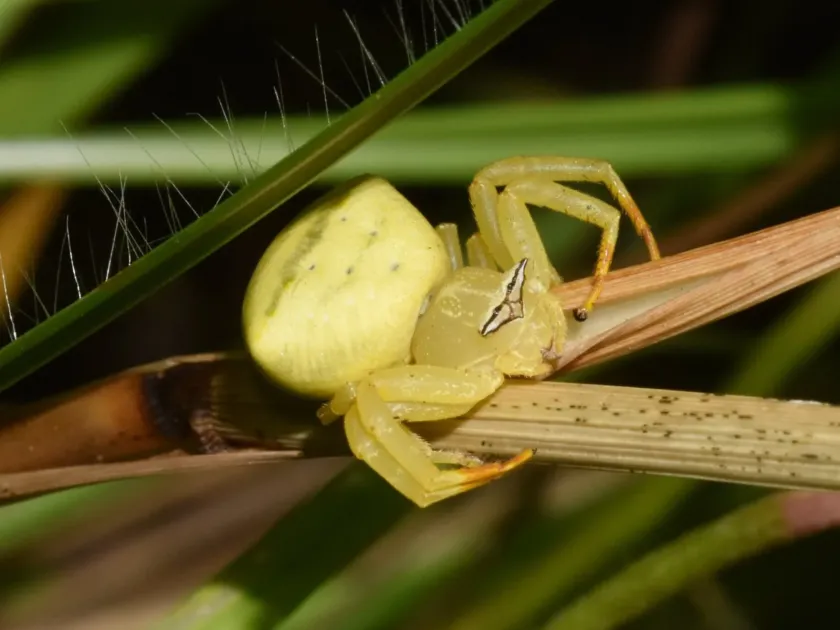
Description
How to identify
Crab spiders (family Thomisidae) get their name from their crab-like appearance and movement. They have a flattened body and two pairs of front legs that are significantly longer than their hind legs, positioned sideways.
Adult individuals are characterized by their mimicry ability: they can change their body color depending on the flower they are hunting on. This makes them nearly invisible to pollinators and other insects.
These spiders do not weave webs to catch prey. They are ambush predators that wait for their victims on the surface of flowers and leaves. They belong to the order Araneae.
Adult sizes vary from 4 to 10 millimeters depending on the species and sex. Females are generally larger than males and show more pronounced color-changing abilities.
The eyes of the spider are arranged in two rows, providing a wide angle of view for precise attacks on insects flying past.
What it damages
It is important to understand that crab spiders are not phytophagous; they do not feed on plant sap. Their damage in agroecosystems is indirect.
The primary concern is their predation on beneficial pollinators, such as bees, bumblebees, and butterflies, which visit your crops for nectar and pollen.
For commercial plantations that rely on entomophilous pollination, the mass presence of crab spiders can lead to reduced yields due to a deficit of high-quality fruit and seed pollination.
In ornamental floriculture, spiders can discourage potential buyers with their presence on flowers, reducing the aesthetic value of the product.
Additionally, spiders can damage delicate bud tissues during movement or while attempting to build temporary silk shelters.
When it appears
The activity of crab spiders begins in the spring, as the soil warms up and early honey-producing crops start to bloom.
The population peak usually occurs in mid-summer, coinciding with the flowering period of most agricultural and ornamental plants.
As autumn temperatures drop, activity decreases, and adult spiders enter a state of diapause, overwintering in plant debris or under tree bark.
The life cycle includes egg, nymph, and adult stages. There is usually one generation per year.
Migration to new areas often occurs through "ballooning," where young spiders use wind currents to travel to new locations.
Signs of infestation
The main sign of their presence is the observation of stationary individuals on flowers, often in a characteristic "waiting pose" with front legs extended.
On inflorescences, you may notice remains of chitinous shells of pollinators that the spider discards after feeding.
Upon careful inspection of the flowers, you may find small egg sacs that the female often attaches to the underside of leaves or between petals.
Changes in pollinator behavior: if bees begin to avoid certain patches of plants, it may indicate the presence of predator ambushes.
Presence of thin silk safety lines on flower stems, though this is primarily an aesthetic issue rather than a sign of active tissue damage.
Control measures
Chemical treatment against crab spiders is rarely justified, as they are part of the ecosystem and also kill some actual agricultural pests.
Manual collection of individuals is the most effective method for small private gardens or greenhouses containing valuable crops.
Maintaining high agricultural standards, including timely weed control, helps eliminate the spiders' preferred ambush locations.
Using biological pest control methods aimed at reducing the overall insect population indirectly decreases the food supply for these spiders.
In cases of absolute necessity, contact insecticides may be used, but this is discouraged due to the high risk of harming beneficial pollinators.
Taxonomy
- Latin name
- Thomisus
- Family
- Thomisidae
- EPPO code
- THMISP
Discussion
No discussions yet — be the first.