
Synema spider
Synema
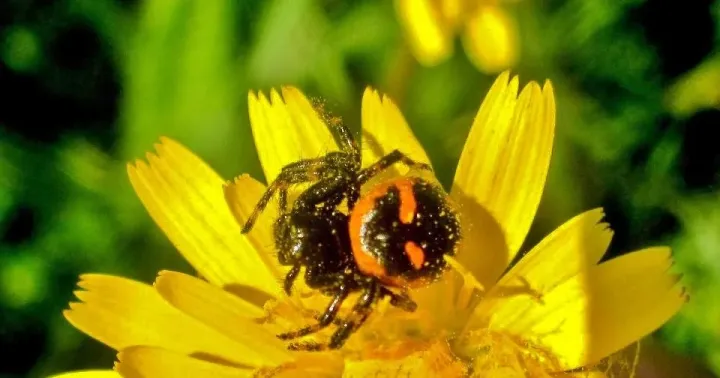
Description
How to identify
The genus Synema belongs to the family Thomisidae, commonly known as crab spiders. These spiders are easily recognized by their unique resting posture and crab-like lateral movement.
They possess a flattened body and long, powerful front legs, which they extend outwards while waiting for prey on flowers or foliage.
Unlike many other spider species, Synema spiders do not construct complex webs to trap prey; they are ambush predators that rely on camouflage and speed.
The coloration of these spiders often mimics the petals of the flowers they inhabit, providing excellent concealment from both predators and prey.
Identification often relies on the specific patterns located on the abdomen, which are distinct for different species within this genus.
What it damages
Synema spiders are not agricultural pests. They do not feed on plant sap, tissues, or seeds, and they pose zero threat to crop integrity.
Their presence on plants is solely for the purpose of hunting insects, using the plant structure merely as a strategic location to await their victims.
They are not involved in any form of plant damage, such as leaf mining, gall formation, or boring, which characterizes true plant-feeding pests.
Farmers often consider these spiders beneficial because they prey on various insects that may otherwise visit the crop for feeding purposes.
As they do not affect plant health or yield, there is no economic justification for managing or eradicating them from an agricultural ecosystem.
When it appears
The active period for Synema spiders typically spans from late spring through late summer, corresponding with peak flowering times in many crops.
They overwinter in sheltered areas, such as leaf litter, bark crevices, or protected spots near the soil surface, emerging when temperatures rise.
Their cycle is closely linked to the phenology of flowering plants, which provide the primary hunting grounds for these spiders.
Mating and egg-laying usually occur during the warm summer months, ensuring that the next generation is ready for the following season.
By late autumn, the activity levels drop significantly as the spiders prepare for their dormant period during the winter months.
Control measures
Because Synema spiders are not pests, no control measures are required. In fact, controlling them is counterproductive for integrated pest management.
The use of broad-spectrum insecticides should be avoided, as these chemicals often eliminate beneficial predators like crab spiders, leading to secondary pest outbreaks.
Management should focus on maintaining a healthy environment where these spiders can thrive and help naturally control other insect populations.
If physical presence on ornamental plants is an issue, simple mechanical removal is sufficient and safer than chemical intervention.
Preserving predatory populations is a core pillar of sustainable farming, and Synema spiders are a valuable part of this ecological balance.
Taxonomy
- Latin name
- Synema
- Family
- Thomisidae
- EPPO code
- SYMASP
Discussion
No discussions yet — be the first.