
Synema globosum
Synema globosum
Description
How to identify
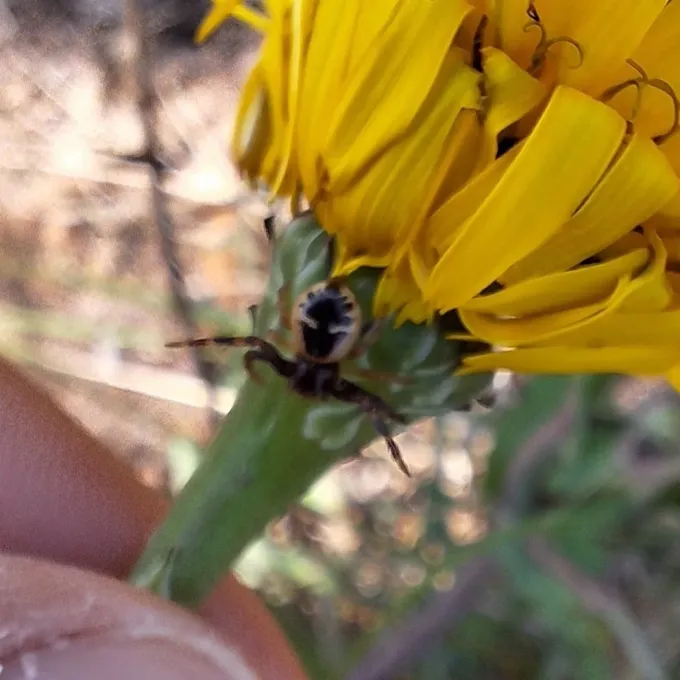
Synema globosum is a species of crab spider belonging to the family Thomisidae. It is widely distributed across Europe and is known for its unique appearance, often featuring a distinct pattern on the abdomen that resembles a human face.
The female, which grows up to 10 mm, displays this pattern with vivid colours ranging from yellow to black or deep red. Males are significantly smaller, typically reaching only about 4 mm in size.
These spiders are characterized by their crab-like movement, where they walk sideways, and their ability to remain motionless for hours while waiting for prey on flowers.
They belong to the order Araneae and act as sit-and-wait predators. Unlike web-spinning spiders, they rely entirely on their camouflage to surprise visiting insects.
It is crucial to categorize this spider not as a plant pest, but as a beneficial predator that contributes to the natural regulation of insect populations in gardens and fields.
What it damages
Synema globosum does not feed on any plant tissue, including leaves, stems, roots, or fruit. It is entirely carnivorous and poses no threat to crops or garden plants.
Its diet consists exclusively of insects such as flies, bees, and other pollinators that frequent flowers. The spider uses its powerful front legs to grab prey instantly.
From an agronomical perspective, these spiders do not cause any economic damage. They do not transmit plant viruses, create necrotic spots, or hinder plant growth in any way.
Because they are predators, they are actually considered beneficial insects. By controlling the population of various insects, they may help mitigate the presence of some minor pests.
There is no evidence that this spider species causes any reduction in crop yields, making any form of control entirely unnecessary and counterproductive.
When it appears
The active life cycle of Synema globosum is synchronized with the blooming period of many plants. They are most commonly observed from late spring through late summer.
During the warmer months, adults are frequently seen positioned on the petals of various flowers, waiting for their prey. This aligns with the peak activity of pollinators.
Wintering occurs in a dormant state within organic debris, leaf litter, or crevices in bark. They emerge as temperatures rise in the spring to begin their annual activity cycle.
The development cycle includes egg, nymph, and adult stages. Females are known to be protective of their egg sacs, often fixing them to leaves and guarding them until hatching.
The abundance of these spiders is directly correlated with the richness of floral resources in an area, as these resources attract the insects that form their primary prey.
Signs of infestation
Signs of presence are limited to visual observation of the spider itself on a flower. No damage to the plant will ever be visible.
There are no tell-tale signs of infestation such as chewed leaves, discoloration, wilting, or web-related damage. The plant remains entirely healthy in the presence of the spider.
If you observe a colorful, crab-like spider sitting motionless on a petal, this is merely a sign of a healthy, functioning ecosystem where a predator is occupying its niche.
Because they do not weave webs over plant parts, the architectural integrity of the plant is never compromised.
Identification is purely based on finding the spider itself, which requires careful searching as it is an expert in camouflage.
Control measures
No control measures are needed for Synema globosum. Since it is a predator and not a pest, it should be encouraged in the garden as part of an integrated pest management strategy.
The use of chemical insecticides should be avoided, as these substances will harm beneficial predators, potentially leading to more severe pest outbreaks.
The best agronomical practice is to preserve the natural habitat of these spiders by minimizing chemical inputs and maintaining floral diversity.
If a spider is found in an area where it is not wanted, the only recommended action is to manually move it to a different location without harming it.
- Avoid the use of broad-spectrum pesticides.
- Encourage biodiversity to support natural predator populations.
- Recognize the beneficial role of spiders in garden health.
Taxonomy
- Latin name
- Synema globosum
- Family
- Thomisidae
- EPPO code
- SYMAGL
Discussion
No discussions yet — be the first.