
Misumenops pallidus
Misumenops pallidus
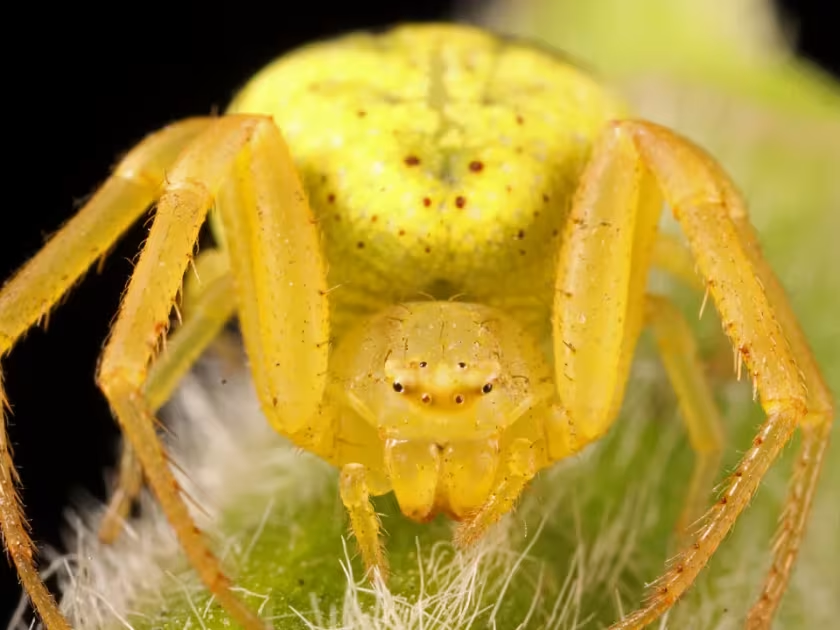
Description
How to identify
Misumenops pallidus, commonly known as a type of crab spider, belongs to the family Thomisidae. It is a predatory arachnid frequently found in agricultural landscapes and gardens.
These spiders are characterized by their ability to change body color to match their environment, typically shifting between shades of yellow, white, and light green to camouflage themselves on plant surfaces.
Their common name, crab spider, is derived from their unique ability to move sideways, backwards, and forwards, which facilitates their hunting behavior among dense foliage and flower petals.
Unlike many other spiders, Misumenops pallidus does not build webs to capture prey. Instead, it relies on an ambush strategy, sitting motionless on flowers or leaves, waiting for small insects to land within striking range.
The morphology of this spider is adapted for hunting efficiency, with robust front legs and excellent visual acuity to detect potential prey items like flies, aphids, and beetles.
What it damages
It is critical to clarify that Misumenops pallidus is not a pest. It does not feed on plant sap, leaves, or stems, meaning it causes absolutely no damage to agricultural crops.
Conversely, this species is a highly beneficial predator. It plays a vital role in natural pest control by preying on various agricultural pests such as aphids, thrips, and small larvae that do cause economic damage.
In farming systems, the presence of these spiders is actually a positive bio-indicator, suggesting that the ecosystem is functioning well and maintaining a natural balance of species.
Any perceived "threat" from this species is purely based on the misunderstanding of its ecological role. Treating it as a pest is counterproductive to sustainable agriculture.
By keeping insect populations in check, Misumenops pallidus helps reduce the overall reliance on chemical pesticides, thereby enhancing the environmental health of the farmland.
When it appears
The activity cycle of Misumenops pallidus is closely tied to the growing season of crops and the availability of insect prey in the surrounding environment.
Adult spiders typically emerge in early spring as temperatures rise, aligning with the early growth stages of plants and the initial emergence of insects.
During the flowering stage of various crops, spider populations often peak, as flowers provide excellent hunting grounds where both predators and prey are highly active.
As the season progresses, females lay eggs, often protecting them within silk cocoons tucked into rolled leaves or hidden in floral structures to ensure the next generation's survival.
With the onset of autumn and decreasing temperatures, the spiders gradually seek sheltered overwintering sites, such as leaf litter, bark crevices, or soil debris.
Signs of infestation
Observing Misumenops pallidus in the field is usually achieved through visual inspection during crop scouting or through sweep-net sampling, where they are collected alongside other insects.
Crucially, there are no characteristic plant symptoms associated with these spiders, as they do not pierce plant tissue or create necrotic lesions on crops.
If you spot these spiders, you will often find them sitting still on flower petals. They are very patient hunters and will remain stationary for long periods to maximize their camouflage effect.
The lack of sticky webs, which are common with species like orb-weavers or spider mites, serves as a clear indication that you are dealing with a wandering hunter rather than a crop pest.
Seeing these predators is a sign of a healthy field, and no intervention or control measures are required when they are present.
Control measures
As a beneficial predator, Misumenops pallidus requires no control measures. In fact, farmers are encouraged to protect and conserve their populations.
To promote these beneficial spiders, it is recommended to minimize the use of non-selective broad-spectrum insecticides that kill both pests and their natural enemies.
Implementing Integrated Pest Management (IPM) practices allows for the survival of Misumenops pallidus, which provides free, natural pest suppression throughout the crop cycle.
Maintaining diverse habitats around field margins provides refuge for spiders during harvest periods and ensures they can re-colonize fields in the following season.
- Avoid unnecessary chemical spraying near flowering borders.
- Preserve natural non-crop vegetation as reservoirs for beneficials.
- Prioritize biological control over prophylactic insecticide use.
Taxonomy
- Latin name
- Misumenops pallidus
- Family
- Thomisidae
- EPPO code
- MISUPA
Discussion
No discussions yet — be the first.