
Crab spider
Misumenops
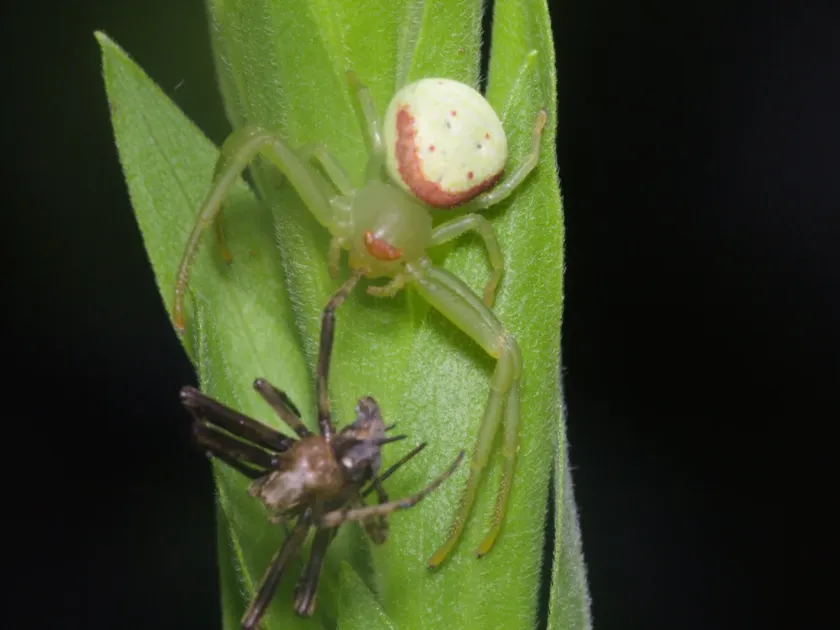
Description
How to identify
Crab spiders of the genus Misumenops belong to the Thomisidae family and are recognized by their distinct crab-like lateral movement.
These spiders are masters of camouflage, capable of changing their body coloration to match the petals of the flowers where they hunt.
The first and second pairs of legs are significantly larger than the posterior ones, allowing them to capture prey with high efficiency.
Adult females are typically larger than males and possess a high degree of color plasticity to blend into various environments.
They do not construct webs for trapping prey but act as sit-and-wait predators, residing predominantly within blossoms.
What it damages
From an agronomic perspective, Misumenops are not considered pests as they do not consume plant sap or damage vegetative tissues.
Their diet consists solely of various insects, including pollinators like bees, flies, and butterflies, which visit the same flowers.
While they may occasionally impact the local population of pollinators, the overall damage to crop yield is negligible.
In fact, their predatory nature can be beneficial, as they often hunt other small insects that might be harmful to the plant's reproductive organs.
There is no evidence of these spiders causing mechanical injury or physiological stress to the host plants they inhabit.
When it appears
The life cycle and activity of these spiders are closely synchronized with the blooming stages of agricultural and wild crops.
They emerge from their overwintering sites in early spring, following the appearance of the first nectar-producing flowers.
Population density typically reaches its peak during the mid-summer season, coinciding with the flowering of major crops like sunflowers or legumes.
As temperatures drop and floral resources diminish in late autumn, the activity of the spiders decreases significantly.
They overwinter as adults, seeking refuge in leaf litter, plant debris, or protected areas in the soil and tree bark.
Signs of infestation
The primary sign of their presence is the visual observation of an immobile spider situated within the center of a flower head.
Observers can often spot them by their wide, crab-like stance, waiting patiently for a pollinator to land on the bloom.
Because they do not weave silk traps, the absence of webbing on plants is a key indicator that distinguishes them from many other arachnids.
Evidence of predation, such as insect exoskeletons found near the flower base, may indicate a successfully hunting spider in the area.
Regular field scouting during the flowering stage allows for the easy detection of these spiders due to their lack of hiding behavior while hunting.
Control measures
No specific control measures are recommended, as crab spiders are generally considered neutral or beneficial organisms within the agroecosystem.
Avoid broad-spectrum insecticide applications, which often cause more harm by eliminating natural predators and beneficial pollinators.
Integrated Pest Management (IPM) practices should focus on controlling actual pests rather than disrupting the existing population of arachnids.
Maintaining a balanced ecosystem around the field margins is sufficient to ensure their population remains at a natural, non-intrusive level.
If their impact on pollination becomes a concern, focus on sustainable practices that encourage a diverse community of natural enemies for all field insects.
Taxonomy
- Latin name
- Misumenops
- Family
- Thomisidae
- EPPO code
- MISUSP
Discussion
No discussions yet — be the first.