
Black hairstreak
Thecla pruni
Description
How to identify
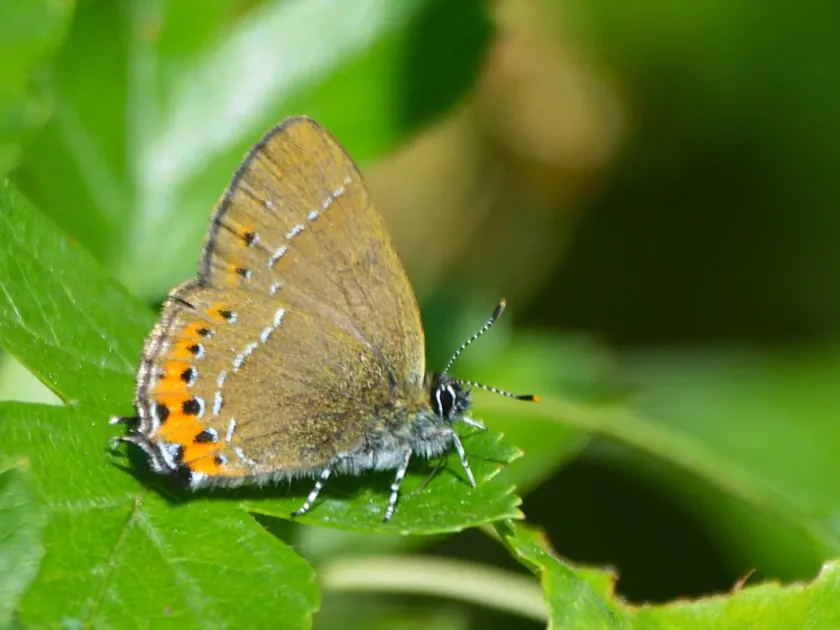
The black hairstreak (Thecla pruni) is a butterfly species belonging to the Lycaenidae family within the order Lepidoptera.
Adult butterflies are characterized by a dark brown wing color with a distinct orange band on the hindwings and a small tail-like projection.
The larvae (caterpillars) have a flattened, woodlouse-like shape and a greenish-yellow color, allowing them to blend perfectly with the foliage of the host tree.
Pupae of this species are brownish and are typically found attached to the bark of branches or stems, remaining camouflaged throughout the pupation stage.
This butterfly is native to temperate regions of Europe and Asia, where it prefers scrublands and orchards featuring its primary host plants.
What it damages
The black hairstreak primarily targets trees belonging to the Rosaceae family, making it a significant pest in orchards and woodland areas.
Host plants include plum (Prunus domestica), blackthorn (Prunus spinosa), bird cherry, and various species of hawthorn (Crataegus).
The larvae feed on the reproductive parts of the plants, specifically targeting buds, developing flowers, and the young fruitlets of the trees.
Heavy infestations can lead to significant yield loss, as the larvae consume the contents of the buds before they even have a chance to bloom.
While the leaves may suffer minor feeding damage, the primary economic impact is driven by the destruction of potential flowers and fruit.
When it appears
The black hairstreak follows a univoltine lifecycle, meaning it completes only one generation per year throughout its range.
The species overwinters in the egg stage, with eggs firmly attached to the crotches of twigs or near the base of buds on the host tree.
Larvae emerge from their eggs in early spring, precisely timed to coincide with the swelling and opening of the host tree buds.
Adult butterflies appear in early summer, typically peaking in June and July, when they spend their time feeding on nectar and seeking mates.
After mating, females deposit eggs on suitable host branches, where they remain in diapause until the following spring cycle begins.
Signs of infestation
The most reliable sign of an infestation is the presence of withered, unsprouted buds that fail to open because their interior has been hollowed out.
Small, whitish, circular eggs visible on the bark of twigs during the dormant winter months are a clear indicator of the pest's presence.
In the spring, one may notice the presence of larval frass on the leaves or branches directly beneath the areas where the caterpillars are actively feeding.
A reduced number of flowers and fruit sets in the absence of obvious fungal pathogens often suggests larval feeding damage within the canopy.
Observing adult butterflies fluttering around the treetops during sunny days in summer indicates a local population is established in the area.
Control measures
Sanitation through pruning is an effective preventative measure, as it allows for the removal of branches containing overwintering egg clusters.
Chemical control should be timed to the larval emergence period, usually applying insecticides just before the trees reach full bloom.
Maintaining biological diversity in the orchard helps, as birds and parasitic wasps often prey on the caterpillars, reducing population numbers.
Monitoring egg clusters during the winter period can help orchardists assess the potential level of infestation and plan early spring treatments accordingly.
Regular inspection of tree health and monitoring for early bud damage are essential steps for protecting susceptible fruit cultivars from this pest.
Taxonomy
- Latin name
- Thecla pruni
- Order
- Lepidoptera (butterflies)
- Family
- Lycaenidae
- EPPO code
- STRYPR
Discussion
No discussions yet — be the first.