
Brown Argus
Aricia agrestis
Description
How to identify
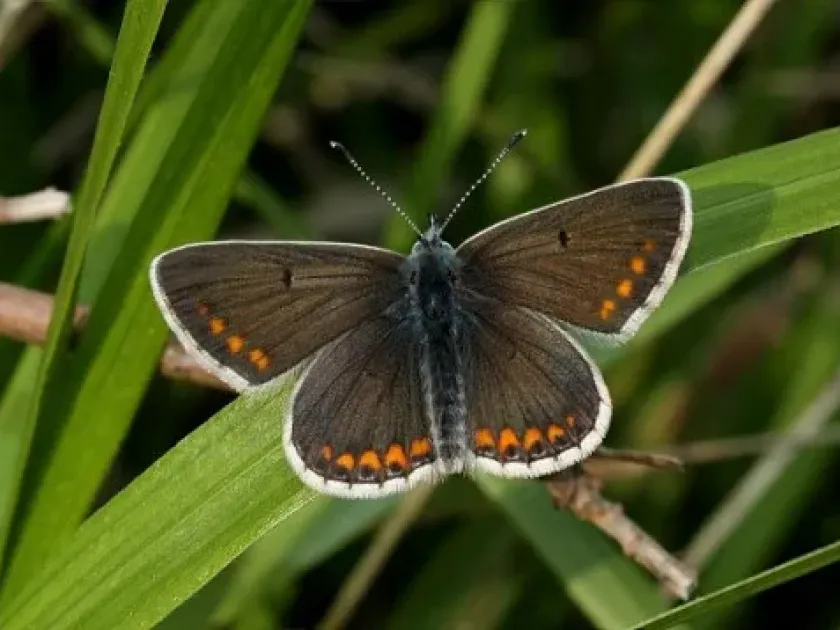
The Brown Argus (Aricia agrestis) belongs to the Lycaenidae family. It is a small butterfly with a wingspan of approximately 25–30 mm, widely distributed across various habitats including fields and meadows.
The upper side of the wings is dark brown, typically with a white fringe. A row of reddish or orange spots is often visible along the outer edge of the hindwings, serving as a key identification mark.
The underside of the wings is grayish-brown, decorated with a series of black dots circled in white. This pattern provides excellent camouflage while the butterfly rests on vegetation.
The larvae (caterpillars) are woodlouse-shaped, varying in color from bright green to yellowish-green, often with a darker dorsal line and lighter lateral markings.
The pupae are typically attached to the host plant or debris. They are compact, often green or brown in color, allowing them to remain hidden among the leaves during the transformation process.
What it damages
The Brown Argus primarily targets legumes (Fabaceae family). Its host plants include various clover species, alfalfa, and wild vetches, which can suffer significant damage under high infestation levels.
The larvae consume the foliage, often starting from the underside of the leaves. As they mature, they can eat large portions of the leaf tissue, leaving only the veins behind.
Besides leaves, the larvae may feed on flowers and buds, leading to a direct reduction in seed yield. This is especially detrimental in fields grown for forage or seed production.
Extensive defoliation weakens the plant, reducing its ability to photosynthesize effectively. This makes the affected crops more susceptible to environmental stress and opportunistic diseases.
Persistent infestations over several seasons can cause a decline in the overall vigor and productivity of forage stands, potentially leading to the need for field reseeding.
When it appears
The Brown Argus generally produces two generations per year. The first brood of adults typically emerges in late spring, around May and June, depending on local climate conditions.
The second generation appears mid-summer, flying through July and August. During this time, they actively search for suitable host plants to lay their eggs.
The eggs are laid singly on the underside of leaves. The duration of the egg stage is influenced by temperature, usually spanning about a week to ten days before hatching.
Larval development takes approximately three to four weeks. After completing their growth phase, the larvae pupate, preparing for the next emergence of butterflies.
Overwintering usually occurs in the larval stage, often hidden in the soil or protected by plant debris at the base of the stems, awaiting the arrival of spring temperatures.
Signs of infestation
Early signs of an infestation include small, localized feeding holes on the leaves. These are often easy to overlook until the larvae grow larger and increase their consumption.
As the larvae mature, the pattern of damage shifts to skeletonization. Large portions of the leaf blade are removed, leaving only the vascular structure of the leaf visible.
The presence of small, dark fecal pellets on the foliage or at the base of the plant is a clear indication that caterpillars are feeding nearby.
- Skeletonized leaves with large missing sections.
- Visible feeding marks on buds and flowers.
- Stunted growth of the plant due to high foliage loss.
- Presence of larvae upon inspection of leaf undersides.
- Dark granular excrement found on stems and ground litter.
Control measures
Effective management begins with proper crop rotation. By avoiding consecutive planting of susceptible legume crops, farmers can disrupt the pest's life cycle significantly.
Field sanitation is critical. Removing host weeds like wild vetches from field borders reduces the availability of secondary food sources, limiting the population growth of the butterfly.
If population densities exceed economic thresholds, insecticides may be employed. Selective products that minimize harm to beneficial insects and pollinators are preferred.
Biological control options, such as the introduction or encouragement of egg parasitoids like Trichogramma wasps, can help manage populations in an environmentally friendly manner.
Monitoring the fields regularly during peak flight periods allows for timely intervention. Early detection is the most effective way to prevent widespread damage across the crop.
Taxonomy
- Latin name
- Aricia agrestis
- Order
- Lepidoptera (butterflies)
- Family
- Lycaenidae
- EPPO code
- ARCZAG
Discussion
No discussions yet — be the first.