
Hairstreak butterfly
Thecla
Description
How to identify
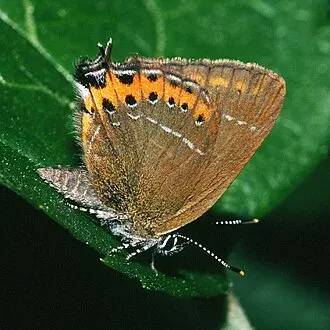
Hairstreaks (genus Thecla) are members of the Lycaenidae family within the order Lepidoptera. Adult butterflies are characterized by the delicate, tail-like extensions on their hindwings, which give the group its common name.
The upper surface of the wings is often a deep blue, violet, or brown with a metallic sheen. This coloration provides camouflage, allowing the insects to blend in with foliage and dappled sunlight.
The larvae, or caterpillars, have a distinctive woodlouse-like shape. They are flattened, green or brownish-green, allowing them to remain virtually invisible while feeding on buds and leaves.
Eggs are typically small, disc-shaped, and laid singly on the bark of young twigs near budding sites. They are designed to overwinter successfully through harsh conditions until spring.
The pupae resemble small, shriveled leaf fragments or bark scales. They are often secured to twigs with a silk girdle, making them extremely difficult to spot during routine garden inspections.
What it damages
The larvae are the primary source of damage, as they feed on the generative parts of fruit-bearing trees. Their feeding habits target the most valuable parts of the plant: buds and young fruit.
Fruit species such as apples, plums, cherries, and apricots are the most common hosts. The caterpillars bore into the buds, destroying the core and preventing the tree from flowering properly.
As the season progresses, larvae may attack young fruit sets. This causes deformation of the fruit and, in many cases, leads to premature fruit drop, which significantly impacts harvest yields.
Feeding activity often leaves open wounds on the tree, which can serve as entry points for bacterial and fungal pathogens, potentially leading to branch dieback or secondary infections.
In years with high population densities, these pests can drastically reduce the productivity of an entire orchard by stripping away the reproductive potential of individual trees.
When it appears
Hairstreaks generally have a univoltine lifecycle, meaning they complete one generation per year. They overwinter as eggs laid on the bark or near dormant buds.
The hatching of larvae is tightly synchronized with the host plant's phenology. As buds swell and open in the spring, the larvae emerge to feed on the tender, nutrient-rich tissues.
The larval stage usually spans through April and May. By early summer, they enter the pupal stage, with adults emerging later in the season to mate and lay eggs for the following year.
Adult butterflies feed on flower nectar and are harmless to the crop, serving only to perpetuate the cycle. Their flight period often occurs in mid-to-late summer.
Weather patterns, particularly early spring warming, can accelerate the emergence of larvae. Monitoring temperature trends is essential for effective pest management scheduling.
Signs of infestation
The first indicator of an infestation is the presence of buds that fail to open, often revealing small holes or hollowed-out interiors where the larva has been feeding.
During the blooming phase, gardeners may notice individual blossoms wilting or failing. Closer inspection of these blossoms often reveals the presence of larvae or their distinct excrement.
Young foliage may show small, irregular bite marks or ragged edges, suggesting that early-stage larvae are present and feeding on the newly developed leaves.
The presence of fine silk webbing between leaves or around flower clusters can be a secondary sign, as the caterpillars often use silk to secure their feeding environment.
- Hollowed-out buds with visible entry holes.
- Premature fruit drop and deformed fruitlets.
- Presence of flat, green caterpillars on the underside of leaves.
Control measures
Applying contact or systemic insecticides during the bud-burst stage is the most effective way to manage larvae before they cause significant damage to the crop.
Cultural practices, such as scraping away loose bark on tree trunks in early spring, can destroy overwintering eggs and reduce the overall population pressure in the orchard.
Encouraging natural predators, such as birds, lady beetles, and lacewings, helps maintain ecological balance and limits the need for broad-spectrum chemical interventions.
Using biological control agents, such as formulations containing Bacillus thuringiensis, offers a selective and environmentally friendly way to control caterpillars while sparing beneficial pollinators.
Regular orchard maintenance, including the removal of fallen fruit and the proper pruning of infested branches, disrupts the lifecycle and removes potential breeding grounds for the pest.
Taxonomy
- Latin name
- Thecla
- Order
- Lepidoptera (butterflies)
- Family
- Lycaenidae
- EPPO code
- THECSP
Discussion
No discussions yet — be the first.