
Red milkweed beetle
Tetraopes tetrophthalmus
Description
How to identify
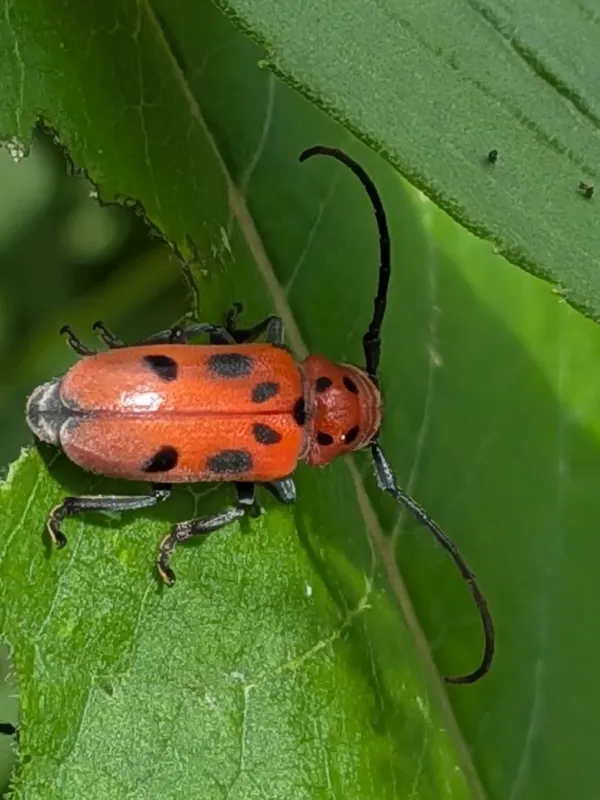
The red milkweed beetle is a striking member of the longhorn beetle family (Cerambycidae), known for its bright red elytra adorned with distinct black spots.
Measuring between 9 and 15 millimeters in length, these beetles possess long antennae and a unique arrangement of eyes that split into two pairs, explaining their specific name, tetrophthalmus.
The species is highly specialized, feeding exclusively on plants within the genus Asclepias, commonly known as milkweed, which contains cardiac glycosides that the beetles sequester to become toxic to predators.
The larvae are typically longhorn beetle in appearance: white, legless, and equipped with a robust, heavily sclerotized head capsule designed for boring into plant tissue.
Adults are diurnal and highly active during sunny summer days, frequently found mating and feeding on the upper leaves and flower buds of their host plants.
What it damages
Damage is primarily caused by both the larval and adult stages, with larvae being significantly more destructive to the overall health of the milkweed plant.
Larvae bore into the roots and the base of the stems, effectively disrupting the vascular system and depriving the plant of essential water and nutrients.
Adults engage in leaf-feeding and bud-munching, which reduces the plant's photosynthetic area and compromises its reproductive potential for the current season.
Chronic infestation weakens the plant significantly, making it susceptible to secondary infections like fungal root rot and opportunistic bacterial pathogens.
Heavily infested milkweed patches may exhibit premature wilting, stunted growth, and eventually total mortality if the larval population is not checked.
When it appears
Adults emerge during the mid-summer months, aligning their lifecycle with the peak flowering period of milkweed species, which ensures an abundant food source.
Females lay eggs in the soil near the base of the host plant or occasionally in crevices on the stem, where the neonate larvae can quickly locate roots.
The larval stage is the longest part of the life cycle, as they remain inside the roots or lower stems to feed throughout the remainder of the summer and the autumn months.
The beetle overwinters as a larva, remaining dormant within the root system or the surrounding soil profile, protected from harsh winter temperatures.
Pupation occurs in late spring or early summer, followed by the emergence of new adults to restart the one-year cycle, necessitating vigilant scouting during the summer.
Signs of infestation
Early warning signs include ragged holes on leaf margins and damage to floral clusters, which are classic indicators of adult feeding activity.
If a milkweed plant shows signs of sudden wilting despite adequate soil moisture, it is a strong indicator that the root system has been compromised by boring larvae.
A closer inspection of the plant base often reveals small exit or entrance holes in the stem or displaced soil, indicating larval presence.
The presence of bright red beetles on the foliage is the most definitive sign, as they are easily spotted due to their high-contrast warning coloration.
Excavating the root system of a declining plant often reveals the larvae themselves or the internal galleries they have excavated, which are usually packed with frass.
Control measures
Manual removal is the most environmentally friendly control method, involving hand-picking the beetles in the cool of the morning when they are less active.
To reduce the population, carefully remove and destroy heavily infested plants including their entire root system to prevent larvae from completing their development.
Systemic insecticides may be utilized in extreme cases, though caution is advised as milkweed is a critical host plant for monarchs and other beneficial pollinators.
Implementing crop rotation or spatially separating milkweed plantings can effectively disrupt the beetle’s ability to locate and colonize host patches.
Tilling the soil around milkweed plantings in the late autumn can mechanically destroy overwintering larvae and pupae residing in the upper soil layers.
Taxonomy
- Latin name
- Tetraopes tetrophthalmus
- Order
- Coleoptera (beetles)
- Family
- Cerambycidae
- EPPO code
- TETETE
Discussion
No discussions yet — be the first.