
Red milkweed beetle
Tetraopes femoratus
Description
How to identify
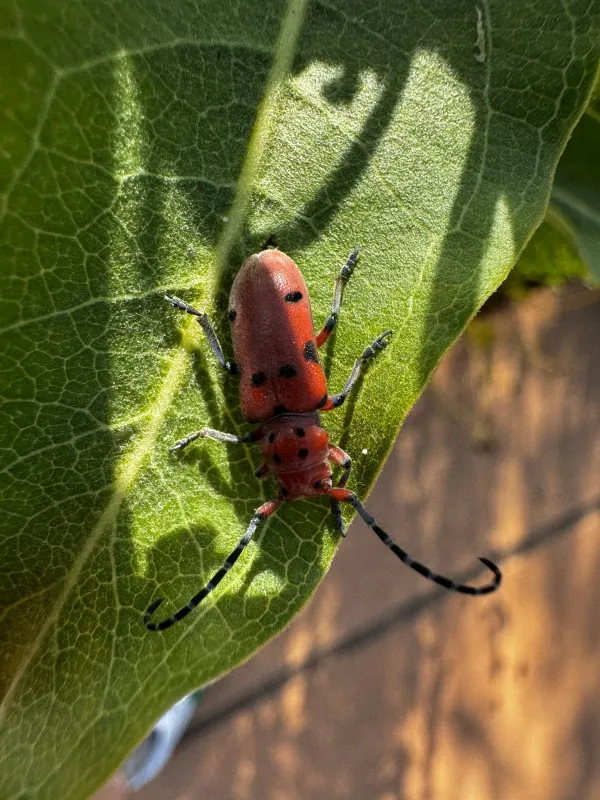
The Red milkweed beetle (Tetraopes femoratus) belongs to the longhorn beetle family (Cerambycidae). This insect is easily identified by its vibrant red or orange elytra marked with distinct black spots.
Adult beetles typically measure between 10 and 16 millimeters in length. Their bodies are covered in fine, dense hairs, giving them a velvety texture that is quite characteristic of the genus.
The head and legs are primarily black, creating a sharp contrast with the bright red coloration of the back, which makes them highly visible during the summer months.
The larvae are creamy-white in color and have the elongated, cylindrical body typical of wood-boring beetle larvae. They spend most of their life cycle hidden inside plant tissues.
While not a major agricultural pest, they are well-known to gardeners and conservationists for their specialized relationship with milkweed plants.
What it damages
The primary food source for the Red milkweed beetle is the genus Asclepias (milkweed). Both adults and larvae rely on these plants for survival throughout their life cycle.
Adult beetles feed on the leaves and young stems of the milkweed. They create irregular holes in the foliage, which can lead to significant aesthetic damage and reduced leaf surface area.
The larvae cause far more severe damage by boring into the roots and the lower stem of the milkweed plant, where they feed on internal tissues.
This root feeding disrupts the plant's ability to absorb water and nutrients, leading to stunted growth, wilting, and in some cases, the death of the entire host plant.
In managed landscapes or nurseries where milkweed is grown for ecological or ornamental purposes, a high beetle population can jeopardize the health of the entire planting.
When it appears
Adult Tetraopes femoratus activity generally occurs during the summer, starting in June and lasting through August or September, depending on the local climate.
The life cycle is univoltine, meaning there is only one generation per year. Mating occurs on the host plants, after which females lay eggs near the base of the stems.
Once the larvae hatch, they burrow down into the soil to access the root system. This is where they remain for the duration of their development, surviving the winter months.
Overwintering occurs in the larval stage within the roots or the soil surrounding the host plant. They undergo pupation in the spring as the ground warms up.
New adults emerge from the soil in early summer, beginning the cycle anew and seeking out host plants for feeding and subsequent reproduction.
Signs of infestation
The most obvious sign of infestation is the presence of adult beetles crawling on the milkweed leaves during the summer months.
Observation of irregularly shaped holes or ragged edges on the leaves indicates adult feeding activity, which is a precursor to a potential larval infestation.
Stunted plant growth or premature yellowing of the foliage, especially during hot, dry weather, often points to internal root damage caused by larvae.
If you inspect the base of the stem at soil level, you may find small entry holes or frass (boring dust), which are clear indications of larval activity.
In severe cases, a gentle tug on the stem of a wilting plant may reveal that the root system has been severely compromised or severed by larval feeding.
Control measures
Effective management requires a combination of monitoring and physical removal. For smaller garden patches, manually picking off the adults is highly effective.
- Hand-pick adult beetles in the early morning when they are sluggish.
- Remove and destroy heavily infested plants to prevent larvae from completing their development.
- Monitor for leaf damage early in the season to catch infestations before they spread.
- Use systemic insecticides only as a last resort, as they may harm pollinators visiting milkweed.
- Improve soil health and plant vigor to help milkweed withstand moderate larval damage.
Biological control methods, such as applying beneficial nematodes to the soil, can target larvae before they cause significant damage to the root system.
Given the host-specific nature of the beetle, rotating plantings or moving milkweed patches to new locations can help break the cycle of infestation in garden settings.
Taxonomy
- Latin name
- Tetraopes femoratus
- Order
- Coleoptera (beetles)
- Family
- Cerambycidae
- EPPO code
- TETEFE
Discussion
No discussions yet — be the first.