
Lantana lace bug
Teleonemia scrupulosa
Description
How to identify
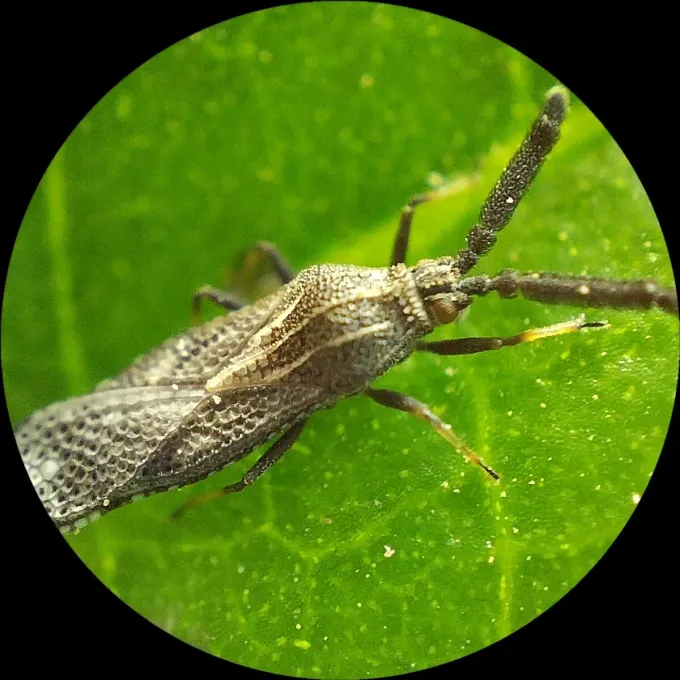
The lantana lace bug (Teleonemia scrupulosa) is a member of the Tingidae family, known for their distinctively patterned, lace-like wings that cover their backs.
Adult bugs are roughly 3 to 4 mm long and typically display a mottled brown or grayish appearance, allowing them to blend into the foliage of their host plants.
The pronotum is extended over the head, giving the insect a hooded appearance that is characteristic of the lace bug family.
Nymphs undergo five instars, appearing as miniature, wingless versions of adults, often covered in small spines or hairs for protection.
Eggs are typically deposited in small, darkened clusters embedded within the plant tissue, often along the veins of the leaves.
What it damages
While primary hosts are Lantana camara, these insects can cause significant damage to other plants within the Verbenaceae family.
Both adults and nymphs feed by piercing the plant tissue with their needle-like mouthparts to extract sap, which disrupts nutrient transport.
Feeding injury results in stippling, chlorosis, and the development of white or yellow spots on the leaf surface, which eventually turn brown.
Severe infestations cause leaves to wilt, curl, and drop prematurely, resulting in total defoliation of the infested plant.
The physiological stress caused by persistent feeding weakens the plant, making it significantly more susceptible to environmental stress and secondary diseases.
When it appears
The life cycle of the lantana lace bug is highly temperature-dependent, typically requiring three to four weeks to complete in warm conditions.
Activity peaks during the warmer months of the year when host plants are in active growth and provide ample nutrition for the population.
Overwintering occurs primarily in the adult stage, sheltered within leaf litter, bark crevices, or protected areas near the base of the plant.
Early spring activity resumes as soon as temperatures stabilize, with adults emerging to feed and immediately begin mating and egg-laying.
Multiple generations per season are common, leading to exponential population growth if left unmonitored during the peak summer period.
Signs of infestation
The most visible indicator of an infestation is the presence of chlorotic spotting on the upper leaf surfaces, often accompanied by a loss of green color.
Leaf undersides will often show accumulations of dark, varnish-like excrement droplets, which are characteristic of lace bug feeding activity.
The appearance of cast-off exuviae (nymphal skins) adhering to the underside of the leaves is a sure sign of a developing colony.
General plant decline, including stunted growth, poor flower production, and scorched-looking leaves, indicates a long-term infestation.
Close visual inspection of the leaf undersides with a hand lens will reveal the presence of adult bugs with their distinctive reticulated wing patterns.
Control measures
Chemical control is most effective using systemic insecticides applied as a soil drench or foliar spray to ensure uptake into the plant sap.
Biological control agents, including specialized parasitic wasps or entomopathogenic fungi, have shown success in managing population numbers in greenhouses.
Pruning out and disposing of infested plant material is a practical method to reduce local populations without the need for extensive chemical use.
Maintaining healthy plant vigor through proper fertilization and watering helps plants recover from the feeding damage inflicted by the bugs.
Regular monitoring of susceptible plant species is critical to detecting early arrivals before they establish a large, self-sustaining population.
Taxonomy
- Latin name
- Teleonemia scrupulosa
- Order
- Hemiptera (bugs, aphids, leafhoppers)
- Family
- Tingidae
- EPPO code
- TELESC
Discussion
No discussions yet — be the first.