
Lantana lace bug
Teleonemia australis
Description
How to identify
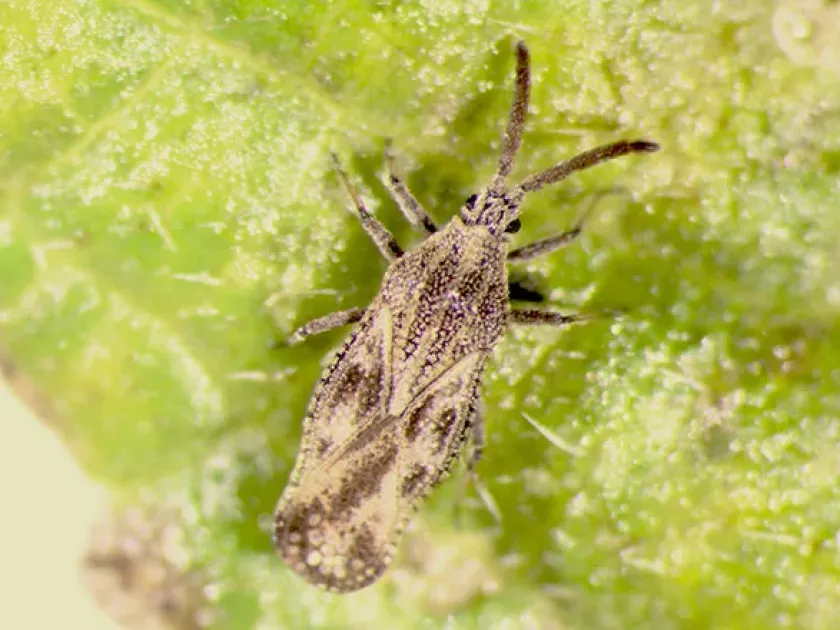
The Lantana lace bug Teleonemia australis is a member of the insect order Hemiptera and the family Tingidae. It is named for the delicate, lace-like appearance of its wings and pronotum.
Adult insects are typically 3 to 4 mm in length. Their bodies are dorso-ventrally flattened, allowing them to remain hidden on the underside of leaves and within leaf crevices.
The coloration of these bugs usually ranges from light brown to dark brown, providing excellent camouflage against plant debris and leaves.
Like all members of this family, the lace bug possesses a piercing-sucking mouthpart designed specifically to extract sap from plant vascular tissues.
Identification often requires careful inspection under magnification to distinguish the specific reticulation patterns on the wings that characterize this particular species.
What it damages
The primary host for this species is Lantana camara, a well-known invasive weed. However, the pest can impact other related plants if the population density becomes high.
Feeding occurs on leaves, tender stems, and flower buds. The bug extracts essential nutrients, which weakens the plant significantly and causes structural distress.
As the bugs feed, they inject saliva into the plant tissues, which can lead to localized necrosis and yellowing, disrupting the normal process of photosynthesis.
Plants heavily infested with Teleonemia australis often show reduced vigor, stunted growth, and a marked decline in the production of flowers or healthy new foliage.
Severe infestations can lead to premature leaf drop, which leaves the plant vulnerable to further environmental stress and secondary pathogen infections.
When it appears
The lifecycle of the Lantana lace bug is highly temperature-dependent, with most activity occurring during the warm months when temperatures exceed +15°C.
Females lay their eggs in clusters, typically inserting them into the underside of the leaves or along the veins to protect them during the developmental phase.
The time from egg to adult takes approximately three to five weeks, which allows for multiple overlapping generations to occur within a single growing season.
Population surges are most frequent in hot, dry conditions, which appear to accelerate the reproductive rate of the lace bug throughout the summer months.
Adults typically survive the winter by seeking shelter in leaf litter, under tree bark, or in other protected spots, emerging when spring temperatures begin to rise.
Signs of infestation
The earliest sign of infestation is the appearance of tiny, yellowish spots on the upper leaf surface, commonly referred to as stippling or chlorotic flecking.
On the underside of the leaves, one can usually observe clusters of nymphs, adults, and small black droplets of excrement, which are clear indicators of their presence.
As the infestation progresses, these chlorotic spots coalesce, turning the entire leaf yellow, causing it to curl and eventually dry out completely.
Adult lace bugs are capable of short, rapid flights and will often scatter when the plant is disturbed, making them quite difficult to capture by hand.
In addition to leaf damage, the overall lack of vigor, stunted stem growth, and a reduction in the number of blooms are significant clues that the plant is under stress.
Control measures
Effective management often requires the use of systemic insecticides, which are absorbed by the plant and target the sap-feeding nymphs and adults.
Applications must be directed to the undersides of the leaves, where the population primarily concentrates, ensuring thorough coverage of the foliage.
Cultural control practices include the removal of dead leaf litter and the management of nearby weed reservoirs that may provide a source for new infestations.
Biological control agents, such as predatory bugs, lacewings, and lady beetles, play an important role in suppressing lace bug numbers naturally in the ecosystem.
Regular monitoring of plant health allows for the early detection of infestation, enabling prompt treatment before the damage to the plant becomes irreversible.
Taxonomy
- Latin name
- Teleonemia australis
- Order
- Hemiptera (bugs, aphids, leafhoppers)
- Family
- Tingidae
- EPPO code
- TELEAU
Discussion
No discussions yet — be the first.