
Lace bug (Teleonemia)
Teleonemia
Description
How to identify
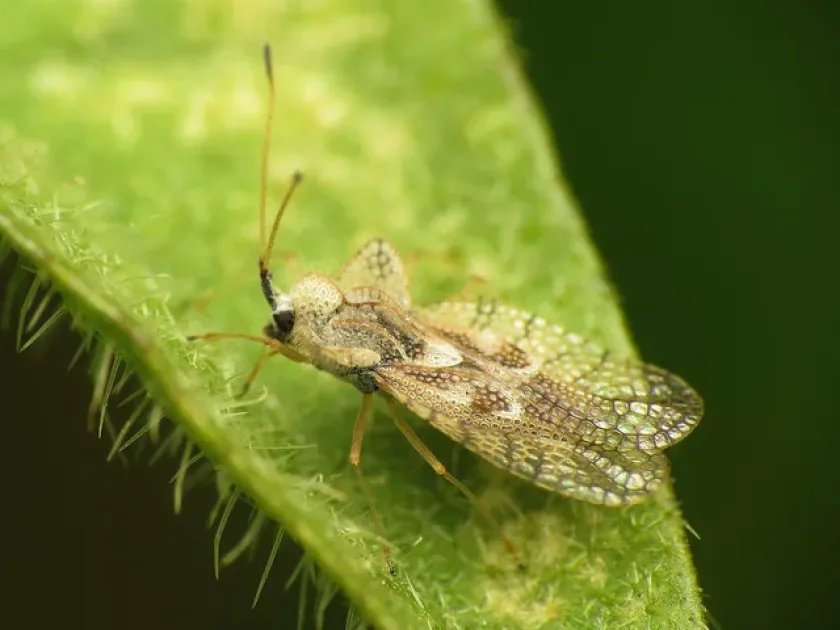
Lace bugs of the genus Teleonemia belong to the family Tingidae within the order Hemiptera. Adult insects are characterized by a distinct reticulated (net-like) structure on the pronotum and wing covers, which resembles fine lace, giving the group its common name.
The insect body is flattened and small, typically ranging from 3 to 5 millimeters in length. The coloration is generally brownish or grayish, providing effective camouflage against the leaf surfaces and bark of host plants.
Nymphs differ significantly from adults: they have more compact bodies, often lack fully developed wings, and are covered with spines or projections. The insects go through several developmental stages, gradually acquiring the appearance of the adult form.
Species of the genus Teleonemia are well-known in entomology for their potential for rapid reproduction on specific host plants. The most prominent example is the Lantana lace bug (Teleonemia scrupulosa), which has been introduced worldwide as a biological control agent for weeds.
The pest can be identified by the clusters of insects on the underside of leaves. With the help of a magnifying glass, one can clearly see the characteristic cellular structures on the wings of adults and the sluggish colonies of nymphs feeding on plant sap.
What it damages
Many Teleonemia species primarily feed on plants in the Verbenaceae family, particularly the popular ornamental plant Lantana camara. The pest selectively targets the most tender parts of the host plant for infestation.
These insects are specialized in sucking cell sap from leaf tissues. This process disrupts photosynthesis, reduces the plant's overall turgor pressure, and leads to premature leaf drop when population densities are high.
Damage caused by nymphs and adults is primarily localized on the lower surface of leaves. Microscopic wounds formed at the points of insertion of the stylet can enlarge over time, potentially becoming entry points for secondary infections or pathogens.
Heavy infestation by Teleonemia can severely stunt plant growth. In agricultural settings or plant nurseries, this results in significant economic losses due to damaged product appearance and reduced vigor of the nursery stock.
While some species are valued as biological control agents against invasive weeds, in home gardens and greenhouses, Teleonemia is considered a serious pest that requires immediate intervention by the agronomist.
When it appears
The activity of lace bugs is directly dependent on temperature and humidity levels. In regions with warm climates, the pest can reproduce year-round, resulting in several overlapping generations per season.
In spring, overwintering adults emerge from their shelters to feed and lay eggs within leaf tissues, initiating a new reproductive cycle on host crops.
The summer period is the peak time for population growth. High temperatures accelerate metabolism, shortening the life cycle from egg to adult to just a few weeks, which often leads to rapid population explosions.
In autumn, as average temperatures drop, the intensity of reproduction decreases. Adults seek shelter in leaf litter, tree bark, or building crevices to enter a state of diapause or simply to survive the winter months.
The overall population dynamics of lace bugs fluctuate throughout the season. Regular monitoring is recommended starting from the first warm days of the year to prevent the establishment of large colonies.
Signs of infestation
The first visual symptom of a lace bug infestation is the appearance of small, chlorotic spots (stippling) on the upper surface of the leaves. These dots are the sites of chlorophyll destruction caused by the insects feeding on the underside.
The underside of the leaf is usually covered with dark, sticky excrement from the pests. The presence of these deposits is a reliable indicator that an active colony of insects is present on that leaf or adjacent plant parts.
During inspection, one might notice shed larval skins (exuviae), which appear as translucent or whitish shells attached to the epidermis. This is a clear sign of active molting and a thriving pest population.
In severe cases, leaves turn yellow, curl, and drop prematurely. The plant takes on a sickly appearance, and apical shoot growth slows significantly due to the massive loss of nutrients and energy required for development.
For accurate diagnosis, use a hand lens to inspect the underside of the leaves. Look for congregations of small, slow-moving nymphs, which often align along the leaf veins where sap concentration is highest.
Control measures
The foundation of lace bug management is regular scouting and the removal of affected plant parts during the early stages of infestation. In home gardens, pruning heavily infested shoots is often sufficient to reduce the pressure on the plant.
Chemical control involves the use of systemic insecticides. Products based on neonicotinoids or pyrethroids are highly effective if applied correctly, ensuring full coverage of the leaf undersides.
Good agricultural practices, such as maintaining optimal watering and fertilization schedules, are essential. A healthy, vigorous plant is much more resilient to pest damage, making proper maintenance a key preventive measure.
Biological control involves attracting or introducing natural enemies such as pirate bugs, lacewings, or lady beetles. In certain scenarios, the application of entomopathogenic fungi can help manage colonies without relying solely on harsh chemical treatments.
- Regular monitoring of the underside of foliage.
- Timely sanitary pruning of damaged shoots.
- Application of insecticidal soap for localized infestations.
- Use of systemic insecticides during heavy outbreaks.
Taxonomy
- Latin name
- Teleonemia
- Order
- Hemiptera (bugs, aphids, leafhoppers)
- Family
- Tingidae
- EPPO code
- TELESP
Discussion
No discussions yet — be the first.