
Ocean field cricket
Teleogryllus oceanicus
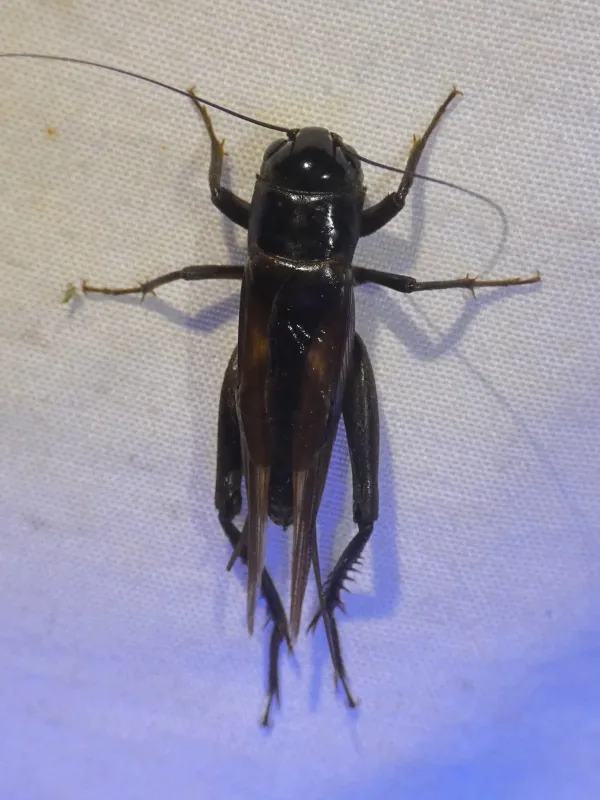
Description
How to identify
The Ocean field cricket (Teleogryllus oceanicus) belongs to the order Orthoptera and the family Gryllidae. These insects typically measure 25–30 mm in length and possess a robust, dark brown body structure.
Adults are equipped with well-developed wings, enabling them to disperse effectively across agricultural landscapes in search of food and suitable oviposition sites.
The head features powerful mandibles designed for chewing through tough plant tissues, making them highly efficient at damaging various vegetation types during their feeding cycle.
Females utilize a prominent ovipositor to deposit eggs deep within the soil or plant stems. Their life cycle consists of the egg, nymph, and adult stages, with nymphs undergoing several molts.
Identification is often assisted by listening to the rhythmic chirping calls produced by males, which serve to attract females and are distinct for this specific species.
What it damages
This cricket is a known polyphagous pest capable of inflicting significant damage on a wide array of agricultural crops. Seedlings of cereals, vegetables, and ornamental plants are particularly susceptible.
In various regions, they are known to attack sugarcane, rice, maize, and pasture grasses, often targeting the collar zone of the plants, which leads to sudden wilting and death.
Plant nurseries face substantial risks, as crickets can rapidly chew through the stems of young plants, resulting in high mortality rates and uneven crop establishment in the field.
Beyond the field, these insects can invade storage facilities, causing harm to stored grains and seeds, as well as damaging packaging materials like sacks and bags.
The severity of the damage is proportional to the local population density. Outbreaks can result in total crop failure at the early development stages, necessitating urgent intervention.
When it appears
Activity typically begins during the warmer months when soil temperatures rise enough to facilitate the emergence of nymphs and adults from their overwintering or daytime hiding spots.
The peak period of feeding and damage usually occurs during the latter part of the growing season, coinciding with optimal environmental conditions for development and reproduction.
In tropical and subtropical climates, activity can be observed year-round, whereas in cooler regions, the insect's activity is restricted to the warm season, decreasing significantly as temperatures drop.
Crickets are primarily nocturnal, remaining hidden during the day in soil crevices, underneath plant debris, or within dense weed patches to avoid predators and desiccation.
Effective monitoring should commence shortly after planting, with particular attention paid to the field at night or early morning when the signs of their feeding activity become visible.
Signs of infestation
The most reliable indicator of cricket activity is the presence of jagged, chewed leaf margins or severed plant stems near the soil level, often appearing as if cut by a small blade.
Small holes in the ground signify the presence of subterranean burrows. These entry points are frequently surrounded by insect frass and scraps of organic plant material.
The distinct, loud chirping heard at dusk and throughout the night serves as a clear acoustic warning of a high population density currently inhabiting the area.
Patches of wilting or dying seedlings in the field often reveal the localized impact of cricket feeding, which prevents the plants from absorbing water and nutrients.
Direct inspection of the field at night, using artificial light, allows agronomists to observe the insects in action and confirm the species identity of the pest.
Control measures
Deep cultivation of the soil is a primary cultural control method, as it disrupts nesting sites and destroys eggs, thereby significantly suppressing future population growth.
The application of poisoned baits containing stomach-action insecticides has proven highly effective for cricket control, especially in sensitive areas or within greenhouses.
Managing weed populations in and around the field is essential to remove alternative food sources and shelters, making the environment less hospitable for the crickets.
Integrated Pest Management (IPM) strategies increasingly incorporate biological control agents, such as entomopathogenic fungi or nematodes, to reduce reliance on chemical inputs.
If economic injury levels are surpassed, targeted application of contact-stomach insecticides to the base of the crop, applied in the evening hours, is recommended for maximum efficacy.
Taxonomy
- Latin name
- Teleogryllus oceanicus
- Order
- Orthoptera (locusts)
- Family
- Gryllidae
- EPPO code
- GRYLOC
Discussion
No discussions yet — be the first.