
House cricket
Acheta domesticus
Description
How to identify
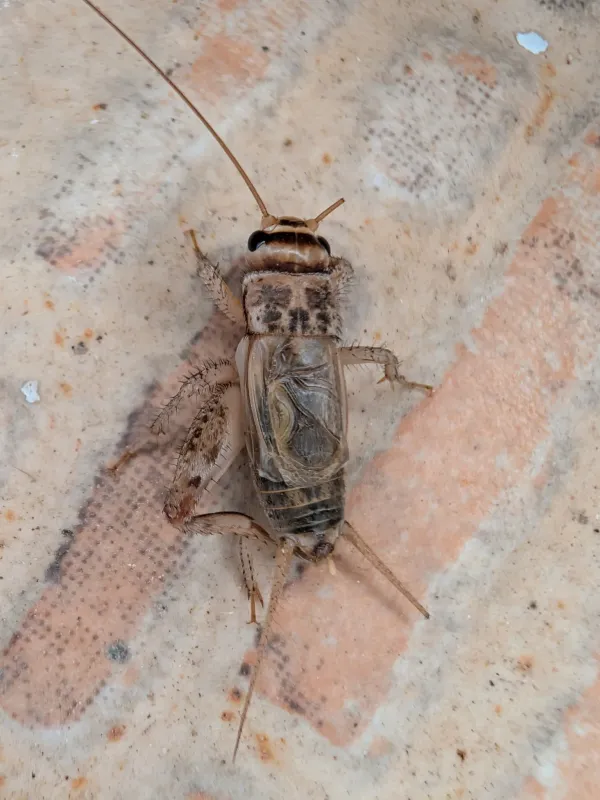
The house cricket (Acheta domesticus) is an insect belonging to the order Orthoptera, family Gryllidae. Adults reach 16–25 mm in length and exhibit a straw-yellow or brownish color.
The species is characterized by very long, thread-like antennae and well-developed hind legs adapted for jumping, which are typical for all crickets.
They possess functional wings and are capable of flight, allowing them to migrate into greenhouses or gardens from nearby buildings or waste areas.
Females are identified by a long, needle-like ovipositor (10–15 mm), which is used to deposit eggs into loose soil, organic debris, or cracks in the ground.
The life cycle consists of the egg stage, 10–12 nymphal instars, and the adult stage. In warm environments, the development is rapid and continuous.
What it damages
The house cricket is a generalist feeder that causes significant damage in greenhouses, nurseries, and indoor gardens, often acting as a serious pest for seedlings.
They feed on young plant shoots and tender seedlings of vegetables such as tomatoes, cucumbers, and peppers, often severing stems at the ground level.
Both nymphs and adults contribute to crop loss, as they can quickly decimate young plant populations in seedbeds, leading to total failure of young crops.
In addition to live plant tissue, they consume decaying organic matter, seeds, and even ripe fruit, leaving small pits that provide entry points for secondary infections.
High population densities in protected environments can lead to complete destruction of sensitive vegetable cultivars, impacting economic yields significantly.
When it appears
In climate-controlled greenhouses, the house cricket can be active year-round, as they do not require a dormant period if environmental conditions are favorable.
In the field, their activity is seasonal, typically occurring from late spring through late autumn when temperatures remain consistently warm.
These insects are strictly nocturnal or crepuscular, meaning their primary feeding and movement activities occur during the night and early morning hours.
Mass migration often occurs during the summer months as adult crickets move from urban structures or compost heaps into adjacent agricultural landscapes.
Soil moisture levels greatly influence their distribution, as they gravitate toward irrigated areas and damp soil during dry spells to sustain their population.
Signs of infestation
The most recognizable sign of an infestation is the persistent chirping sound made by males, which is clearly audible during the night in infested areas.
Damage symptoms include seedlings that have been completely cut off or leaves that appear ragged and chewed, particularly at the lower parts of the plant.
Small entry holes or burrows in the soil near the base of plants are indicators of cricket activity, as these serve as shelters for the insects during the day.
The presence of small, dark, granular frass (excrement) on the soil surface near plants provides evidence of a concentrated population of crickets.
Ripe fruits showing irregular, concave bite marks that often develop into mold or rot are common signs when crickets are present in vegetable crops.
Control measures
Effective management begins with sanitation: clearing out piles of debris, tall weeds, and organic mulch that provide excellent nesting sites for crickets.
Regular soil cultivation or tilling helps disrupt their breeding cycles, destroy egg-laying sites, and kill nymphs present in the top layers of the soil.
Trapping techniques, such as sinking containers filled with bait like beer or sugar-water flush with the ground, can significantly reduce adult populations.
In cases of severe infestation, the application of registered insecticides as a bait or spray may be necessary to suppress the cricket population in greenhouses.
Exclusion methods, including sealing gaps in greenhouse foundations and installing mesh screens over vents, are critical to prevent migration into protected zones.
Taxonomy
- Latin name
- Acheta domesticus
- Order
- Orthoptera (locusts)
- Family
- Gryllidae
- EPPO code
- ACHTDO
Discussion
No discussions yet — be the first.