
Asian house cricket
Teleogryllus mitratus
Description
How to identify
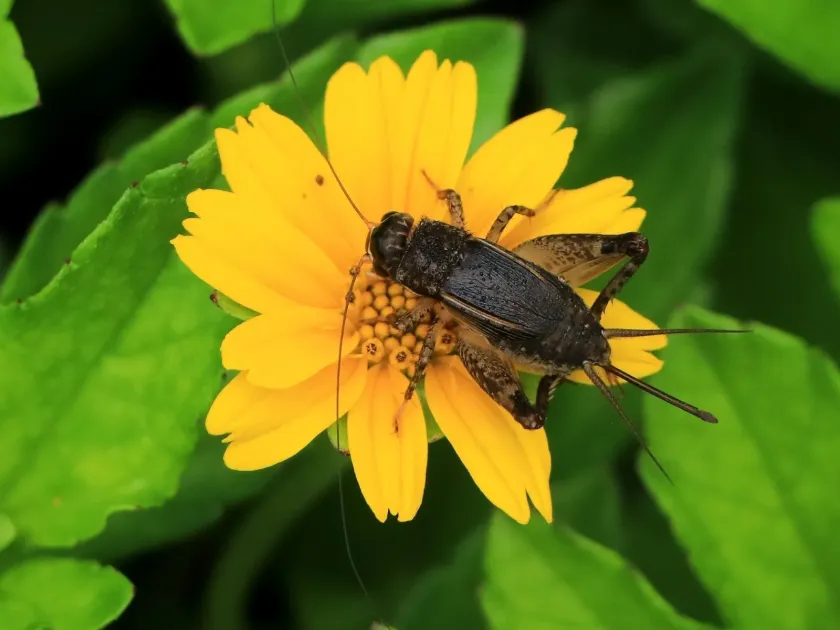
The Asian house cricket (Teleogryllus mitratus) belongs to the order Orthoptera and the family Gryllidae. It is a medium-sized insect, typically brownish in color, with a robust body structure.
Adults possess strong mandibles designed for chewing, allowing them to cause significant damage to various plant parts. Their morphology includes long, thread-like antennae and powerful hind legs adapted for jumping.
This species is highly adaptable, inhabiting both natural environments and agricultural lands. Females have a prominent ovipositor, which they use to insert eggs into moist soil.
Nymphs appear similar to adults but are smaller and wingless. The life cycle comprises egg, nymph, and adult stages, with most development occurring within or near the soil surface.
These insects are primarily nocturnal, making them elusive during the day. Their cryptic behavior often leads to them being overlooked until significant crop damage has already occurred.
What it damages
As a polyphagous pest, the Asian house cricket feeds on a wide array of cultivated plants. It poses a particular threat to nurseries, greenhouses, and vegetable gardens.
The most severe damage occurs at the seedling stage. Crickets frequently chew through young stems, causing plants to collapse and die shortly after emergence.
Mature plants may suffer from irregular holes in the foliage. Such defoliation reduces the plant's photosynthetic capacity, ultimately hindering its growth and yield.
The pest often focuses on the root collar, causing stem girdling. In dense populations, the destruction of seedlings can lead to total crop loss in localized areas.
Furthermore, the physical damage caused by feeding facilitates the entry of secondary pathogens, which can trigger fungal or bacterial infections in the weakened tissues.
When it appears
Cricket activity is highly temperature-dependent, with optimal reproduction occurring in warm conditions (25–30 degrees Celsius). High humidity also favors their development.
In temperate zones, peak infestation usually occurs from late spring through the summer months. Their population size is closely linked to soil moisture availability.
Within greenhouses and indoor facilities, the Asian house cricket can reproduce throughout the year, provided there is adequate heat and a steady food supply.
They are most active during the night. Daylight hours are typically spent in burrows, under organic mulch, or within soil crevices to avoid predators and extreme heat.
Overwintering occurs primarily in the nymphal or adult stages, usually deep in the soil or protected structures, allowing for quick population recovery in early spring.
Signs of infestation
Early signs of infestation include ragged, notched leaf margins. Seedlings that appear "felled" or cut at the base are a definitive indicator of cricket feeding.
The persistent chirping of male crickets during the evening and night is a strong indicator of their presence and indicates a breeding population in the vicinity.
Soil inspections may reveal burrow entrances or small tunnels. These are often accompanied by the presence of frass (excrement) around the base of damaged plants.
Plants on affected plots may appear stunted or wilted due to root or stem damage. In greenhouses, localized spots of dead seedlings are common signs.
A nighttime survey with a flashlight is the most effective way to confirm an infestation, as crickets are easily spotted while foraging on the soil or lower foliage.
Control measures
Integrated management is essential. Cultivation practices, such as deep soil tilling, can destroy burrow systems and expose eggs to desiccation or predation.
Sanitation is critical; removing weeds and piles of debris eliminates the daytime hiding spots that crickets require for shelter and moisture retention.
Light traps can be utilized during the night to significantly reduce the adult population, especially during the early stages of a planting season.
In cases of heavy infestation, insecticidal baits formulated with bran or other attractants can be placed near suspected harboring areas, strictly following safety protocols.
Modifying moisture levels is a key preventative measure. Keeping soil surfaces slightly drier or improving drainage can make the habitat less attractive to crickets.
Taxonomy
- Latin name
- Teleogryllus mitratus
- Order
- Orthoptera (locusts)
- Family
- Gryllidae
- EPPO code
- GRYLMI
Discussion
No discussions yet — be the first.